
Caregivers who qualify for both a state paid leave program and a Medicaid waiver do not have to choose between them. The two benefits compensate different things, paid leave replaces wages lost from a job, while waiver pay covers the hands-on care itself, so collecting both at once is legitimate as long as no single hour gets claimed twice from two government sources. Indiana, Michigan, and Illinois each have active Medicaid waiver programs through Structured Family Caregiving , Home Help, and the Community Care Program respectively, and caregivers in those states pair them with employer PTO, short-term disability, or Illinois's Paid Leave for All Workers Act. Sequencing matters: waiver enrollment takes weeks or months, so starting it early lets the time-limited leave carry the transition while the waiver becomes steady ongoing income once leave runs out. Paid leave income is generally taxable, but certain Medicaid waiver payments made for in-home care qualify for exclusion from federal gross income under IRS Notice 2014-7, and reporting the two as separate income streams to the right agencies keeps eligibility reviews and delayed payments from disrupting either benefit.
When you qualify for both a state paid leave program and a Medicaid waiver that pays you to care for a loved one, you don't have to pick one. You can stack them, and most caregivers who run the numbers find that the combination protects their income far better than either source alone. The catch is timing and reporting. Paid leave for family caregivers and Medicaid waiver pay are funded by completely separate systems, and if you treat them like the same thing, you'll either leave money on the table or trip a reporting rule that delays a check.
This guide walks through the exact order of operations: how to confirm both apply, how to layer the benefits without double-dipping on the same hours, and how to report each one correctly. It's written for caregivers in Indiana, Michigan, and Illinois, but the logic holds in any state with a paid family leave law and an HCBS waiver.
A quick framing before the steps. Paid family leave replaces a portion of your wages for a limited window, usually because you stepped away from a job. A Medicaid waiver pays you an ongoing wage or stipend to provide hands-on care. They answer different questions, which is exactly why they can coexist. If you want the full breakdown of how these two systems differ, the comparison in paid family leave versus paid caregiver programs is worth reading first.
Step 1: Confirm both programs actually apply to your situation
Start by separating the two questions, because they have different gatekeepers.
Paid family leave eligibility usually hinges on your employment history and your state's specific law. Illinois doesn't have a standalone paid family leave insurance program the way some coastal states do, but it does have the Paid Leave for All Workers Act, which gives most workers earned paid time off they can use for caregiving. Michigan and Indiana don't have statewide paid family leave insurance either, so for many caregivers in these three states, "paid leave" means employer-provided benefits, accrued PTO, short-term disability, or the unpaid job protection under FMLA rather than a state insurance payout.
That distinction matters. If your "paid leave" is really employer PTO or a private short-term disability policy, the stacking rules below still apply, but the funding source is your employer or insurer, not the state. Check your employee handbook and call HR to confirm what you actually have. If you're relying on federal job protection, the mechanics of FMLA for caregivers are unpaid leave with a guaranteed job to return to, which pairs cleanly with waiver pay.
Medicaid waiver eligibility runs on a separate track entirely. It depends on your loved one's care needs and Medicaid status, not your job. In Indiana that means programs like Structured Family Caregiving and the Attendant Care benefit. In Michigan it's the Home Help program and CHAMPS. In Illinois it's the Community Care Program and the IDHS Home Services Program. To confirm the waiver side, you're verifying that your loved one qualifies for Medicaid long-term care and that the waiver allows a family member to be the paid caregiver. The overview at how the qualification process works lays out what that screening looks like.
- Paid leave question: Does my employment or my state law give me a wage replacement or protected time off while I care?
- Medicaid waiver question: Does my loved one qualify for a waiver that pays me an ongoing wage or stipend for the care I provide?
If the answer to both is yes, you have a stacking opportunity. Move to Step 2.
Step 2: Map which hours each benefit covers
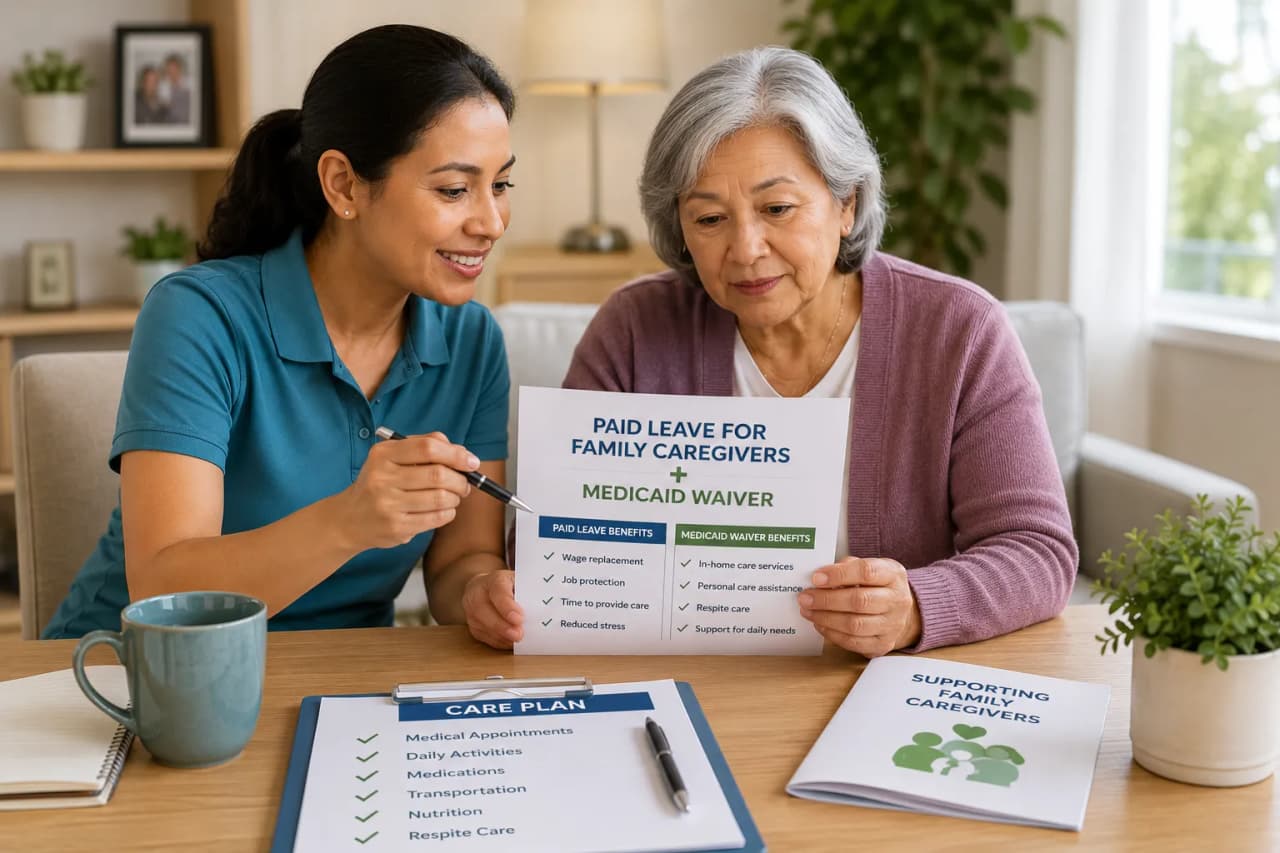
The single rule that keeps you out of trouble: you cannot be paid twice for the same hour of care from two government sources that both expect that hour to be "work."
Paid family leave and a Medicaid waiver wage occupy different time. Think of it this way. Paid leave typically replaces income from a job you stepped away from. Waiver pay compensates the actual caregiving you perform. The leave covers the gap your absence from work created. The waiver covers the care itself. As long as you're not claiming a waiver caregiving hour and a paid-leave "working" hour for the exact same clock time at the same employer, you're layering, not double-dipping.
Here's a concrete picture. Say you take eight weeks of paid leave from your office job to manage a parent's recovery after a hospital stay. During those eight weeks you also enroll as the paid caregiver under your state's waiver, logging the bathing, medication reminders, meal prep, and mobility help you provide. The paid leave replaces a slice of your office wages. The waiver pays you for the hands-on care. Two checks, two purposes, zero overlap.
Where caregivers get tangled is in self-directed programs that let multiple family members split caregiving duties. If that's your setup, the breakdown in using a Medicaid waiver to pay multiple family caregivers shows how to divide hours so no single block gets claimed twice.
Step 3: Sequence the benefits in the right order
Order matters because paid leave is almost always time-limited, while waiver pay is ongoing. You want to use the expiring benefit first and let the durable one carry you afterward.
The pattern that works for most caregivers:
- Apply for and enroll in the Medicaid waiver early. Waiver enrollment takes weeks or sometimes months because it involves a Medicaid eligibility determination and a care assessment for your loved one. Start this the moment you know caregiving is your road ahead, even if you're still working.
- Use paid leave for the intensive transition window. When care needs spike, after a fall, a diagnosis, a discharge, that's when paid leave or PTO earns its keep. It buys you weeks of replaced income during the period when you can't hold your job and provide intensive care at once.
- Let waiver pay become your steady income as leave runs out. By the time your leave expires, your waiver enrollment should be active and paying. The waiver wage then becomes your ongoing compensation for the care you continue providing.
This sequence avoids the most common mistake: waiting until paid leave is exhausted to even apply for the waiver, then facing a gap with no income. If you're already in that gap, the strategies in closing pay gaps during program transitions can help bridge it. For caregivers in our core states, the fastest enrollment routes run through Structured Family Caregiving in Indiana , the Michigan Home Help program , or the Illinois Community Care Program .
Step 4: Report each payment to the right agency the right way
This is where the two systems stop being parallel and start interacting, because both can affect taxes, and waiver income can affect your loved one's Medicaid status and sometimes your own benefits.
Paid family leave or short-term disability income is generally taxable wage replacement. You'll get a tax form for it and report it as income. Medicaid waiver pay is more nuanced. Under IRS Notice 2014-7, certain Medicaid waiver payments you receive for caring for someone living in your home can be excluded from your federal gross income. Whether your specific stipend qualifies depends on how your state structures the payment, so this is one to confirm rather than assume. The difference between an excludable stipend and a taxable wage is laid out in caregiver stipend versus caregiver wage taxes .
Three reporting checkpoints to keep straight:
- To the IRS: Report paid leave income normally. Apply the Notice 2014-7 exclusion to qualifying waiver payments only if your situation meets the requirements. The full picture is in the guide on when Medicaid waiver payments are taxable .
- To your state Medicaid agency: If you receive your own Medicaid health coverage, new income can affect your eligibility. Walk through how caregiver income affects your Medicaid eligibility before you file anything.
- To Social Security, if applicable: If you or your loved one receive SSI or SSDI, report income changes promptly. The interaction is explained in how caregiver pay affects disability benefits and SSI .
Report the paid leave and the waiver pay as two distinct income streams. Lumping them together is what triggers eligibility reviews and delayed checks.
Step 5: Protect your job and your long-term finances
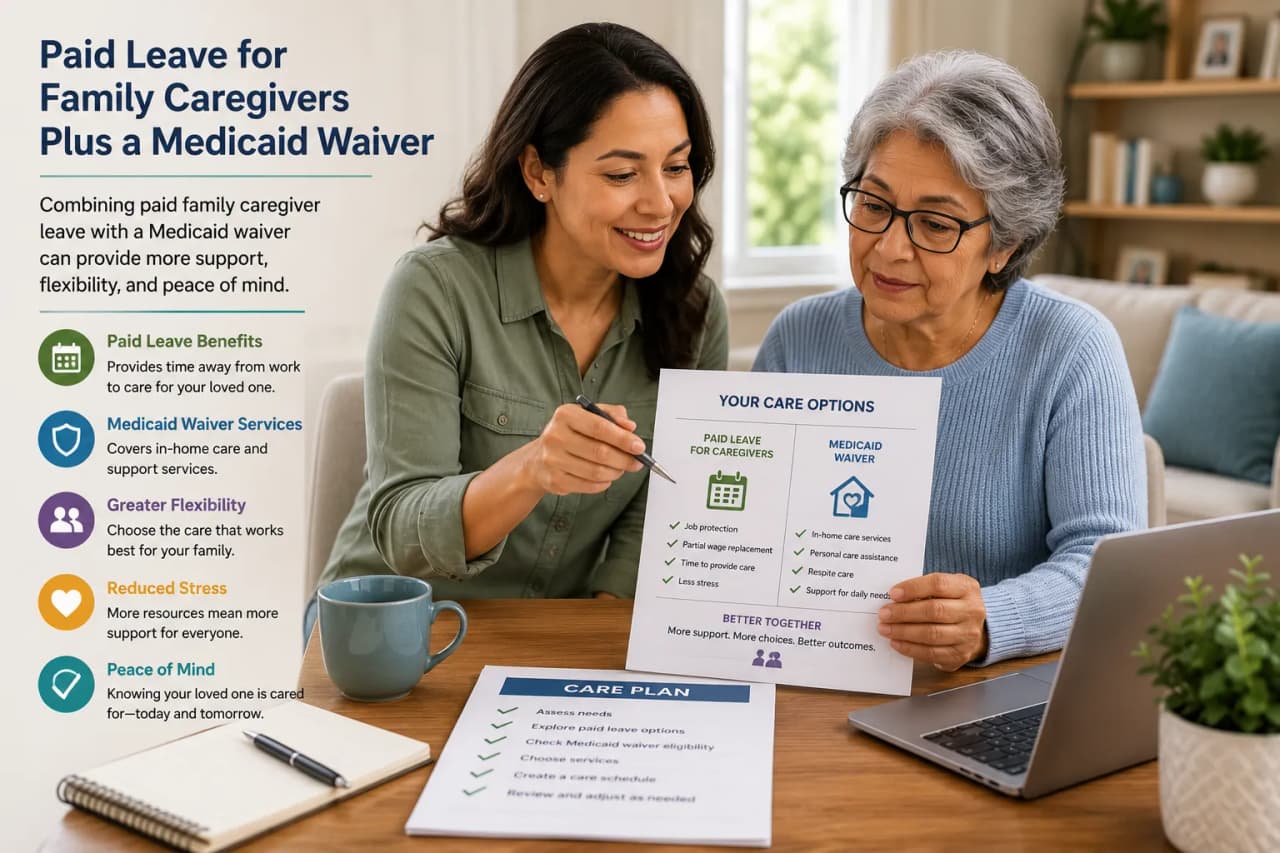
Once both benefits are flowing, two things deserve attention: keeping your employment options open and turning this income into stability rather than a temporary patch.
On the job side, FMLA gives eligible workers up to 12 weeks of unpaid, job-protected leave per year to care for a family member with a serious health condition. Paid leave or PTO can run concurrently with FMLA, so you collect income while your job stays protected. If your caregiving will outlast your protected leave, decide early whether you're returning to that job or transitioning to caregiving as your primary income. Many caregivers in this situation make the move full-time, and the path is covered in transitioning from an unpaid to a paid caregiver .
On the financial side, treat the waiver wage as real income that deserves a plan. Set aside taxes if your payments aren't excluded, track your caregiving hours carefully, and think about Social Security credits and retirement. Caregivers who build a budget around their pay from the start avoid the cash crunch that hits when paid leave ends. The step-by-step approach in building financial stability as a paid caregiver is the natural next move once your income is established. And if you're juggling caregiving with a part-time or full-time job, getting paid as a caregiver while working covers the hour limits and scheduling rules.
A simple side-by-side to keep the two straight
| Feature | Paid family leave / PTO | Medicaid waiver pay |
|---|---|---|
| What it pays for | Wages lost while away from a job | The hands-on care you provide |
| Eligibility based on | Your employment and state law | Your loved one's Medicaid and care needs |
| Duration | Limited window (weeks) | Ongoing while care continues |
| Taxable | Generally yes | Sometimes excluded under Notice 2014-7 |
| Affects loved one's Medicaid | No | Possibly, report it |
Used together, these two cover different needs at different stages. Paid leave carries the sharp early weeks. The waiver carries the long road.
Frequently asked questions
Can I collect paid leave and Medicaid waiver pay at the same time?
Yes, in most cases you can collect paid leave for family caregivers and Medicaid waiver pay simultaneously, because they compensate different things. Paid leave replaces wages from a job you stepped away from, while the waiver pays you for the care you provide. The rule to respect is that you can't claim the same clock hour as both paid work for an employer and paid caregiving under the waiver. Keep them as separate income streams and you're stacking benefits legitimately.
Does my state offer paid family leave if I live in Indiana, Michigan, or Illinois?
None of the three has a statewide paid family leave insurance payout the way some states do, so your "paid leave" usually comes from your employer's PTO, a short-term disability policy, or Illinois's Paid Leave for All Workers Act, which grants earned paid time off. FMLA still provides unpaid, job-protected leave for eligible workers in all three states. The Medicaid waiver side, however, is fully active in each, through Indiana's Structured Family Caregiving, Michigan's Home Help, and Illinois's Community Care Program.
Will the waiver income make my paid leave benefits get reduced?
Generally no, because employer PTO and short-term disability aren't reduced by income from a separate caregiving program. Where reductions can happen is with means-tested benefits like SSI or your own Medicaid health coverage, which count income to determine eligibility. Report any new income to the right agency and confirm how it's counted before assuming it's safe.
How do I report Medicaid waiver pay on my taxes if I'm also reporting paid leave?
Report paid leave as taxable wage replacement using whatever tax form your employer or insurer issues. For waiver pay, check whether your payments qualify for the IRS Notice 2014-7 exclusion, which lets you leave certain in-home caregiving payments out of federal gross income. The two get reported differently, so don't combine them on the same line.
Getting both benefits to work together comes down to confirming eligibility on each track, sequencing them so the time-limited one goes first, and reporting each payment to the right agency. If you're ready to add the durable income stream, the team at Paid.care can walk you through qualifying for the Medicaid waiver in your state so your paid leave and your caregiver pay reinforce each other instead of working against you.