
Will Getting Paid as a Caregiver Affect Your Disability Benefits or SSI?

Caregiver pay from a Medicaid waiver program is earned income in the eyes of the Social Security Administration. That single fact shapes everything about whether getting paid as a caregiver will affect your disability benefits or SSI. But the answer depends entirely on which benefit you receive, how much you earn, and whether your state's program pays you through a W-2 or a stipend. The good news: most family caregivers can get paid without losing their benefits, as long as they understand the rules.
Below you'll find answers to the specific questions caregivers ask most about disability benefits and caregiver income. Each one is a real concern, and each one has a real answer.
Does Caregiver Pay Count as Earned Income for SSI?
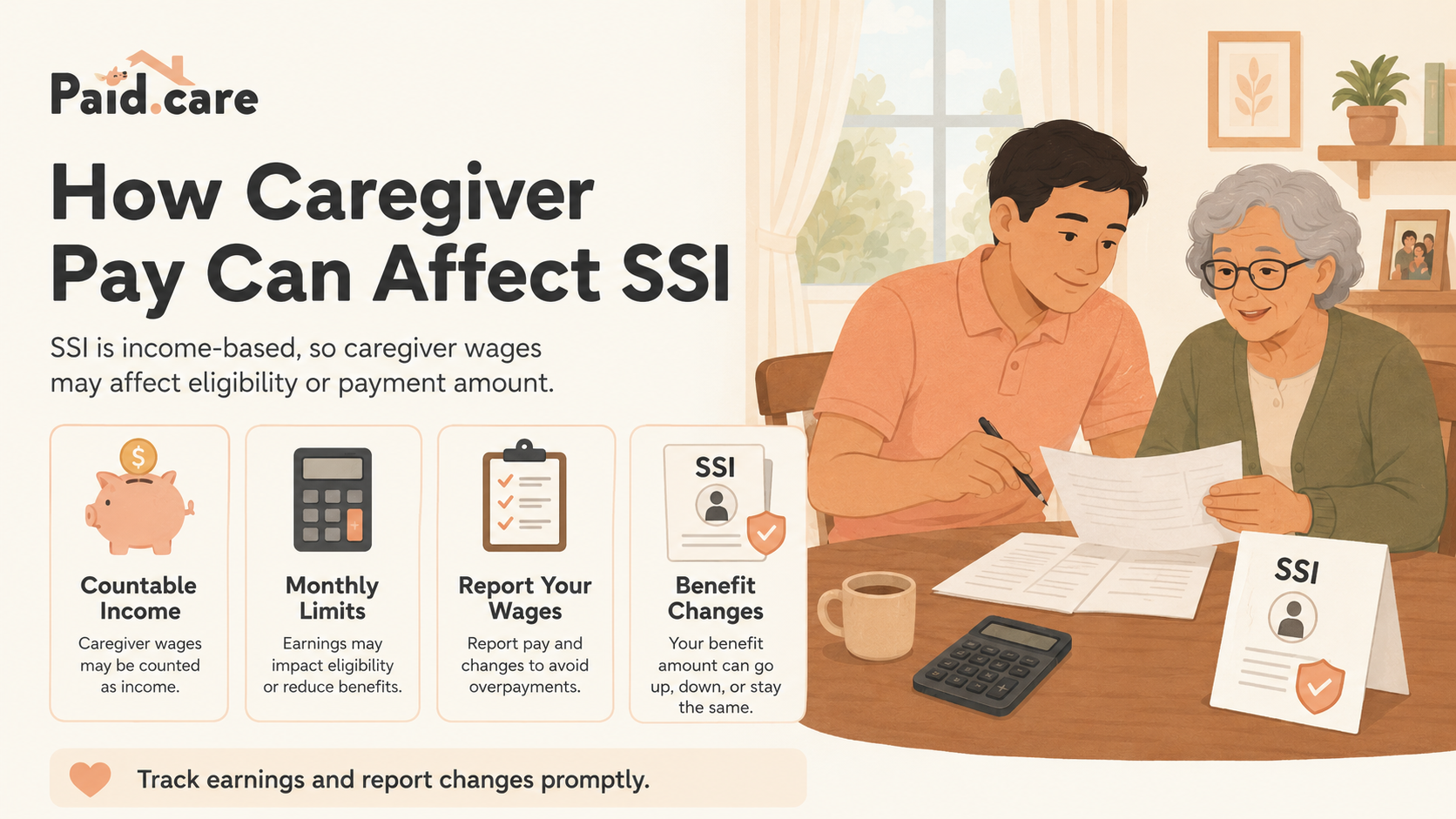
Yes. If you receive Supplemental Security Income (SSI) and you start earning caregiver wages through a Medicaid waiver or similar program, the Social Security Administration (SSA) treats those wages as earned income. SSI is a means-tested benefit, which means the amount you receive each month adjusts based on what you earn.
Here's how the math works in practice. SSA ignores the first $65 of earned income per month, plus the general $20 income exclusion (if you haven't already used it against unearned income). After those exclusions, SSA reduces your SSI payment by $1 for every $2 you earn. So if you bring home $500 per month from caregiver work, your SSI payment drops by roughly $207 — not dollar for dollar.
That's a meaningful reduction, but it also means your total household income (SSI plus caregiver wages) goes up. You come out ahead financially in most scenarios. The fear that you'll "lose everything" usually doesn't match the actual arithmetic. Still, you need to report your caregiver income to SSA promptly. Failing to report creates overpayments that SSA will eventually claw back, sometimes years later.
Will Caregiver Pay Affect SSDI Benefits?
Social Security Disability Insurance (SSDI) works differently from SSI because it isn't means-tested. Your SSDI payment amount doesn't change based on how much money you have in the bank or how much unearned income comes in. What SSDI cares about is whether you're performing "substantial gainful activity" (SGA).
For 2026, the SGA threshold is expected to remain near $1,550 per month for non-blind individuals (SSA adjusts this annually). If your caregiver wages stay below that line, your SSDI benefits continue uninterrupted. Many family caregivers working part-time through Medicaid waiver programs earn below SGA, especially when their hours are set by the care recipient's approved service plan rather than by how much the caregiver wants to work.
Even if your earnings occasionally bump above SGA, SSDI has a nine-month Trial Work Period. During those months (which don't have to be consecutive), you can earn any amount without losing benefits. After the trial period, a 36-month Extended Period of Eligibility lets you receive SSDI for any month your earnings dip below SGA again. The system has built-in cushions. Use them.
Can You Get Paid as a Caregiver and Keep Medicaid Coverage?
This is often the bigger worry. Losing Medicaid coverage can be more financially devastating than a reduced SSI check, especially if you or the person you care for depends on Medicaid for prescriptions, home health services, or waiver program enrollment.
If you receive SSI, you automatically qualify for Medicaid in most states. When caregiver income reduces your SSI payment, your Medicaid eligibility usually survives thanks to a provision called 1619(b). Under this rule, you can earn above the SSI payment threshold and still keep Medicaid as long as you meet certain conditions, primarily that you still have the disabling condition and that your income doesn't exceed your state's 1619(b) threshold. These thresholds vary by state but are often surprisingly high (many states set them above $30,000 per year).
For caregivers on SSDI who also have Medicare, the calculus is different. Medicare eligibility tied to SSDI doesn't end immediately if you return to work. An Extended Period of Medicare Coverage gives you at least 93 months of continued Medicare after your Trial Work Period ends.
If the person you're caring for is the one on Medicaid, your income as their caregiver generally doesn't count against their eligibility. Medicaid looks at the recipient's income and assets. That said, if you and the care recipient share a household and file taxes together (such as a spouse), the picture gets more complicated. A financial coach who understands caregiver programs can help you map this out for your specific situation.

Are Medicaid Waiver Caregiver Payments Taxable?
Generally, yes — but there's an important exception. Under IRS Notice 2014-7, Medicaid waiver payments for care provided to someone who lives in the same home as the caregiver are excludable from gross income for federal tax purposes. This applies to many family caregivers, since the whole point of these programs is that you're caring for a loved one in a shared home.
If Notice 2014-7 applies to your situation, your caregiver payments won't show up as taxable income on your federal return. And here's where it gets interesting for SSI recipients: even though SSA counts Medicaid waiver wages as earned income for benefit-calculation purposes, the IRS exclusion can reduce your adjusted gross income on paper. That disconnect trips people up, so it's worth understanding that SSA and the IRS don't always treat the same dollar the same way.
You can read more about how this works in our guide to Medicaid waiver payment tax rules. For state taxes, the rules vary. Indiana, Michigan, and Illinois each handle it differently, so check with a tax professional or your program coordinator before filing.
What Happens If You Don't Report Caregiver Income to SSA?
Nothing good. SSA will eventually find out — wage data from employers flows to SSA through quarterly tax filings, and Medicaid agencies report payments as well. The timeline might be months or even a couple of years, but the match will happen.
When it does, SSA calculates an overpayment for every month your benefits should have been lower. They send you a notice demanding repayment, sometimes for thousands of dollars. You can request a waiver if the overpayment wasn't your fault and repaying it would cause financial hardship, but that's a stressful process with no guaranteed outcome.
Report your earnings when they start, even if the amount seems small. Call SSA at 1-800-772-1213 or visit your local office. If you're earning through a Medicaid-funded caregiver program, your program coordinator should be able to help you understand exactly what to report and when. Proactive reporting is always less painful than retroactive corrections.
Do ABLE Accounts Help Protect Benefits While Earning Caregiver Pay?
ABLE (Achieving a Better Life Experience) accounts are one of the most underused tools for people on SSI who earn caregiver income. An ABLE account lets you save up to $18,000 per year (2026 limit, adjusted periodically) without that money counting toward SSI's $2,000 asset limit. Balances up to $100,000 are excluded from SSI's resource test entirely.
If you're earning caregiver wages and worried about accumulating too much in your bank account — which could push you over SSI's asset ceiling — an ABLE account gives you a place to park that money safely. You can use the funds for disability-related expenses: housing, transportation, assistive technology, health care, education, and more.
Not everyone qualifies to open an ABLE account. You must have a qualifying disability with an onset before age 26 (this threshold was raised from the original age-26 rule; check current eligibility criteria at ablenrc.org for the latest). But if you do qualify, it's one of the strongest protections available. Our guide to ABLE accounts for family caregivers covers the setup process in detail.
How to Plan So Caregiver Pay Doesn't Disrupt Your Benefits
The biggest mistakes happen before the first paycheck arrives. A little advance planning goes a long way.
Know Your Benefit Type
SSI and SSDI have completely different rules. If you receive both (which is possible), each program evaluates your caregiver income separately. Pull your most recent SSA benefit letter or log into my.ssa.gov to confirm exactly which programs you're enrolled in.
Run the Numbers Before You Start
Estimate your expected monthly caregiver earnings. For SSI, apply the earned-income exclusions ($20 general + $65 earned, then the 50% reduction) to see how your check will change. For SSDI, compare your expected earnings to the current SGA threshold. If you're close to the line, ask whether your program allows flexible scheduling so you can manage your hours month by month.
Set Up Reporting Systems Early
Don't wait until tax season. Report earnings to SSA within the month you receive them. If your state's program issues pay stubs or earnings statements, keep every one. Create a simple folder, digital or paper, where you store pay records, SSA correspondence, and any communication with your Medicaid agency. When questions come up later (and they will), you'll have everything in one place.
If you're in Indiana, Michigan, or Illinois, Paid.care's caregiver onboarding process includes guidance on benefit reporting. The team has seen these situations repeatedly and can walk you through what to expect before your first check arrives.
Frequently Asked Questions
Can a disabled person be a paid caregiver for someone else?
Yes. Having a disability doesn't disqualify you from being a paid caregiver. What matters is whether you can perform the care tasks outlined in the recipient's service plan. Many people on SSDI or SSI provide care for a spouse, parent, or other family member through Medicaid waiver programs while continuing to receive their own benefits. The key is keeping your earnings within the limits discussed above.
Will caregiver pay affect my food stamps (SNAP)?
It can. SNAP benefits are based on household income, and caregiver wages count. However, SNAP has its own deductions for earned income (a 20% earned-income deduction, plus deductions for dependent care and excess shelter costs). Your SNAP benefit might decrease, but increased earnings usually more than offset the reduction. Report income changes to your SNAP caseworker within 10 days to avoid overpayment issues.
Does the caregiver pay affect disability benefits for the person receiving care?
No. The wages you earn as a caregiver are your income. They don't count against the care recipient's SSI, SSDI, or Medicaid eligibility — unless you and the recipient are legally married, in which case SSI may "deem" a portion of your income to the recipient. For parent-child or sibling caregiving arrangements, the care recipient's benefits remain unaffected by your earnings.
What if I only earn a small amount as a caregiver — do I still need to report it?
Yes. SSA requires you to report all earned income regardless of the amount. Even $50 per month matters for SSI calculations. For SSDI, any month you earn above the Trial Work Period threshold (around $1,110 in 2026) counts as a trial work month. Under-reporting is the single most common way caregivers end up with surprise overpayment notices. The reporting itself is quick. A phone call or an online update through my.ssa.gov protects you down the road.
Where can I get help figuring out how caregiver pay will affect my specific benefits?
Your best free resource is a Benefits Planning Query (BPQI) report from SSA, or a session with a Community Work Incentives Coordinator (CWIC) through the Ticket to Work program. These specialists analyze your exact benefit situation and model what will happen when you start earning caregiver income. You can find a CWIC by calling the Ticket to Work helpline at 1-866-968-7842. For program-specific questions in Indiana, Michigan, or Illinois, reach out to Paid.care — the team provides financial coaching as part of the caregiver onboarding process and can help you plan around your benefits.

