
How Family Caregivers Can Build Financial Stability While Getting Paid to Care

Medicaid caregiver programs in states like Indiana, Michigan, and Illinois pay family members directly for care they provide, and that income comes with real tax obligations, benefit reporting rules, and retirement-building opportunities that start the moment the first check arrives. Payments classified under IRS Notice 2014-7 are excludable from federal taxable income and still count as earned income for IRA contributions and the Earned Income Tax Credit, which is a significant financial advantage most caregivers miss. Caregiver income reported as W-2 wages also accrues Social Security credits, recovering ground that unpaid caregiving years leave empty. Benefits like SSI, SNAP, and personal Medicaid coverage each have their own income-counting rules, and proactive reporting to the Social Security office prevents overpayment notices that take years to resolve. Building an emergency fund, contributing even small amounts to a Roth IRA, and saving during stable periods are the moves that turn a caregiving paycheck into lasting financial ground.
Getting paid through a Medicaid caregiver program changes your financial picture overnight. Suddenly you have reportable income, tax obligations, and real questions about how that paycheck interacts with benefits you might already receive. Financial planning for paid family caregivers starts the moment your first check clears, and the decisions you make in the first few months can either set you up for long-term stability or create problems that take years to untangle.
Here's a step-by-step approach to turning caregiver income into lasting financial ground beneath your feet, covering everything from budgeting basics to retirement savings and benefit protection.
Step 1: Know Exactly What You're Earning, And How It's Classified
Before you can plan anything, you need to understand the nature of your income. Caregiver pay through Medicaid programs arrives in different forms depending on your state and program type. In Indiana, Structured Family Caregiving pays a daily stipend. In Michigan, the Home Help program pays an hourly wage. In Illinois, the Community Care Program has its own pay structure. Each classification matters for taxes and benefits.
Some Medicaid waiver payments qualify for a tax exclusion under IRS Notice 2014-7, which means certain payments for live-in caregivers may not count as taxable income. Others are treated as standard W-2 or 1099 wages. The distinction is significant: a tax-excluded stipend doesn't reduce your eligibility for programs like Medicaid or SSI the same way regular wages do. If you're unsure how your payments are classified, check with your program coordinator or read through the 1099 vs. W-2 breakdown for family caregivers to see where you fall.
Get Your Pay Rate in Writing
Request documentation of your hourly rate or daily stipend, the number of approved hours or days per week, and any rules about overtime or holiday pay. You'll need this paperwork for budgeting, tax filing, and any future benefit applications. The family caregiver pay rate guide covers what to expect by state if you're still in the early stages.
Step 2: Build a Budget That Accounts for Variable Income
Caregiver income can fluctuate. If your loved one has a hospital stay, a temporary placement in a rehab facility, or even just a few missed documentation submissions, your hours (and pay) may dip. A budget built on the assumption of a steady, identical paycheck every week is fragile.
A more resilient approach: calculate your minimum guaranteed income per month, the lowest realistic number you'd receive if a few things went sideways. Build your fixed expenses (rent, utilities, insurance, car payment) around that floor, not around your best-case earnings. Any income above that floor goes into three buckets:
Emergency savings: aim for at least one month of expenses to start, then grow toward three months
Irregular expenses: car repairs, medical copays, school costs, annual insurance premiums
Long-term goals: retirement contributions, debt payoff, education savings
If you've been caregiving unpaid for a while, the temptation to spend freely once checks start arriving is real. Resist the urge to inflate your lifestyle before you've built a buffer. The paid family caregiver budgeting guide walks through this in more detail with specific spending categories.

Step 3: Protect Your Benefits Before They're Affected
This is where most caregivers run into trouble. You start receiving caregiver pay, and three months later, you get a letter saying your Medicaid coverage is under review, or your SSI has been reduced. The income caught you off guard because nobody told you about the reporting rules.
If you currently receive SSI, SSDI, Medicaid health coverage, SNAP, or housing assistance, your new caregiver income may push you over the eligibility threshold for one or more of those programs. But "may" is doing a lot of work in that sentence. The actual impact depends on the type of caregiver payment, your state's income counting rules, and whether your payments qualify for exclusions.
SSI and SSDI: Different Rules
SSI counts most earned income against your benefit amount after a small monthly exclusion. SSDI has a Substantial Gainful Activity threshold; earn above it for too long and your benefits may stop. However, if your Medicaid waiver payments are excluded under IRS Notice 2014-7, they may also be excludable for SSI/SSDI purposes. This isn't automatic, though. You often need to provide documentation to your local Social Security office. The guide on caregiver pay and disability benefits explains the specific thresholds and how to report properly.
Don't wait for a problem to appear. Report your income proactively and bring your pay classification documents with you. A 20-minute appointment at the Social Security office is far less painful than an overpayment notice six months later.
Medicaid Health Coverage for You
Your loved one's Medicaid coverage (which funds your caregiver payments) is separate from your own Medicaid health coverage. Earning caregiver income can affect your personal eligibility. The full breakdown of how caregiver income affects Medicaid eligibility covers the mechanics state by state, including which types of payments get excluded from income calculations.
Step 4: Set Up Your Tax Strategy Early
Tax season shouldn't be a scramble. If you start planning from the very beginning, filing is simple. If you wait until March to figure out what you owe, it's a mess.
Here's what to do right now, regardless of where you are in the calendar year:
Confirm your tax classification. Are you a W-2 employee or a 1099 independent contractor? W-2 employees have taxes withheld automatically. 1099 contractors need to set aside money for quarterly estimated tax payments, typically around 25-30% of each check, depending on your total income and state.
Check if your payments qualify for the IRS Notice 2014-7 exclusion. If you live with the person you care for and your payments come through a Medicaid waiver program, some or all of your income may be excludable from federal taxes. This is a big deal financially.
Track every potential deduction. Mileage for medical appointments, supplies you purchase for caregiving, portions of your home used for care — these add up. Keep receipts or use a simple spreadsheet.
Claim the credits you're owed. The 2026 guide to tax deductions and credits for family caregivers covers the Dependent Care Credit, medical expense deductions, and state-level credits that many caregivers miss entirely.
One more thing: if your caregiver income is your household's only income and it falls below the standard deduction, you may owe nothing in federal taxes. But you still need to file. Filing triggers eligibility for refundable credits like the Earned Income Tax Credit, which can put real money back in your pocket.
Step 5: Start Retirement Contributions. Even Small Ones
Caregiving years are often described as "lost" retirement years, and there's a painful reason for that. Time spent providing unpaid care is time without employer-matched 401(k) contributions, without Social Security credits accruing, without any of the normal retirement-building mechanisms that employed people take for granted.
Getting paid changes this. Even modest contributions to a retirement account during your caregiving years can make a meaningful difference decades from now, thanks to compound growth. Here's what's available to you:
Traditional or Roth IRA: You can contribute up to the annual limit (currently $7,000, or $8,000 if you're 50+) as long as you have earned income. If your caregiver payments count as earned income, you qualify. A Roth IRA is particularly attractive for lower-income years because you pay taxes now (when your rate is low) and withdraw tax-free later.
Social Security credits: If your caregiver pay is reported as W-2 wages, you're earning Social Security credits. Each year you earn above the minimum threshold, you're adding to your future benefit. After years of unpaid caregiving with no credits accruing, this matters more than you might expect.
Even $50 a month into a Roth IRA adds up. The retirement planning guide for full-time caregivers covers strategies specifically designed for people whose earning years look different from the typical career path.
Step 6: Layer in Additional Financial Benefits
Your caregiver paycheck is one piece of a larger financial picture. Paid family caregivers often qualify for benefits they don't know exist, or assume they can't access because they're already receiving Medicaid-funded payments.
Programs worth investigating:
Respite care coverage: Most Medicaid waiver programs include a respite benefit, which means someone else covers your caregiving duties for a set number of hours per year while you keep your income. That's not a luxury; it's a financial benefit built into your program. Use it.
Free training and certifications — Some programs cover the cost of caregiver training, CPR certification, and specialized care education. These credentials can increase your pay rate or open doors to higher-paying care positions later.
ABLE accounts — If you or your loved one qualifies, an ABLE (Achieving a Better Life Experience) account lets you save up to a certain amount without affecting means-tested benefit eligibility. The ABLE account guide for caregivers covers who qualifies and how the accounts work.
The full rundown of financial benefits beyond the weekly paycheck is worth reading cover to cover. Many of these benefits have enrollment windows or require specific paperwork, so the sooner you know about them, the better.
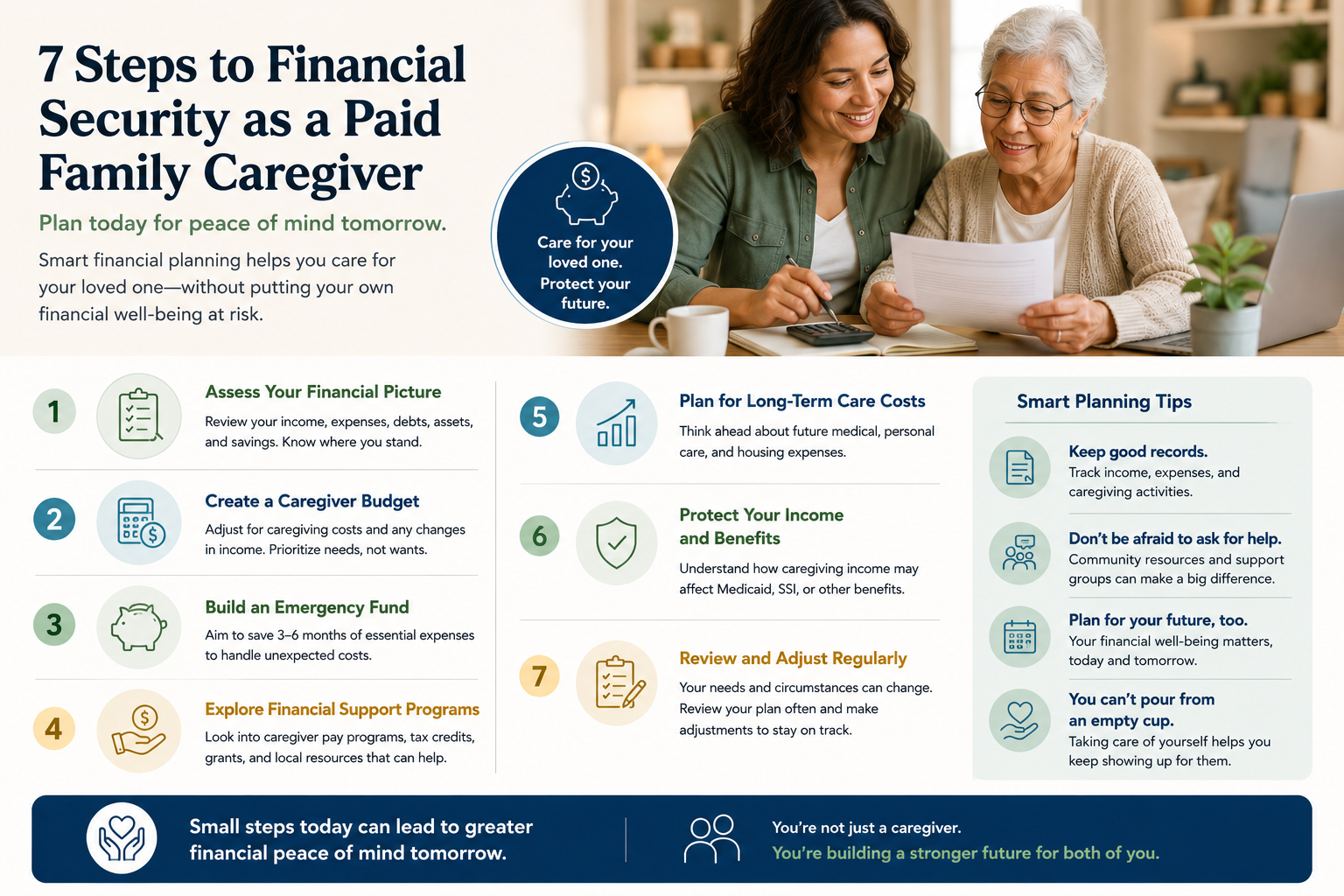
Step 7: Build a Financial Safety Net for Transitions
Caregiving doesn't last forever. Your loved one's condition may improve. They may move to a facility. They may pass away. When the caregiving role ends, your income ends too — often without warning.
Financial planning for paid family caregivers has to include a plan for what comes after. A few concrete steps:
Keep your professional identity active. Even while caregiving full-time, maintaining a resume, staying connected to former colleagues, or doing occasional freelance or part-time work keeps your options open. The guide to listing caregiving on your resume can help you frame this period as the skilled work it actually is.
Understand your unemployment options. Depending on your state and whether you were classified as a W-2 employee, you may qualify for unemployment benefits when caregiving ends. This isn't guaranteed — it depends on your state's rules and your employer relationship.
Save aggressively during stable periods. If your caregiving income is steady for several months, use that stability to build your emergency fund faster. The calm periods are the time to prepare for the unpredictable ones.
Transition planning isn't pessimistic. It's the single most responsible thing you can do for yourself while you're in a stable caregiving arrangement.
Frequently Asked Questions
Does financial planning for paid family caregivers require hiring a financial advisor?
Not necessarily. Most of the steps above — budgeting, benefit protection, tax planning, and starting retirement savings — can be handled on your own with the right information. A financial advisor becomes worth the cost when you're dealing with complex situations like managing an estate, protecting assets from Medicaid recovery, or coordinating multiple benefit programs simultaneously. For everyday caregiver financial planning, free resources and program-specific guidance (like financial help programs for caregivers) cover a lot of ground.
How much should I save from each caregiver paycheck?
Aim to save at least 10-15% of each check if your basic expenses are covered. If you're rebuilding from a period of unpaid caregiving with no savings, even 5% is a start. The priority order is: one month of emergency expenses first, then split additional savings between an irregular-expense fund and a retirement account. Adjust the percentages as your income stabilizes.
Will my caregiver income count against me when applying for a mortgage or car loan?
Caregiver income can help your loan application, not hurt it, as long as it's documented. Lenders want to see consistent income over time — usually two years of tax returns showing the same type of income. If you've been receiving W-2 caregiver wages for at least a year and can show it's ongoing, most lenders will count it. Keep your pay stubs, tax returns, and any program enrollment letters organized for this purpose.
Can I contribute to an IRA if my caregiver income is tax-exempt under IRS Notice 2014-7?
Yes. The IRS clarified that Medicaid waiver payments excluded from gross income under Notice 2014-7 still count as earned income for purposes of IRA contributions and the Earned Income Tax Credit. This is a significant advantage — you can contribute to a Roth IRA using income you didn't have to pay federal taxes on.
What if I don't know which Medicaid program I qualify for?
Start with your state's Medicaid waiver programs for family caregivers. If you're in Indiana, Michigan, or Illinois, Paid.care's process page walks you through the qualification steps and matches you with the right program based on your loved one's needs and your state. Getting enrolled is the first step — everything in this article builds from there.

