
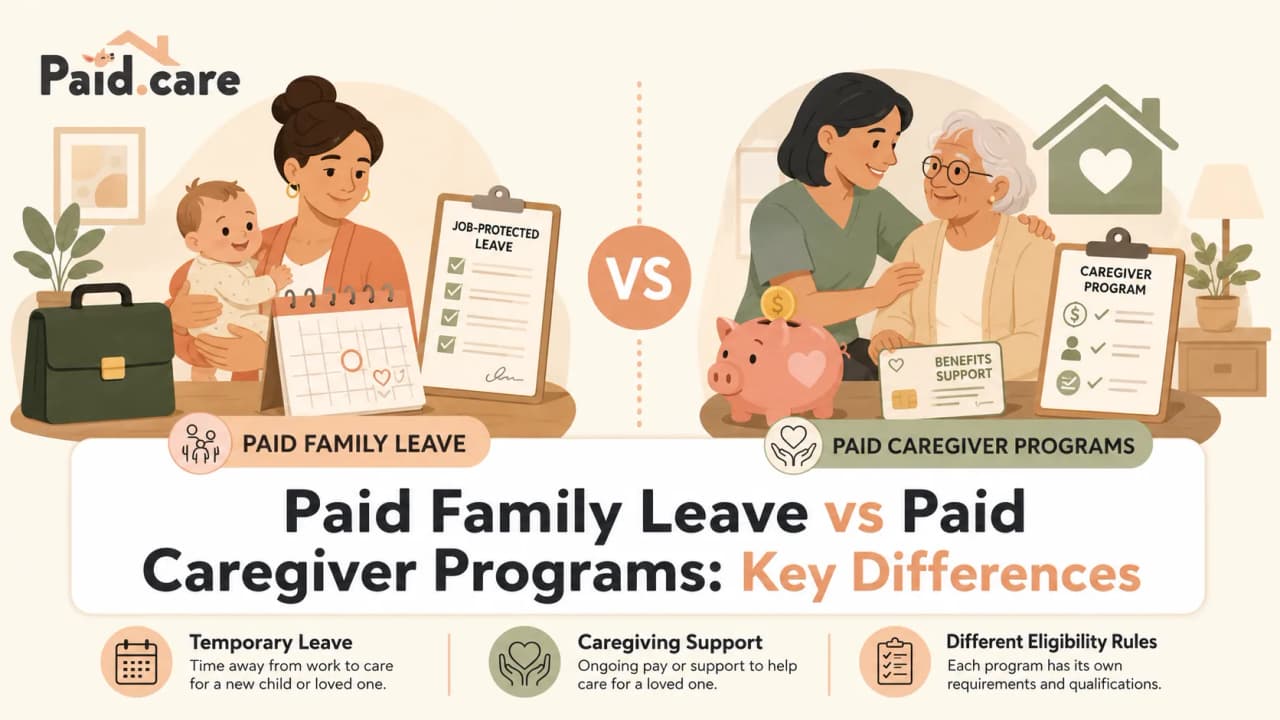
Paid family leave and paid caregiver programs come from different funding sources, serve different timelines, and require different people to qualify. Paid family leave is an employment benefit that replaces a portion of your wages while you take time off from a job, and it runs out in weeks. Paid caregiver programs, primarily funded through Medicaid, pay you for the hands-on care you provide at home and can run for years with no expiration date. Paid family leave eligibility is based on your work history; paid caregiver program eligibility is based on the care recipient's medical and financial situation. Medicaid waiver caregiver payments may also be excludable from federal income tax under IRS Notice 2014-7 if you live with the person you care for, a distinction that changes what you actually take home compared to paid family leave benefits, which are federally taxable.
Paid family leave and paid caregiver programs sound like they solve the same problem, but they work in completely different ways, cover different people, and come from different funding sources. If you're caring for an aging parent or a family member with a disability, picking the wrong one, or not knowing the other exists, can cost you months of income you could have been earning.
Paid family leave is a job-protection benefit tied to your employment. Paid caregiver programs, especially those funded through Medicaid, actually pay you to deliver hands-on care at home. The eligibility rules, the duration, the pay structure, and the long-term financial impact are different across the board. This comparison breaks down each option across the criteria that matter most so you can figure out which one fits your situation, or whether you should be using both.
What Each Program Actually Is
Before comparing them head-to-head, it helps to get clear on what these two categories cover, because the names get used loosely online and in conversation.
Paid Family Leave
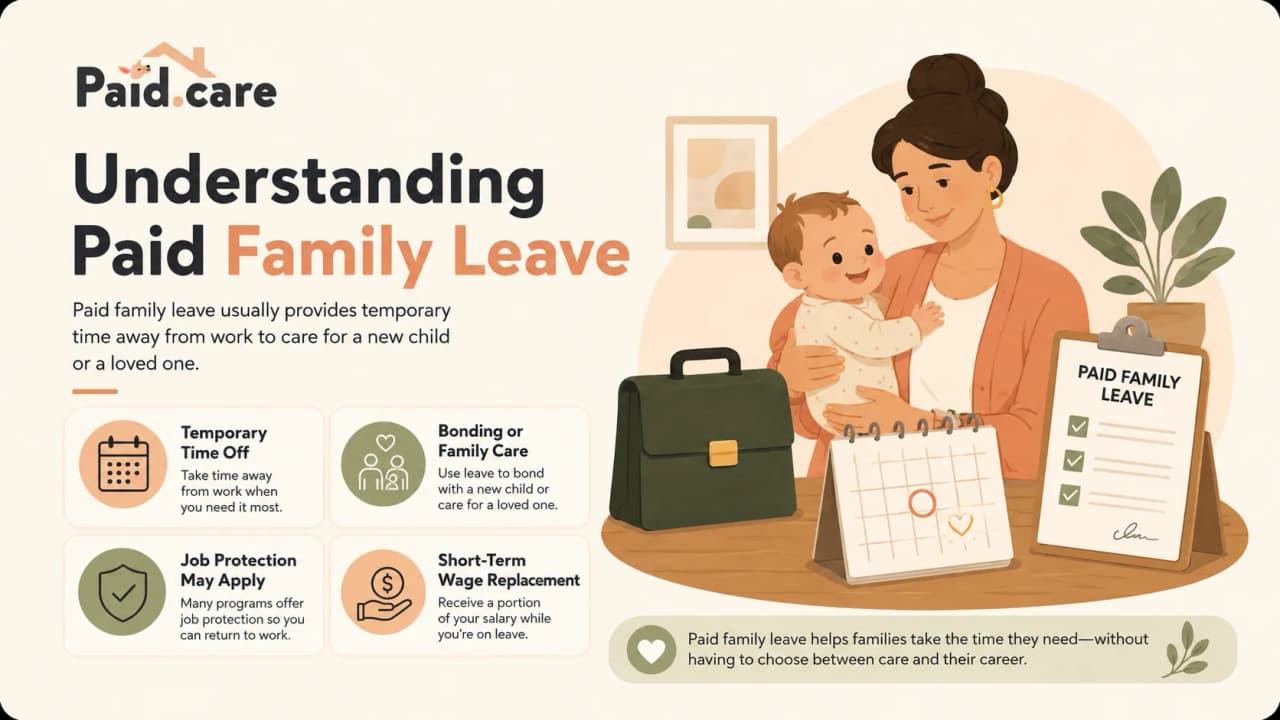
Paid family leave (PFL) is an employment benefit. It gives you partial wage replacement while you take time away from your job to care for a seriously ill family member, bond with a new child, or handle certain military-related family needs. The federal Family and Medical Leave Act (FMLA) provides unpaid job-protected leave for up to 12 weeks, but it doesn't put money in your pocket. FMLA protections for caregivers keep your job safe, but that's where they stop.
Actual paid family leave comes from state programs. As of 2026, states like California, New York, New Jersey, Washington, Oregon, Colorado, Connecticut, Massachusetts, Maryland, Delaware, Minnesota, and Maine (plus Washington, D.C.) have enacted paid family leave laws. Each sets its own wage replacement rate, maximum weekly benefit, and duration. Typically, you'll receive somewhere between 60% and 90% of your wages for 4 to 12 weeks, depending on the state.
The funding usually comes from payroll deductions — either employee-only or shared between employer and employee. You file a claim with your state's paid leave program, provide medical certification for the family member, and receive payments while you're away from work.
Paid Caregiver Programs
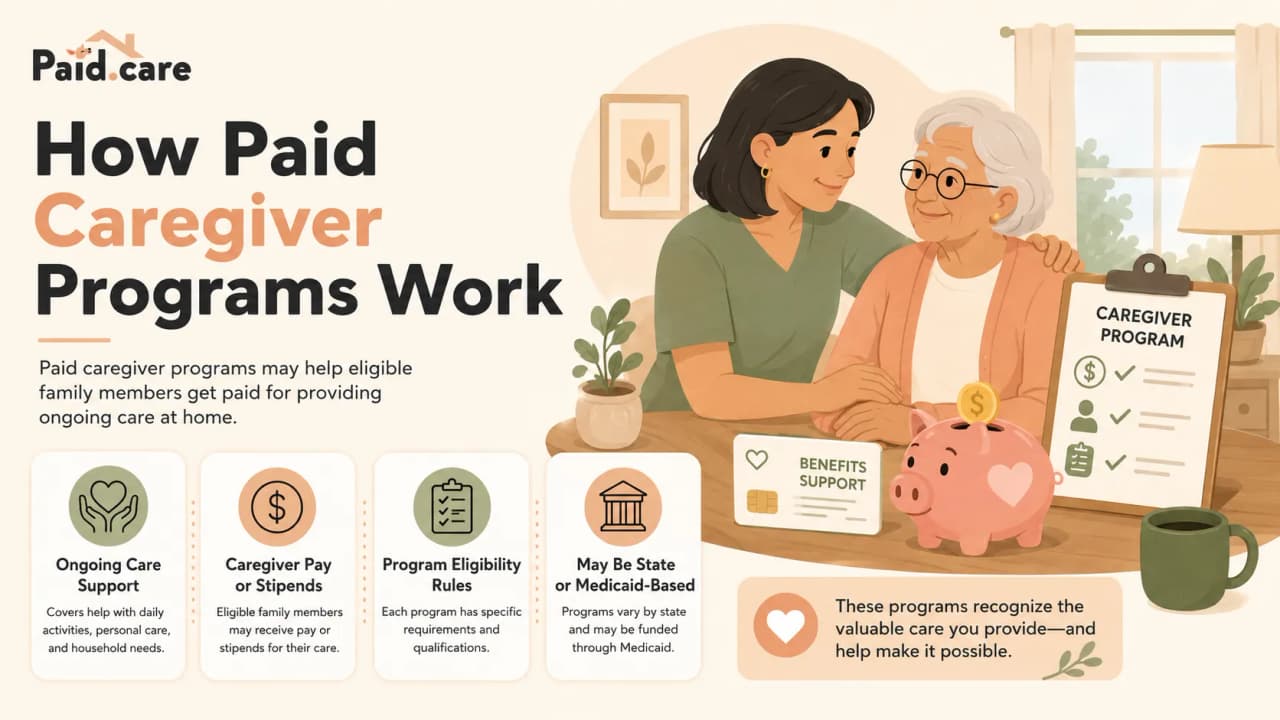
Paid caregiver programs are a different animal entirely. These programs pay you directly for the caregiving work you perform — bathing, meal preparation, medication reminders, mobility assistance, and other activities of daily living. The funding comes primarily through Medicaid waiver programs , state home and community-based services (HCBS), or Veterans Affairs programs like the Veteran Directed Care Program .
Unlike paid family leave, these programs don't require you to have an outside job. In fact, many family caregivers use these programs as their primary income. You're compensated for the hours you spend providing care, often on a weekly or biweekly pay schedule. The pay comes to you because you're performing a recognized caregiving role, not because you're temporarily absent from other employment.
Programs like Indiana's Structured Family Caregiving , Michigan's Home Help Program , and the Illinois Community Care Program are all examples. Each state structures its program differently, but the core idea is the same: the care recipient qualifies through Medicaid, and you get paid to keep them safely at home instead of in a facility.
Eligibility: Who Qualifies for What
This is where the two programs diverge most sharply.
For paid family leave, eligibility is based on your employment status. You need to have worked enough hours or earned enough wages in a recent base period (the specifics vary by state). You also need to work for a covered employer — some states exempt very small businesses. FMLA requires 12 months of employment and 1,250 hours worked. State PFL programs usually have lower thresholds, but they still require recent work history and W-2 employment or, in some states, self-employment opt-in.
Paid caregiver programs flip the equation. Eligibility is based on the care recipient's medical and financial situation. Your loved one typically needs to qualify for Medicaid (which means meeting income and asset limits) and demonstrate a need for home-based care through a functional assessment. You can read more about how Medicaid caregiver programs work and what the qualification process looks like.
The caregiver side has its own requirements too; background checks, training certifications, and sometimes age minimums. But there's no employment history requirement. You don't need a previous job. You don't need to be "taking leave" from anything. You simply need to be a family member (or in some programs, a friend) willing to provide documented care.
| Criteria | Paid Family Leave | Paid Caregiver Programs |
|---|---|---|
| Who must qualify | The employee (you) | The care recipient (your loved one) |
| Employment required | Yes, recent W-2 work history | No; caregiving is the work |
| Income/asset test | No | Yes; Medicaid eligibility for care recipient |
| Medical documentation | Physician certification of family member's condition | Functional needs assessment by state agency |
| Background check | No | Yes, in most states |
Duration and Timing
Paid family leave is temporary by design. Most state programs cap benefits at 6 to 12 weeks per year. Some allow intermittent use, taking leave in blocks of days rather than all at once, which can help if you need to attend medical appointments or handle care transitions. But the clock runs out. Once you've used your allotted weeks, you're back to work or you're off the payroll.
Paid caregiver programs, by contrast, can run for years. As long as the care recipient continues to meet Medicaid eligibility and the assessed need for home-based services remains, you can keep providing (and getting paid for) care. Some caregivers stay enrolled for a decade or longer. There's no annual cap on the program itself, though authorized hours per week are set during the care plan assessment and reviewed periodically.
If your caregiving situation is short-term. Say, your parent is recovering from surgery and needs 8 weeks of help. Paid family leave might cover the gap. But if you're looking at ongoing, indefinite care for a parent with dementia or a child with a disability, a Medicaid-funded paid caregiver program is built for that timeline. For help understanding how to transition from unpaid to paid caregiving , that guide walks through the process step by step.
Pay Structure and Amounts
With paid family leave, your benefit is calculated as a percentage of your regular wages, subject to a state-set maximum. In California, for example, benefits replace about 60–70% of weekly wages up to a cap. In New York, it's 67% up to a maximum tied to the state average weekly wage. If you earn a high salary, you'll hit the cap quickly. If you earn minimum wage, the replacement rate might feel close to your full paycheck.
Paid caregiver programs work on an hourly or daily rate set by the state Medicaid program. Rates vary widely. Family caregiver pay rates range from roughly $10 to $20+ per hour depending on the state, the specific waiver, and the level of care needed. Indiana's Structured Family Caregiving program pays a daily stipend rather than hourly wages, which can work out differently depending on care intensity.
One important distinction: paid family leave benefits are generally taxable income at the federal level (and in most states). Paid caregiver income through Medicaid waivers may be excludable from federal taxes under IRS Notice 2014-7 if the caregiver lives with the care recipient. That's a significant financial difference. The tax treatment of Medicaid waiver payments deserves a careful look because it can affect your total take-home substantially.
Job Protection and Employment Impact
Paid family leave preserves your relationship with your employer. FMLA and state PFL laws protect your job — your employer must hold your position (or an equivalent one) while you're on leave. You keep your health insurance. You accrue seniority in some cases. When leave ends, you return to your job.
Paid caregiver programs offer none of that, because they aren't tied to outside employment. If you leave a job to become a full-time paid family caregiver through Medicaid, your former employer has no obligation to hold your position. You're choosing caregiving as your work, and the program becomes your employer (or you become a self-directed worker, depending on the state model).
For some families, this is exactly the right trade-off. If your job pays $14 an hour and the caregiver program pays $16 an hour to do work you're already doing for free at home, the math speaks for itself. But if you have a career with benefits, retirement contributions, and advancement potential, walking away carries a real cost. The retirement planning considerations for full-time caregivers are worth reviewing before making that call.
Which States Offer What
Coverage gaps are one of the biggest sources of confusion. Paid family leave is only available in a handful of states — roughly 13 states plus D.C. as of 2026. If you live in Indiana, Michigan, or most of the Midwest and South, there is no state-level paid family leave program. FMLA gives you unpaid leave (if your employer is large enough), and that's it.
Paid caregiver programs through Medicaid, on the other hand, exist in some form in nearly every state, because HCBS waivers are a federal-state partnership. The specifics differ enormously; which family members can serve as caregivers, how many hours are authorized, what the pay rate is. But the option exists in places where paid family leave doesn't. If you're in Indiana, Michigan, or Illinois, Medicaid-funded caregiver programs are likely your primary path to getting paid for the care you provide. You can see how the qualification process works for those states specifically.
Can You Use Both?
Yes, in some situations. If you live in a state with paid family leave and your loved one also qualifies for a Medicaid caregiver program, the two can serve different purposes at different times.
A common sequence: you take paid family leave from your job for 8 weeks while your parent stabilizes after a health crisis. During that time, you get your parent assessed for Medicaid HCBS services. Once leave ends, you either return to work and hire a different caregiver through the program, or you resign and become the paid caregiver yourself through the Medicaid waiver.
You generally cannot collect paid family leave benefits and Medicaid caregiver wages simultaneously for the same hours, because PFL assumes you're away from work (not working a different job). But the timing can overlap during transitions.
Decision Guide: Which Program Fits Your Situation
Match the program to your actual circumstances.
- You have a full-time job and need short-term leave. Paid family leave (if your state has it) protects your position and replaces part of your wages while you handle a temporary care need. Start with FMLA protections and check whether your state offers paid benefits on top.
- You've already left work or never had outside employment. A Medicaid-funded paid caregiver program is the clear fit. There's no employment requirement, and the program can run as long as the care need exists.
- Your loved one needs ongoing, daily assistance with activities of daily living. Paid caregiver programs are designed for exactly this. Paid family leave runs out in weeks; caregiver programs don't.
- Your loved one doesn't qualify for Medicaid. Paid family leave doesn't require the care recipient to meet income or asset tests. If your parent has too much income for Medicaid but you need time off work, PFL is the available tool.
- You live in a state without paid family leave (like Indiana, Michigan, or Illinois). Your path is through Medicaid caregiver payment programs . These three states all have active programs that pay family members to provide home-based care.
- You want to build caregiving into a longer-term income source. Paid caregiver programs offer training, certification, and in some cases financial coaching that builds your caregiving into a recognized career path, not just a leave of absence.
Frequently Asked Questions
Can I get paid family leave to care for an elderly parent?
In states with paid family leave laws, yes — caring for a parent with a serious health condition qualifies as a covered reason in every state PFL program currently active. You'll need a healthcare provider to certify the condition. If your state doesn't have a paid family leave law, look into Medicaid caregiver programs as an alternative that pays you directly for hands-on care.
What's the difference between paid family leave and a paid caregiver program through Medicaid?
Paid family leave replaces a portion of your wages while you take time off from your job. A paid caregiver program through Medicaid pays you for the actual caregiving hours you provide at home. The first protects your employment; the second treats caregiving as the employment. They come from different funding sources, have different eligibility rules, and serve different timelines — paid family leave lasts weeks, while Medicaid caregiver programs can last years.
Do I need to quit my job to become a paid family caregiver through Medicaid?
Not necessarily. Some caregivers work part-time outside the home and provide authorized care hours around that schedule. It depends on how many hours of care are approved in your loved one's care plan and whether you can manage both. Many families find that full-time caregiving through the program replaces the outside income anyway, especially when you account for budgeting strategies specific to paid family caregivers .
Are paid family leave benefits taxable?
Federal law generally treats state paid family leave benefits as taxable income. Some states exempt PFL benefits from state tax, but you should expect to owe federal tax. Medicaid waiver caregiver payments, by contrast, may be excludable from gross income if you live with the person you're caring for, per IRS Notice 2014-7. The difference in tax treatment can meaningfully change what you actually take home.
Which option pays more?
It depends on your current wages and your state's program rates. Paid family leave replaces a percentage of your existing salary — if you earn well above minimum wage, PFL may pay more per week. But if your current job pays near the minimum and your state's Medicaid caregiver rate is competitive, the caregiver program can match or beat it, with the added advantage of no expiration date. Check your state's family caregiver pay rates to compare.
If you're providing care right now without getting paid, and you're trying to figure out which program applies to your family, the fastest way to find out is to check your eligibility through Paid.care . The qualification process covers Medicaid caregiver programs in Indiana, Michigan, and Illinois, and the team can walk you through what your specific situation calls for.