
1099 vs W-2 for Family Caregivers: Clear Differences, Tax Rules, and Risks Explained

Understanding the difference between W-2 and 1099 classification is essential for families who pay a relative to provide care and for caregivers themselves. W-2 employees are paid as household employees with payroll taxes withheld and employer responsibilities, while 1099 independent contractors are treated as self-employed and responsible for their own taxes. This article explains how classification affects taxes, benefits, and legal risk, and it maps practical steps families can take to convert care arrangements to compliant employment relationships. You will learn the IRS common law factors used to classify workers, how payroll and self-employment taxes differ, when Medicaid waiver payments may be tax-exempt under IRS Notice 2014-7, and the penalties tied to misclassification. The guide also compares the real-world advantages of W-2 caregiver status and describes how Paid.care helps families navigate eligibility, payroll, training, and weekly payments. Read on for clear comparisons, EAV tables, checklists, and state-specific notes for Indiana, Michigan, and Illinois plus planned expansion states.
What Are the Key Differences Between W-2 and 1099 Caregiver Classifications?
W-2 and 1099 classifications diverge primarily on control, financial arrangement, and the employment relationship, which determine tax withholding and employer responsibilities. W-2 caregivers qualify as household employees when a family controls what work is done and how it is done, triggering withholding of income taxes and employer payroll taxes; 1099 caregivers operate with greater independence and handle self-employment taxes. The practical outcome is different take-home pay, access to overtime and unemployment protections, and legal liability for the family as household employer. Below is a concise comparison table that highlights these attributes in a caregiver context and supports families deciding how to structure paid care.
How Does the IRS Define W-2 Employees and 1099 Independent Contractors?
The IRS uses common law factors grouped as behavioral, financial, and the nature of the relationship to decide whether a caregiver is an employee or an independent contractor. Behavioral factors ask who directs the day-to-day work and methods; financial factors examine who controls business aspects like supplies and opportunity for profit; relationship factors consider written agreements and permanency. Applying these tests, a relative who follows a family-set schedule and relies on the household for work is more likely a W-2 employee than an independent contractor. Families can use this checklist—who sets the schedule, who trains the caregiver, who supplies tools—to quickly evaluate classification and reduce legal risk.
These IRS common law factors provide a practical framework for families assessing caregiving arrangements and lead directly into what qualifies someone specifically as a household employee under IRS rules.
What Is the Household Employee Caregiver Definition and Why Does It Matter?
A household employee is someone who performs duties in a private home and works under the control of the household employer; this definition matters because it triggers payroll tax obligations for families. When a caregiver is a household employee, the family must withhold the employee share of FICA, pay the employer share, file required forms, and issue a W-2 at year end—steps that protect caregiver benefits and reduce classification risk. Failing to treat a household employee as a W-2 worker can result in retroactive taxes and penalties, so families should document control and payment arrangements carefully. Knowing when you become a household employer helps determine whether to set up payroll or pursue a compliant W-2 service to manage obligations.
Recognizing household employee status naturally leads into the tax implications families and caregivers face under each classification, which the next section explains in detail.
What Are the Tax Implications for Family Caregivers Under W-2 vs 1099?
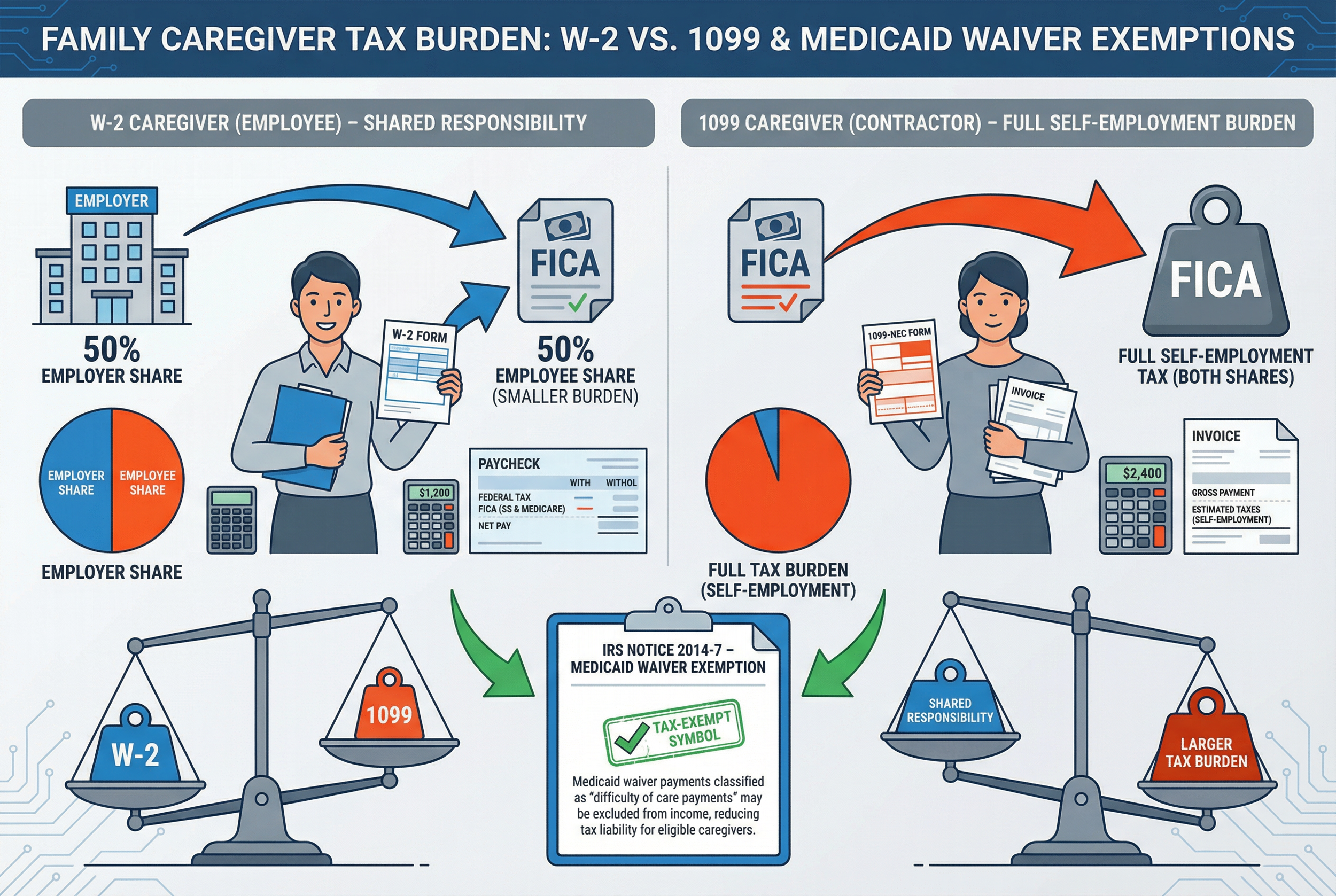
At a high level, W-2 employment shifts payroll tax withholding and employer contributions to the household employer, while 1099 arrangements place full self-employment tax responsibility on the caregiver. For W-2 caregivers, employers withhold income tax and split FICA taxes, reducing the caregiver’s out-of-pocket tax burden; for 1099 caregivers, self-employment tax covers both shares of Social Security and Medicare and often raises effective tax rates. Reporting also differs: families issue Form W-2 for employees and Form 1099-NEC for contractors, and caregivers report earnings on Schedule C plus Schedule SE for self-employment. The table below shows common tax types and who pays them in caregiver scenarios to clarify immediate monetary consequences.
How Do Payroll Taxes and Self-Employment Taxes Differ for Caregivers?
Payroll taxes for W-2 workers split FICA into employer and employee shares, which lowers the net tax hit for caregivers compared to self-employment tax that covers both shares. For example, on $1,000 gross pay: a W-2 employee might see roughly half of FICA withheld from wages, while the employer covers the other half; a 1099 caregiver effectively pays both shares via self-employment tax, increasing their tax bill and administrative burden. This difference affects take-home pay and also influences retirement contributions and Social Security benefits over time. Understanding the numeric impact helps families and caregivers decide whether a W-2 arrangement that includes employer contributions is financially preferable.
When Are Medicaid Waiver Payments Tax-Exempt Under IRS Notice 2014-7?
IRS Notice 2014-7 clarifies that some Medicaid waiver payments may be classified as “difficulty of care payments” and could be excluded from income for the care recipient or caregiver under certain conditions. Payments qualify when they compensate for unusual or specialized care needs tied to a recipient’s medical condition and follow state program rules that designate those funds as assistance rather than wages. Families should verify state Medicaid guidance and documentation requirements because the tax-exempt status depends on program specifics and how payments are administered. When in doubt, families should document the medical necessity and program terms to support an exemption claim and consult tax professionals for filing.
Confirming whether waiver payments are exempt connects directly to legal risk: misclassification and incorrect tax treatment can trigger penalties, which the following section outlines.
What Are the Legal Risks and Penalties of Misclassifying Family Caregivers?
Misclassifying a caregiver as a 1099 independent contractor when IRS or DOL factors point to W-2 employee status exposes families and caregivers to back taxes, interest, fines, and potential wage claims. Agencies can assess unpaid payroll taxes, require employer contributions for past periods, and impose penalties for failure to withhold and report. For caregivers, misclassification may mean lost access to unemployment insurance, workers’ compensation, and proper Social Security contributions, undermining long-term financial security. Families facing potential misclassification should act quickly to correct payroll practices and document changes, because proactive compliance often reduces liability and clarifies benefits for caregivers.
What Penalties Do Families and Caregivers Face for 1099 Misclassification?
Penalties for misclassification can include assessed back payroll taxes with interest, civil fines from tax authorities, and labor-law damages for unpaid overtime or minimum wage violations. Additionally, families might face state unemployment tax liabilities and retroactive worker’s compensation premiums if a caregiver should have been treated as an employee. Financial exposure can be significant depending on the length of misclassification and total wages paid, so immediate remedial steps—such as retaining payroll records, reclassifying the worker, and consulting with a payroll compliance service—are important to limit risk. Prompt corrective action often lowers penalties and provides clarity for both families and caregivers.
How Does Misclassification Affect Caregiver Benefits and Wage Protections?
When caregivers are classified as 1099 contractors, they typically lose critical wage protections and benefit access that W-2 employees receive, including overtime pay, unemployment insurance, and worker’s compensation coverage. This absence reduces short-term protections and erodes long-term retirement and Social Security accruals because self-employment tax and inconsistent reporting can affect benefit calculations. For caregivers who plan for long-term financial stability, correct classification ensures employer-paid contributions toward Social Security/Medicare and access to state benefit programs. Families who prioritize caregiver financial security therefore often choose W-2 arrangements to preserve protections and reduce legal exposure.
W-2 vs. 1099 for Caregivers: Tax and Employment Implications In some states, caregivers are employees who receive a Form W-2 from the employer, while in others, they may be classified as independent contractors. This distinction has significant implications for tax obligations, benefits, and legal protections for both the caregiver and the hiring family.
Why Is W-2 Employment Safer and More Beneficial for Family Caregivers?
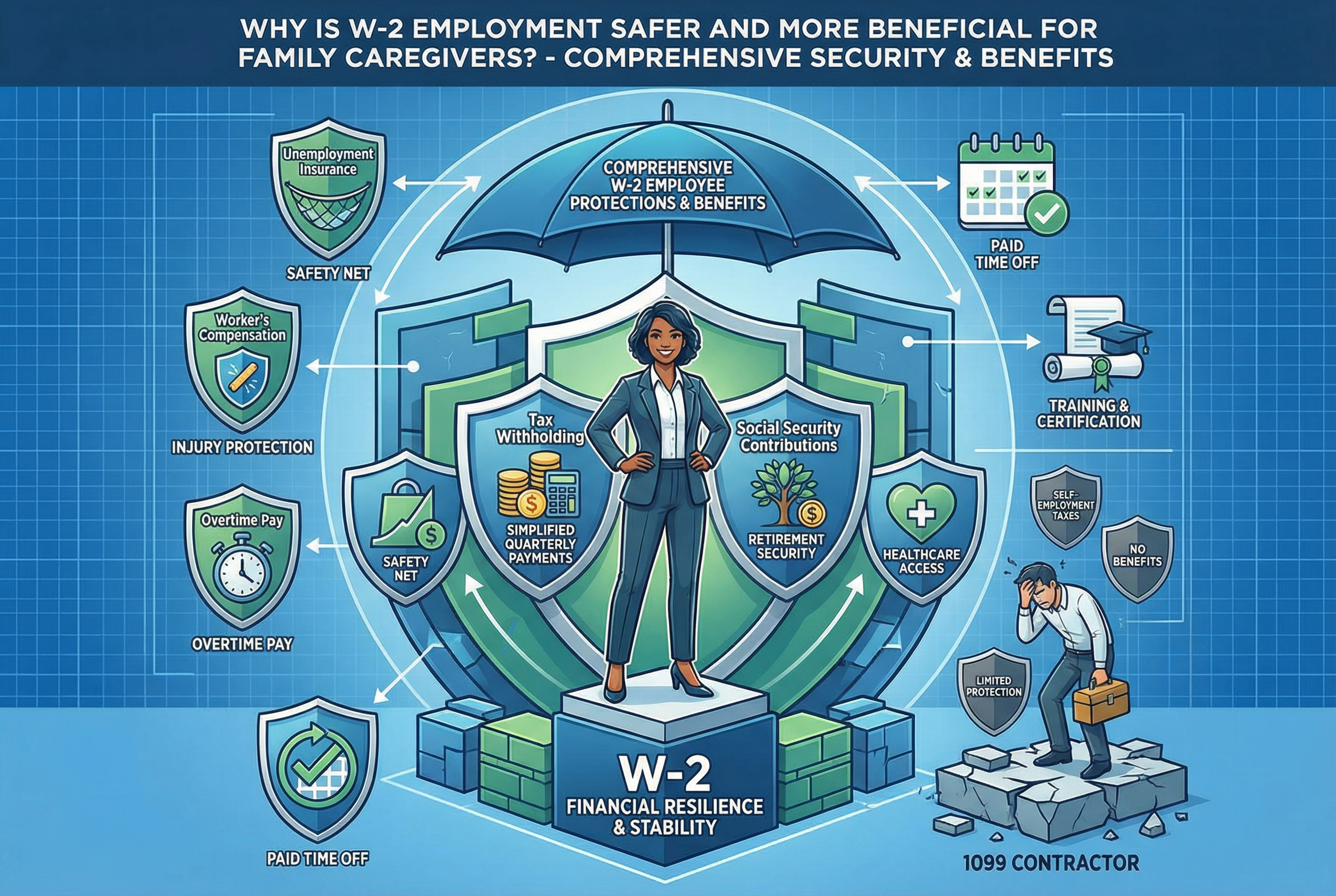
W-2 employment provides formal employee protections, employer contributions to payroll taxes, and clearer access to benefits that support caregiver stability and long-term security. As employees, caregivers receive withholding that simplifies quarterly tax payments and ensures consistent Social Security and Medicare contributions, while families maintaining compliant payroll reduce their liability for back taxes and fines. W-2 status often enables eligibility for overtime, unemployment insurance, and worker’s compensation, which matters for caregivers who rely on steady income and benefits during emergencies. Choosing W-2 classification aligns the financial interests of families and caregivers and creates a transparent framework for payroll, reporting, and workplace protections.
What Employee Benefits Do W-2 Caregivers Receive Compared to 1099 Contractors?
W-2 caregivers can access overtime pay where applicable, unemployment insurance, and the protections of worker’s compensation in the event of on-the-job injury, while 1099 caregivers generally do not have these safety nets. Employer payroll contributions also support Social Security and Medicare accruals that increase long-term benefits, and some programs offer paid time off or access to training and certification when the caregiver is on payroll. This collection of benefits improves financial resilience and lowers personal risk for caregivers who depend on caregiving as a primary income source. Families who value these protections often find the administrative overhead of W-2 payroll worthwhile for long-term caregiver security.
How Do Employer Payroll Contributions Support W-2 Caregivers?
Employer payroll contributions—such as the employer share of FICA, state unemployment taxes, and sometimes workers’ compensation premiums—reduce the caregiver’s direct tax burden and fund unemployment and injury protections. For example, employer-paid FICA covers half of Social Security and Medicare taxes, lowering the caregiver’s immediate tax responsibility and ensuring contributions toward future benefits. These employer-side payments also fund state-based protections like temporary disability or jobless benefits and create a documented employment history that supports claims for retirement and Social Security. Families who understand this math can weigh the net financial impact and decide whether formal W-2 employment is the better option for caregiver stability.
How Does Paid.care Simplify W-2 Compliance and Support for Family Caregivers?
Paid.care acts as a lead-generation and information hub that helps families and caregivers navigate eligibility for programs, manage W-2 payroll logistics, and access caregiver training and support. The service focuses on simplifying the process of getting paid for caregiving by guiding families through Medicaid and HCBS program eligibility checks, consumer-directed program enrollment, and proper payroll setup for compliant W-2 employment. Paid.care also facilitates weekly payments, offers care coaching, provides caregiver training and certifications, and provides a $1,000 sign-on bonus for qualified W-2 caregivers in supported states. These operational supports reduce administrative burden for families while ensuring caregivers receive consistent pay and access to benefits.
Eligibility guidance: Checks for Medicaid, HCBS, and veteran-directed program qualification.
Payroll and weekly pay: Manages W-2 payroll setup, withholding, and weekly payments.
Training and support: Provides caregiver training, certifications, and 24/7 care coaching.
Incentives: Offers a $1,000 sign-on bonus for qualified W-2 caregivers in eligible states.
These services form a workflow: eligibility check → training and certification → payroll setup → weekly W-2 pay, which eases the transition to compliant employment and connects families to program resources.
What Services Does Paid.care Offer to Ensure Proper W-2 Classification?
Paid.care’s services include eligibility checks for Medicaid and HCBS waiver programs, W-2 payroll and withholding management, caregiver training and certifications, ongoing care coaching, and weekly payments to caregivers. By coordinating eligibility verification with payroll setup, Paid.care reduces the chance of misclassification and ensures that caregiver wages are processed with correct tax withholding and reporting. The training and care coaching components support caregiver quality while certifications can be necessary for certain state-directed programs. These combined services streamline compliance for families and help caregivers access steady pay and benefits while meeting program requirements.
How Does Paid.care Support Caregivers Across Different States?
Paid.care currently operates primarily in Indiana, Michigan, and Illinois and plans to expand to Tennessee, Ohio, and South Dakota, adapting its services to state-specific Medicaid waiver and HCBS program rules. The organization tailors eligibility checks and payroll processes to the administrative requirements of each state’s programs, helping families confirm whether their care arrangement qualifies for consumer-directed payments and whether payments may be tax-exempt under IRS Notice 2014-7. As Paid.care expands, it monitors state program rollouts and updates families on enrollment and compliance steps to ensure caregivers receive weekly pay and that families remain legally compliant. Those in planned expansion states should watch for announcements and prepare documentation to support eligibility verification.
What Are the State-Specific Tax and Classification Rules for Family Caregivers?
State rules vary in how they treat household employers, unemployment coverage, and the administration of Medicaid waiver payments, so families must check state guidance where care is provided. Indiana, Michigan, and Illinois each have nuances in program enrollment, payroll tax thresholds, and how consumer-directed services are administered, which affect whether a family must register as an employer or whether the state administers payments directly. Practical impacts include differences in whether the state treats waiver payments as wages for taxation, how payroll taxes are withheld, and where to file for employer accounts.
Given these variations, families in any state should confirm program details and payroll responsibilities with state Medicaid agencies or an experienced compliance service to avoid misclassification and ensure accurate tax treatment. The preceding information connects back to the IRS factors and tax rules discussed earlier and guides families toward compliant, stable caregiving arrangements.
FAQs
-
A 1099 caregiver is treated as an independent contractor—they’re considered self-employed, handle their own taxes, and usually don’t get benefits. A W-2 caregiver is an employee—the person or agency paying them withholds payroll taxes, and the caregiver may be eligible for unemployment, workers’ comp, or other benefits. For family caregivers, the key question is whether you’re truly running your own “business” or you’re being treated like an employee in how, when, and where you work.
-
If you’re paid as a 1099 contractor:
You get a Form 1099 if you earn enough from one payer.
You must file self-employment taxes (Social Security and Medicare) on your earnings.
You may deduct certain business expenses if you qualify as self-employed.
If you’re paid as a W-2 employee:
You get a Form W-2 showing your wages and tax withholdings.
Income tax, Social Security, and Medicare are usually withheld from each paycheck.
Your employer pays the employer’s share of Social Security and Medicare taxes.
Either way, you must report caregiver pay to the IRS, but the forms and responsibilities look very different.
-
Not safely. Worker classification is based on the law, not convenience. If the person paying you (the family or a program) controls your schedule, duties, and how the work is done, you usually look more like a W-2 employee. Calling an employee a “1099 contractor” can be treated as misclassification, which can lead to back taxes, penalties, and problems for both the caregiver and the person paying them. When Medicaid, VA, or payroll agencies are involved, they often have specific rules about how caregivers must be classified.
-
Possible risks of 1099 status include:
Higher tax burden if you’re paying both the employer and employee side of Social Security and Medicare
No automatic access to unemployment insurance, workers’ comp, or employee benefits
Surprise tax bills if you don’t make estimated tax payments during the year
Risk that the IRS or state may later decide you were really an employee, leading to audits or back taxes for you and the payer
Some caregivers prefer 1099 for flexibility or deductions, but many family caregivers are actually treated as household employees or program employees (W-2) under tax rules.
-
To avoid mistakes:
Review IRS worker classification guidelines (behavioral control, financial control, and relationship of the parties).
If using Medicaid self-directed programs, VA benefits, or an agency, ask them directly whether they treat caregivers as employees or contractors and how payroll is handled.
Consider using a household payroll service if you’re privately hiring a caregiver and expect W-2 status.
Talk with a tax professional (CPA or enrolled agent) or elder law attorney if you’re unsure.
Getting classification right from the start helps protect the caregiver’s benefits, avoids surprise tax bills, and keeps both the family and the caregiver on the right side of IRS and state rules.

