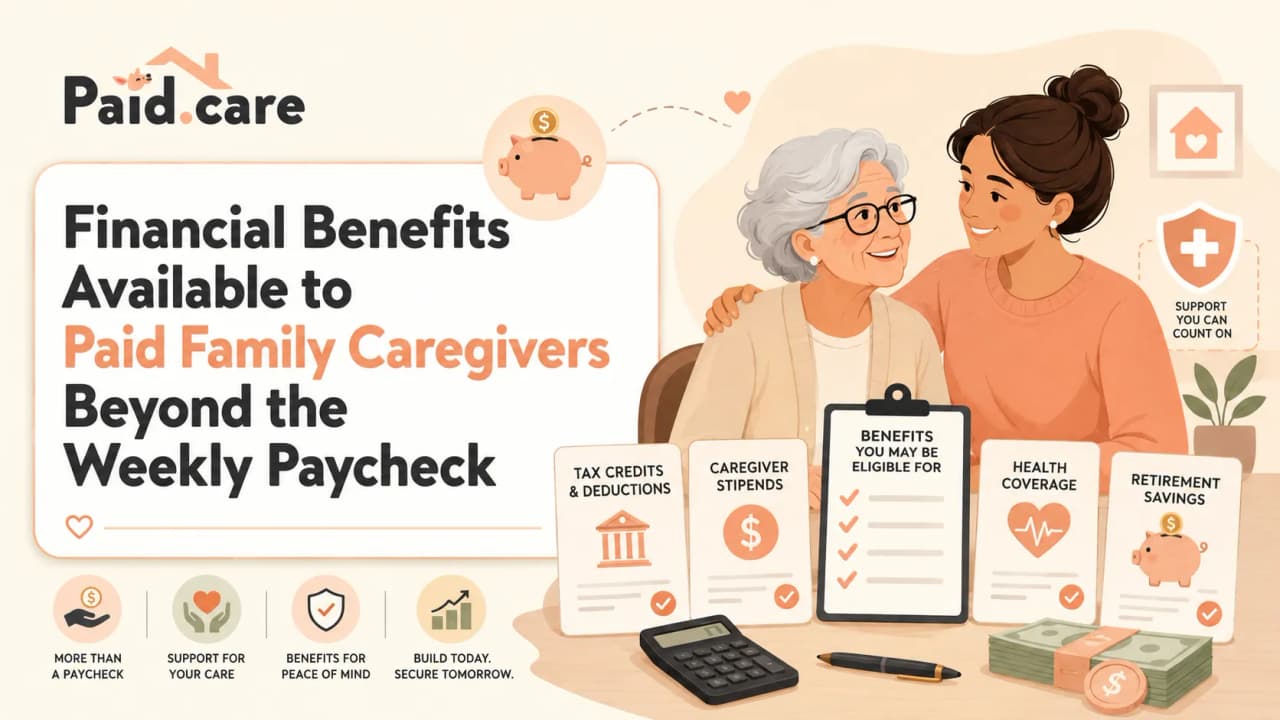
Paid family caregivers enrolled through Medicaid waiver programs , VA caregiver programs, or state-funded home care plans have access to financial benefits that go well beyond the weekly paycheck. The IRS Difficulty-of-Care income exclusion under Notice 2014-7 allows Medicaid waiver payments made in the home to be excluded from gross income entirely, reducing federal tax liability to zero for qualifying caregivers. W-2 classification through a fiscal intermediary or employer of record brings unemployment insurance, workers' compensation, and employer-paid Social Security and Medicare contributions that add thousands of dollars in annual value. Every quarter a paid caregiver earns above the minimum threshold counts toward Social Security credits, replacing the zeros that unpaid caregiving years leave on an earnings record. State programs in Indiana, Michigan, and Illinois layer on additional supports including free training, respite hours, and covered home modifications that cut household expenses without appearing as taxable income.
Your weekly caregiver paycheck is only part of the financial picture. Paid family caregivers who enroll through Medicaid waiver programs, VA caregiver programs, or state-funded home care plans can access financial benefits for family caregivers that most people overlook: tax credits, retirement protections, respite coverage, training stipends, and more. Knowing what's available and how to claim it can add thousands of dollars in annual value on top of the hourly wage you're already earning.
This guide covers the full range of financial benefits beyond base pay, including federal tax advantages, state-specific supports in Indiana, Michigan, and Illinois, employer-of-record protections, and long-term wealth-building tools. Each section below maps to a deeper resource you can explore as your situation demands.
Tax Credits and Deductions That Reduce Your Caregiver Tax Bill
Paid caregiving income shows up on your tax return, but so do several credits and deductions designed to offset your costs. The most impactful one for most family caregivers is the Dependent Care Tax Credit (or its cousin, the Credit for Other Dependents), which can apply when the person you care for qualifies as your tax dependent. If your parent or family member lives with you and meets the IRS support test, you may also claim head-of-household filing status, which comes with a larger standard deduction and more favorable tax brackets.
Beyond federal credits, some states offer their own caregiver tax credits. Indiana, for instance, has explored caregiver-specific deductions tied to home modification costs and out-of-pocket medical expenses you cover for your care recipient. Illinois caregivers enrolled in the Community Care Program may qualify for deductions related to unreimbursed caregiving supplies. You can find a full breakdown of current federal and state credits in our 2026 guide to federal and state caregiver tax credits .
The Difficulty-of-Care Income Exclusion
One of the most valuable — and most misunderstood — tax provisions for Medicaid-funded caregivers is the Difficulty-of-Care income exclusion under IRS Notice 2014-7. If you provide care in your home (or the home of the person you care for) through a Medicaid waiver program, your caregiver payments may be excludable from gross income entirely. That means you could owe zero federal income tax on your caregiver wages. The exclusion applies specifically to payments from qualified Medicaid waiver programs, not to private-pay arrangements. Our detailed walkthrough of whether Medicaid waiver payments are taxable explains how to report this correctly on your return.
Get this wrong and you'll either overpay the IRS or trigger an audit. Get it right and you keep significantly more of your caregiving income. If you're enrolled through a W-2 employer of record, your pay stubs may already reflect this exclusion. If you're paid as a 1099 contractor (less common in Medicaid programs but it happens), you'll need to handle the exclusion yourself at filing time. See our comparison of 1099 vs. W-2 classification for family caregivers for the specifics.
Worker Protections Through W-2 Employment
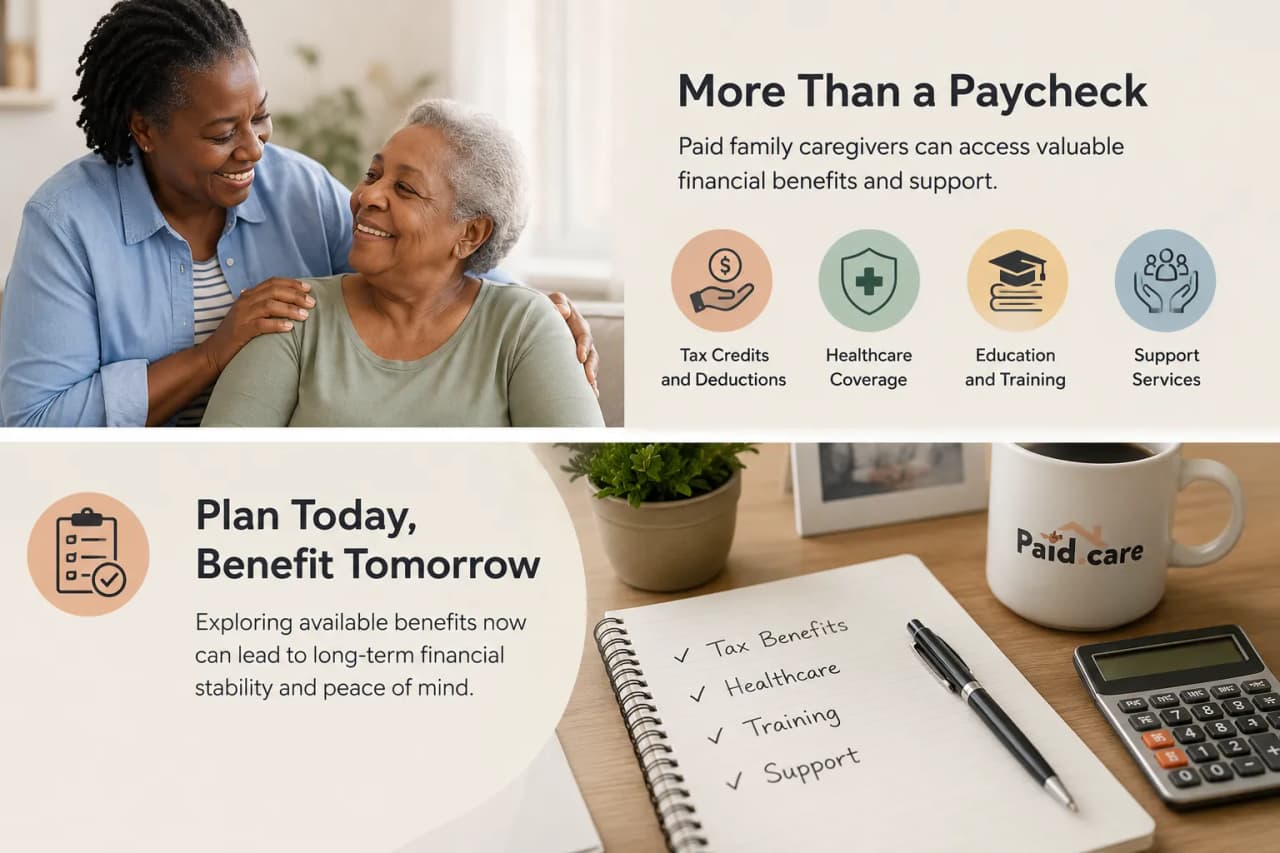
Many family caregivers don't realize that getting paid through a structured program often means becoming a W-2 employee, with all the protections that come with it. When you're classified as an employee rather than an independent contractor, you gain access to unemployment insurance, workers' compensation coverage, and employer-contributed Social Security and Medicare taxes. These aren't abstract perks. If you're injured while transferring your parent from bed to wheelchair, workers' comp covers your medical bills. If the person you care for passes away or moves to a facility, unemployment insurance can bridge the income gap while you figure out what's next.
The W-2 structure also means half of your Social Security and Medicare tax is paid by the employer of record. That's money you'd otherwise pay yourself under a 1099 arrangement (the self-employment tax adds roughly 7.65% on top of income tax). Over a year of full-time caregiving, that employer contribution alone can be worth several thousand dollars.
Programs like Structured Family Caregiving in Indiana , Michigan's Home Help Program , and the Illinois Community Care Program typically set up caregivers as W-2 employees through a fiscal intermediary or employer of record. If you're exploring how this process works step by step, our How It Works page walks through the full enrollment and payment flow.
Respite Care Benefits: Paid Time to Recharge
Burnout is the biggest threat to a caregiver's financial stability because it leads to quitting, and quitting means losing your income stream entirely. Most Medicaid waiver programs build in respite care hours that cover the cost of a substitute caregiver so you can take time off. These hours are funded by the waiver itself, meaning you don't pay out of pocket and (in most programs) you don't lose your own pay during the respite period.
Indiana's the program and Structured Family Caregiving program include respite provisions. Michigan's MI Choice Waiver offers respite as a covered service. Illinois allocates respite hours through Community Care Program care plans. The number of hours varies by state and by the care recipient's assessed needs, but the point is this: the program is designed to keep you caregiving long-term, and paid respite is one of the tools that makes that possible.
If you've never used your respite hours, you're leaving a benefit on the table. Our Respite Care 101 guide explains how to access these hours and what to expect from the process. We also have a piece on how to take respite without guilt , because the emotional barrier is often bigger than the logistical one.
Financial Benefits for Family Caregivers Through Training and Certification
Caregiving programs don't just pay you to provide care. Many of them also pay for your training, or at least cover the cost of required certifications. This is a direct financial benefit: skills you'd otherwise pay to acquire are provided free as part of your enrollment.
In Indiana, Structured Family Caregiving includes a training component that covers personal care techniques, medication management basics, emergency response, and care documentation. Michigan's Home Help Program requires orientation and ongoing training that's provided at no cost to the caregiver. Illinois requires certain training hours through the Community Care Program, again at no charge to you.
These certifications carry real market value. If you ever decide to pursue professional caregiving work outside the family context, your documented training hours and program experience make you a stronger candidate. Some caregivers use this training as a springboard into nursing assistant certification or home health aide roles that come with higher hourly rates. You can explore the specific skills these programs cover in our practical guide to caregiving skills .
Social Security Credits and Retirement Planning
Here's a benefit that won't show up in your bank account this month but could be worth tens of thousands of dollars over your lifetime: Social Security credits. Every quarter you work as a W-2 caregiver and earn above the minimum threshold (currently $1,810 per quarter in 2026), you earn a Social Security credit. You need 40 credits (roughly 10 years of work) to qualify for retirement benefits. Caregivers who spent years providing unpaid care and fell short of that threshold can start filling in the gaps once they enter a paid program.
This matters more than most caregivers realize. Unpaid caregiving years are invisible to the Social Security Administration. They don't count toward your earnings record, which means your future retirement benefit calculation has zeros in those years, dragging your average down. Getting paid through a formal program replaces those zeros with real earnings numbers.
If you're already providing care and haven't enrolled in a paid program yet, every month you wait is a month of zero earnings on your Social Security record. Our guide to retirement planning for full-time caregivers goes deeper into how paid caregiving income affects your long-term financial picture, and our post on transitioning from unpaid to paid caregiver lays out the steps to get started.
Health Insurance Access and Medicaid Interactions
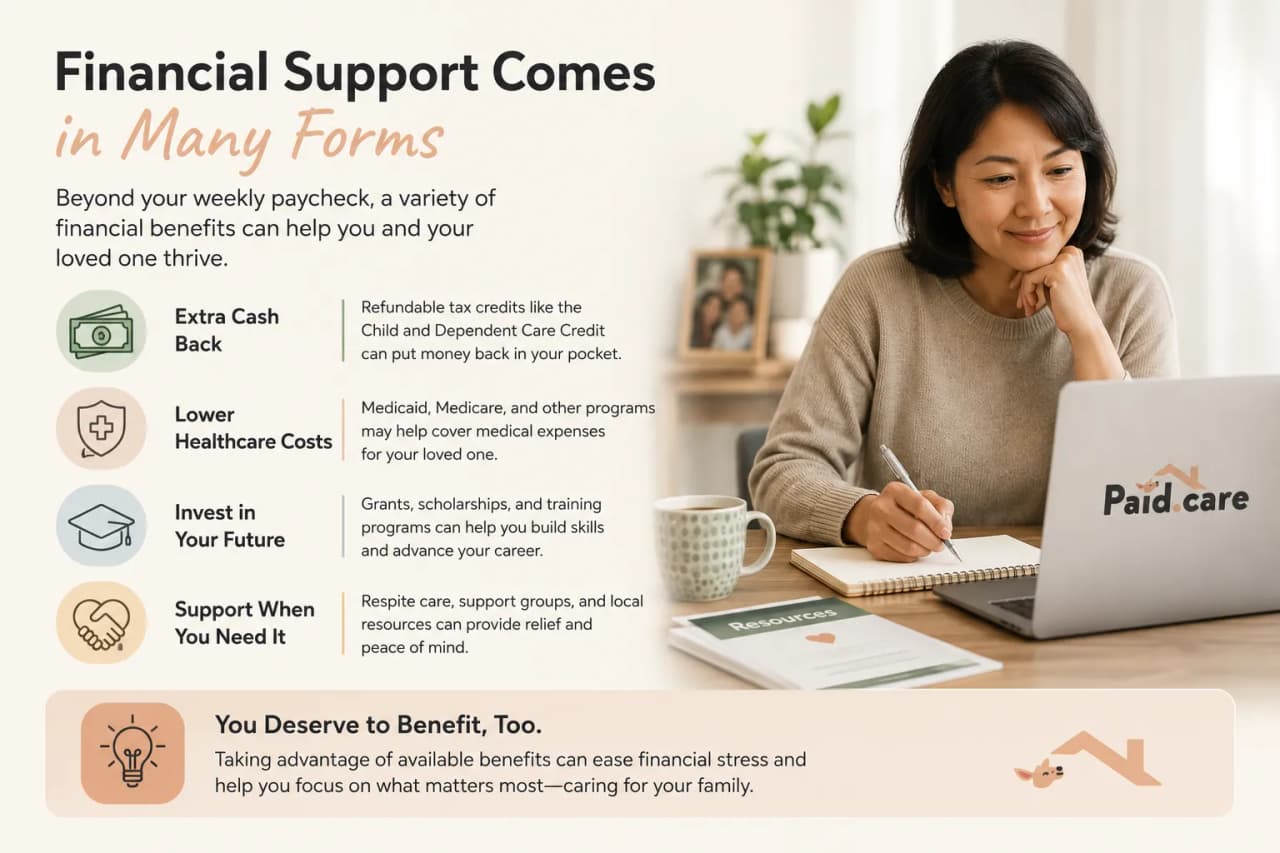
Caregiver income interacts with your health insurance eligibility in ways that can either help or hurt you, depending on how your income is classified. If your Medicaid waiver payments qualify for the Difficulty-of-Care exclusion (discussed above), that income doesn't count toward your Modified Adjusted Gross Income (MAGI) for ACA marketplace purposes. In practical terms, this means you might still qualify for subsidized health insurance through the marketplace even while earning caregiver wages.
For caregivers in Indiana, Michigan, and Illinois who are on Medicaid themselves, it's important to understand how your caregiver pay interacts with Medicaid income limits. Adding earned income from a caregiver role could push you above eligibility thresholds if the income isn't properly excluded. We've written a detailed guide on how to report caregiver income without losing health coverage that walks through the reporting mechanics for each situation.
Some employer-of-record agencies also offer health insurance as an employment benefit, though this varies significantly by program and state. It's worth asking about during your enrollment process.
FMLA Protections and Leave Policies
The Family and Medical Leave Act gives eligible employees up to 12 weeks of unpaid, job-protected leave per year to care for a family member with a serious health condition. If you're balancing a W-2 caregiving role with another job, or if your spouse needs to take time off from their job to support your caregiving duties, FMLA may apply.
FMLA won't put money in your pocket directly. But job protection has real financial value because it prevents the cascading income loss that happens when someone gets fired for taking time off to handle a caregiving crisis. Our FMLA for caregivers guide breaks down eligibility requirements and how to file a request with your employer.
State-Specific Financial Supports Worth Knowing About
Beyond the federal-level benefits above, each state layers on its own set of financial supports for family caregivers. Here's a snapshot of what's available in the three states where paid caregiving programs are most active:
Indiana
Indiana's Structured Family Caregiving program pays a daily stipend , which can work out to a higher effective hourly wage for caregivers providing round-the-clock support. The state also covers care-related supplies and offers free care coaching through partner agencies. Indiana's Medicaid waiver system includes multiple waiver tracks, each with different benefit packages. Our Indiana Medicaid waiver reimbursement rates page tracks current payment levels.
Michigan
Michigan's Home Help Program pays an hourly rate and provides caregivers with W-2 employment through CHAMPS-enrolled agencies. The state's MI Choice waiver includes additional covered services like home modifications and assistive technology that reduce out-of-pocket costs for caregiving families. These are real financial benefits for family caregivers even though they don't show up as income: a grab bar installed through the waiver is one you don't have to buy yourself.
Illinois
Illinois' Community Care Program pays caregivers on a tiered system based on the care recipient's assessed needs. The state also funds caregiver training programs and has expanded eligibility criteria in recent years. Illinois caregivers who serve adults with disabilities (rather than older adults) may access additional supports through the state's Home Services Program.
ABLE Accounts and Benefit-Protection Tools
If the person you care for has a disability that began before age 26, they may qualify for an ABLE account , a tax-advantaged savings account that allows them to save money without jeopardizing their Medicaid or SSI eligibility. While the ABLE account belongs to the care recipient, it indirectly benefits you as the caregiver because it provides a financial cushion that can cover care-related expenses without disrupting the Medicaid waiver that funds your pay.
Think of it this way: if your loved one's savings push them over the Medicaid asset limit and they lose waiver eligibility, your paid caregiver position disappears too. An ABLE account protects against that scenario. We cover the mechanics in our guide on using ABLE accounts to protect benefits while paying a family caregiver .
Building a Full Financial Picture as a Paid Caregiver
When you stack all of these benefits together, the total compensation picture for a paid family caregiver looks considerably larger than the hourly rate alone. Consider what adds up: excluded income that reduces your tax burden to near zero, employer-paid Social Security contributions that build your retirement benefit, free training that has real market value, respite hours that prevent burnout-driven income loss, and state-funded home modifications that cut your household expenses.
The caregivers who capture the most value from these programs are the ones who know what's available and actively claim it. A tax credit you don't file for is worth nothing. Respite hours you don't use expire. Social Security credits you don't earn never appear on your record.
If you're currently caring for a family member without pay, or if you're enrolled in a paid program but aren't sure you're capturing every benefit available to you, start with our budgeting guide for paid family caregivers . And if you haven't yet explored whether your caregiving situation qualifies for a paid program, the How It Works page at Paid.care walks you through eligibility, enrollment, and what to expect from the payment process. It's the fastest way to see whether you're leaving money on the table.
Frequently Asked Questions
Do financial benefits for family caregivers differ by state?
Yes, significantly. Each state administers its own Medicaid waiver programs with different pay structures, respite allotments, training requirements, and supplemental benefits. Indiana uses a daily stipend model through Structured Family Caregiving. Michigan pays hourly through the Home Help Program. Illinois uses a tiered system through the Community Care Program. Federal benefits like the Difficulty-of-Care income exclusion and Social Security credits apply everywhere, but state-level supports vary enough that you need to look at your specific program's benefit package. Our caregiver pay rate guide compares compensation across states.
Can I receive caregiver pay and still qualify for Medicaid myself?
In many cases, yes. If your Medicaid waiver payments qualify for the IRS Difficulty-of-Care exclusion, that income is excluded from your MAGI calculation, which is the number Medicaid uses to determine your eligibility. This means you could earn caregiver wages without those wages pushing you over Medicaid income limits. However, the details depend on your state's specific rules and how your payments are classified. Our guide on reporting caregiver income without losing health coverage explains the reporting process step by step.
What happens to my caregiver benefits if my loved one passes away or enters a facility?
Your paid caregiver position ends when the person you care for no longer receives services at home. If you're classified as a W-2 employee through your program, you may be eligible for unemployment insurance benefits during the transition period. Your Social Security credits and any retirement contributions earned during your caregiving tenure stay on your record permanently. Training certifications you earned also remain valid and can support a move into professional caregiving work. We cover the transition process in our guide on what options exist when Medicaid waivers run out .
Are there grants or one-time financial supports available to family caregivers?
Some states and nonprofits offer caregiver grants, vouchers, or one-time assistance funds. These tend to be limited in availability and competitive, but they do exist. The National Family Caregiver Support Program (administered through local Area Agencies on Aging) provides some direct financial assistance in certain regions. Our grants for family caregivers resource lists current options worth exploring.
How do I start capturing these benefits if I'm currently an unpaid caregiver?
The first step is determining whether your loved one qualifies for a Medicaid waiver or state-funded home care program, since most financial benefits for family caregivers flow through these programs. If the person you care for is elderly, disabled, or a veteran, there's a strong chance a program exists in your state. Start with the Paid.care enrollment process to check eligibility, or explore our overview of Medicaid waiver programs for family caregivers to understand which programs apply to your situation.