
Does Illinois Pay for Family Caregivers? A Complete Guide
If you're currently helping a parent, spouse, or other loved one with daily care at home, you may already be doing the work of a professional caregiver—without the paycheck. The good news is that in Illinois, family caregivers can and do get paid for the support they provide. Through a combination of state Medicaid programs, federal VA benefits, long-term care insurance, and home care agency employment, thousands of Illinois families are earning real income for the hands-on care they deliver every day.
This guide answers the question once and for all: yes, Illinois does pay family caregivers—and this is everything you need to know about how it works, who qualifies, and how much you can expect to earn.
The Short Answer: Yes, Illinois Pays Family Caregivers
Illinois has several established programs that allow family members to receive compensation for providing in-home care to an aging, disabled, or chronically ill loved one. These programs are funded through a mix of state and federal dollars and are designed to keep vulnerable residents in their own homes rather than transitioning them to nursing facilities or residential care settings.
The most widely used pathway is through Illinois's Medicaid program, specifically the Home Services Program (HSP), which falls under the state's broader Home and Community-Based Services (HCBS) waiver framework. But Medicaid is just one piece of the picture. Veterans' benefits, long-term care insurance policies, and home care agency employment all provide additional routes to compensation for Illinois caregivers.
Pay rates across the state typically range from $13 to $25 per hour, depending on the program, the region, and the level of care being provided. Caregivers in the Chicago metro area tend to earn toward the higher end of that range, while those in mid-sized cities like Rockford, Springfield, and Peoria generally fall somewhere in the middle. The statewide average hovers around $17 per hour.
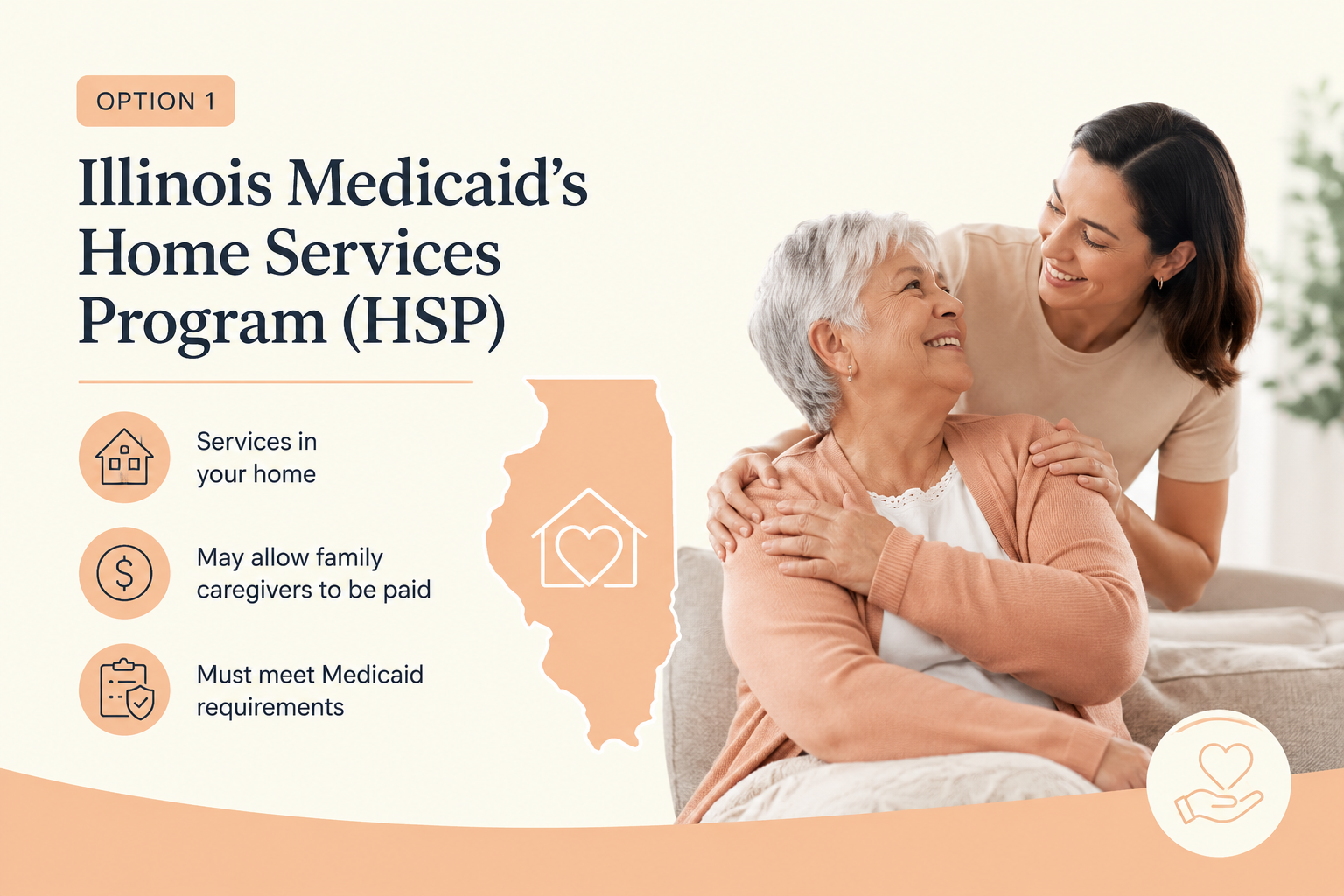
Option 1: Illinois Medicaid's Home Services Program (HSP)
The Home Services Program is Illinois's primary mechanism for compensating family caregivers. Administered by the Illinois Department of Human Services (IDHS), the HSP is funded through a combination of state and federal Medicaid dollars and is available to qualifying residents across all 102 Illinois counties.
Under the HSP, approved family caregivers—including adult children, siblings, and other relatives—can be hired as paid personal assistants to provide in-home support to a loved one who meets eligibility criteria. The person receiving care must be enrolled in Medicaid, have a disability or age-related condition, and require help with activities of daily living such as bathing, grooming, dressing, meal preparation, medication management, and mobility.
Caregivers must be at least 18 years old, pass a background check, and complete required training. Some programs also request legal guardianship documentation or power of attorney depending on the care recipient's situation. Once approved and hired through the program, caregivers receive regular paychecks for the hours they work—typically directly from the state or through a fiscal intermediary.
What caregivers can earn through the HSP:
•Hourly wages ranging from $13 to $20+ depending on location and care needs
•Overtime pay for hours worked beyond standard thresholds
•Sick leave and paid time off in some cases
•Mileage reimbursement for care-related travel
•Potential tax-free income if you share a home with the care recipient
Option 2: VA Caregiver Support Programs for Illinois Veterans
If the person you're caring for is a veteran, federal VA caregiver programs open up another significant source of income. Two programs are particularly relevant for Illinois families: VA Aid & Attendance and the Program of Comprehensive Assistance for Family Caregivers (PCAFC).
VA Aid & Attendance is a pension benefit that provides additional monthly payments to veterans who need help with daily activities. The PCAFC, on the other hand, is designed specifically for post-9/11 veterans with serious injuries or illnesses and offers a more structured caregiver stipend alongside additional support services.
Both programs are available to eligible Illinois veterans regardless of where in the state they live—from Chicago to rural southern Illinois. Compensation through these programs can take the form of a monthly pension, a structured salary, or hourly wages, and rates frequently exceed Illinois's minimum wage, particularly when the veteran's condition requires intensive daily involvement.
Beyond the base pay, VA program caregivers in Illinois may also receive respite care, health insurance coverage, paid leave, and access to caregiver training and support services. In many situations, VA benefits can be stacked alongside Medicaid or Medicare coverage, creating a more comprehensive compensation and support package for the whole family.
Option 3: Long-Term Care Insurance Reimbursement
This is one of the most overlooked sources of caregiver compensation in Illinois. If your loved one holds a long-term care insurance policy, there's a real chance that policy includes provisions that allow it to reimburse family members providing direct care—and many Illinois families simply don't know to look.
Long-term care policies are typically structured to cover services that help with activities of daily living, which is exactly what most family caregivers provide. Reimbursable tasks commonly include hygiene support, meal preparation, medication reminders, mobility assistance, and health monitoring. The amount you receive depends on the specific policy terms, the level of care involved, and the documentation you submit.
When claims are approved, reimbursements can significantly reduce out-of-pocket care costs and create a steady income stream. Many reimbursements also qualify as tax-free income, and some policies offer additional tax credit provisions tied to documented care activity. The key to maximizing this benefit is keeping detailed service logs and submitting thorough, accurate documentation with every claim.
Option 4: Get Hired Through a Home Care Agency in Illinois
Another increasingly popular route for Illinois family caregivers is formal employment through a licensed home care agency. Many agencies throughout Illinois—from the suburbs of Chicago to mid-sized cities like Rockford, Peoria, and Springfield—actively hire family members as paid employees to care for their own loved ones.
This arrangement transforms an informal, uncompensated role into a legal employment relationship with all the protections and benefits that come with it. Agency-employed caregivers in Illinois receive a documented hourly wage that regularly exceeds the state's minimum wage, along with access to employee benefits like health insurance, sick leave, respite care, and formal employment safeguards.
Agency requirements vary, but most expect caregivers to be 18 or older, pass a background screening, complete hands-on training with a registered nurse, and confirm that the person they're caring for has a genuine need for daily assistance. If you're already receiving support through Medicaid or VA benefits, many agencies can coordinate with those programs so your income streams work together without gaps.
What Tasks Qualify for Payment in Illinois?
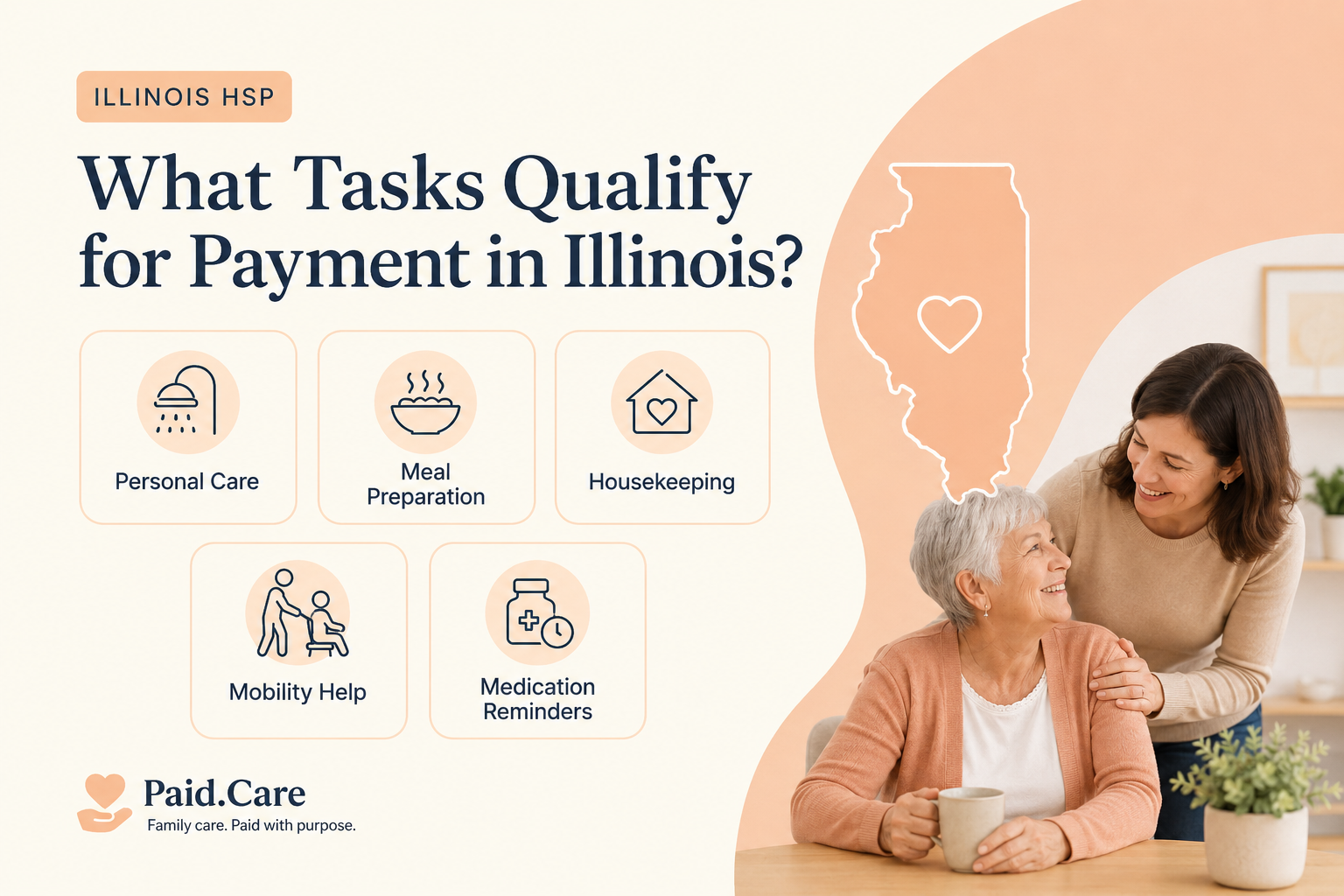
Under Illinois Medicaid programs and state-approved waivers, a broad range of everyday caregiving activities are recognized as reimbursable services. If you're regularly performing any of the following for a qualifying loved one, you may be eligible for compensation:
•Bathing, dressing, and grooming
•Mobility and transfer assistance
•Meal preparation and help with eating
•Medication reminders and management
•Light housekeeping
•Health monitoring
•Respite care and supervision
These services support aging in place—keeping Illinois residents in their homes and communities rather than in nursing facilities, and compensating the family members making that possible.
Tax Considerations for Illinois Caregivers
One financial detail worth understanding upfront is how caregiver income is treated for tax purposes. In some situations—particularly when you share a home with the person you're caring for—caregiver income may be partially or fully tax-exempt. This can significantly increase the effective value of your compensation.
If you hold legal guardianship or act under power of attorney, your specific tax obligations and benefit eligibility may differ from program to program. Rules around income reporting, tax credit eligibility, and benefit interaction vary across Medicaid, VA, and insurance-based programs, and they can change based on individual circumstances.
It's worth consulting with a qualified financial or tax professional about your specific situation—and Paid Care can help you understand the landscape before you get started.
How Paid Care Helps Illinois Families Get Paid
Navigating the intersection of Medicaid waivers, VA programs, insurance policies, and agency employment can feel overwhelming—especially when you're already managing the day-to-day demands of caring for a loved one. That's where Paid Care comes in.
Paid Care works with family caregivers across Illinois to simplify the process from start to finish. We help you identify which programs you qualify for, handle eligibility verification and documentation, coordinate in-home evaluations, manage program paperwork, and set up real-time payment tracking through our secure platform. We also stay actively engaged after enrollment—monitoring compliance requirements and program updates so your pay keeps coming without interruption.
Here's a summary of what Paid Care does for Illinois caregivers:
•Confirm eligibility across Medicaid, veteran, and insurance programs
•Handle background check coordination and documentation gathering
•Guide you through caregiver training requirements
•Submit program paperwork accurately and on time
•Set up hour tracking and real-time payment monitoring
•Keep you compliant with Illinois law, Medicaid guidelines, and health insurance rules
Start Getting Paid for the Care You Already Provide
The work you do every day—managing medications, preparing meals, helping with mobility, and providing safety and comfort to someone you love—is skilled, essential care. It has real value, and Illinois has programs specifically designed to compensate you for it.
Whether you're in Chicago, Rockford, Springfield, or anywhere else across the state, there is a path to getting paid. The programs exist. The funding is available. The only thing standing between you and a paycheck is knowing where to start—and having someone to help you get there.
Connect with Paid Care today and begin earning at or above Illinois's minimum wage for the care you're already giving your family every day.
FAQs
-
Yes. Through Illinois's Home Services Program (HSP), family members can be hired as paid personal assistants to care for a qualifying loved one at home. The care recipient must be enrolled in Medicaid and need help with daily living activities. Once approved, caregivers receive regular paychecks for their hours worked.
-
Pay rates across Illinois typically range from $13 to $25 per hour depending on the program, location, and level of care provided. The statewide average is around $17 per hour. Caregivers in the Chicago metro area tend to earn toward the higher end, while those in cities like Rockford and Springfield generally fall in the middle range.
-
Yes. Federal VA programs — including VA Aid & Attendance and the Program of Comprehensive Assistance for Family Caregivers (PCAFC) — provide compensation to eligible family caregivers of veterans across Illinois. Pay can take the form of a monthly pension, structured salary, or hourly wages, and often exceeds Illinois's minimum wage. Additional benefits like health insurance and respite care may also be available.
-
Requirements vary by program, but most ask caregivers to be at least 18 years old, pass a background check, and complete some form of caregiver training — often alongside a registered nurse. Prior certifications and experience can strengthen your application and in some cases increase your pay rate, but they are generally not required to get started.
-
Possibly. Many long-term care insurance policies include provisions that reimburse family members providing direct care, though this often goes unclaimed. Coverage typically applies to hands-on daily living support such as meal prep, hygiene assistance, and medication reminders. The reimbursement amount depends on the specific policy terms and the documentation submitted. Paid Care can help you review the policy and determine what you're eligible to claim.

