
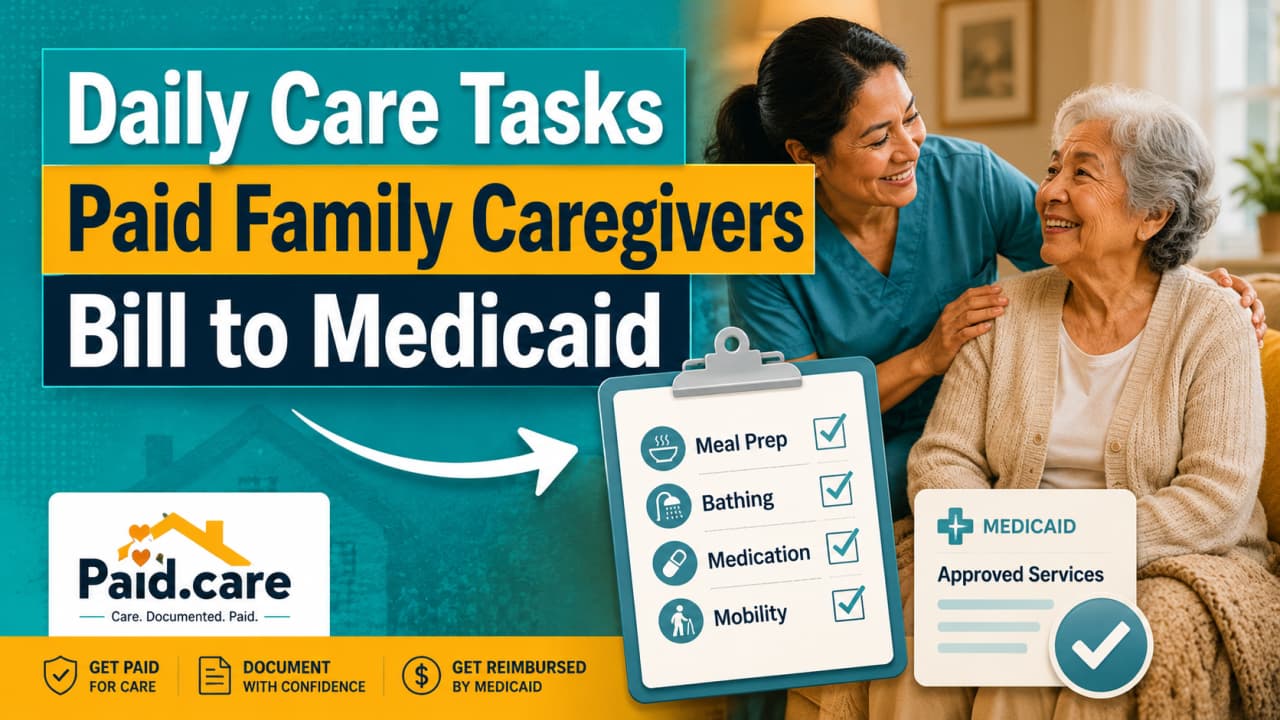
Helping your mother out of bed, into the shower, and dressed for the day is billable work. So is reheating her lunch, running her laundry, driving her to a cardiology appointment, and sitting with her because she can't be left alone. Those aren't favors a state agency thanks you for. They are the exact daily care tasks a paid family caregiver performs under Medicaid programs, and in Indiana, Michigan, and Illinois they're the tasks a care plan gets built around.
What follows is a ranked walkthrough of the tasks that carry the most weight when a Medicaid program decides whether you qualify and how many hours or what daily rate you're approved for. The order isn't random. Tasks near the top are the ones assessors count first, because they're the ones that establish medical necessity. Tasks near the bottom still get paid, but they rarely qualify anyone on their own. At the end you'll find what Medicaid will not pay for and how these tasks get documented once you're approved, which is where most new caregivers stumble.
Needs Assessments Weigh Paid Family Caregiver Daily Care Tasks for Medicaid Far Above Household Tasks
Every state program starts with the same question: can this person safely stay at home, and what hands-on help do they need to make that possible? The answer comes out of a needs assessment, and assessments weight activities of daily living (ADLs) far more heavily than instrumental activities of daily living (IADLs). ADLs are the body-contact tasks: bathing, dressing, toileting, transferring, eating. IADLs are the running-a-household tasks: cooking, cleaning, errands, appointments.
The practical consequence is worth sitting with. A care recipient who needs help with three ADLs will usually qualify for a waiver or a structured family caregiving program. A care recipient who only needs groceries picked up and bills sorted, no matter how many hours that takes you each week, often won't clear the threshold at all. Some state programs require assistance with multiple ADLs to qualify. That's the shape of the gate in most states, even where the number differs.
So the ranking below runs from highest assessment weight to lowest. Use it two ways: as a checklist of what you're already doing that counts, and as a prompt for what to bring up at the assessment that you might otherwise forget to mention.
Bathing ranks highest because falls and dignity loss happen there
Bathing sits at the top of nearly every ADL scale because it's the task where falls happen and where dignity erodes fastest. Paid work here covers the full arc: getting your loved one into and out of the tub or shower, washing hair and body, sponge baths when a full shower isn't safe, oral care, shaving, nail care, and skin checks while you're already looking at their skin anyway.
Partial assistance counts. You don't have to be doing all of it. If your father can wash his own chest but cannot reach his feet or safely stand on wet tile, that's assistance with bathing, and it belongs on the assessment exactly that way. Caregivers routinely undersell this by saying "he mostly does it himself." Describe what happens when you're not in the room instead.
Toileting and incontinence care most often moves someone from ineligible to eligible
This is the task families are most reluctant to discuss with a stranger holding a clipboard, and it's the one that most often moves someone from ineligible to eligible. Covered work includes helping to and from the bathroom, transfers on and off the toilet, cleaning and peri-care, changing briefs or pads, managing a bedside commode or urinal, and emptying and cleaning a catheter bag where state rules allow an unlicensed caregiver to do it.
Nighttime toileting matters here too. If you're up twice a night, say so plainly at the assessment. Overnight need is what supports a higher approved hour count, and it's frequently left out because the caregiver has stopped thinking of 3 a.m. as work. Programs also differ on how they treat awake-and-available time versus hourly task time, which the rules around overnight and on-call hours spell out in more detail.
Transfers carry heavy weight because they cause the most injuries
Any time you physically move a person or the equipment holding them up, that's paid care. Helping someone stand from a recliner, pivot from bed to wheelchair, walk to the kitchen with a gait belt or a hand under the elbow, climb three porch steps, or shift position in bed every two hours to protect their skin.
Transfers carry heavy weight for a simple reason: they're the task most likely to send both of you to the emergency room if done wrong. Programs that pay family caregivers usually pair this with hands-on technique training, and taking it is not a formality. Body mechanics for a two-person lift performed by one person is a skill, and it's the difference between doing this for eight more years and doing it until your back gives out.
Dressing and grooming includes adaptive equipment and prescribed skin care
Selecting weather-appropriate clothes, working compression stockings onto swollen legs, managing buttons and zippers when arthritis has taken fine motor control, putting on and taking off braces or prosthetics, brushing hair, and applying prescribed lotions and ointments. All of it is reimbursable task time.
Compression stockings deserve their own mention. They're prescribed constantly for heart failure and edema, they're truly hard to put on correctly, and they take real minutes every single morning. Caregivers rarely log them because the task feels too small to name. Log it.
Feeding is a distinct reimbursable task separate from meal preparation
Feeding covers cutting food into safe pieces, hand-over-hand guidance for someone with tremors or dementia, spoon-feeding, thickening liquids for a swallowing disorder, cueing and reminders through a meal for someone who forgets to keep eating, and monitoring for choking.
Feeding is distinct from meal preparation, and the split matters on a timesheet. Cooking is an IADL. Sitting beside someone for forty minutes making sure each bite goes down safely is an ADL. When both happen at lunch, they're two entries, not one.
Unlicensed caregivers can remind and hand over medications but not administer them
Here the rules get sharp, and getting the line wrong causes billing problems. Unlicensed family caregivers can generally set up pill organizers, give reminders, hand over the correct bottle at the correct time, open containers, read labels aloud, refill prescriptions, and watch for and report side effects. What's often restricted is anything that counts as administering a medication: injections, IV lines, adjusting a dose, or in some states placing a pill in a person's mouth.
State lines differ enough that this is worth a direct question to your case manager or program coordinator before you start recording it. Ask specifically: what medication tasks am I permitted to perform and bill under this program? Get the answer written into the care plan. A vague care plan is what turns a routine audit into a repayment demand.
Supervision for dementia counts as paid work even when hands stay still
For dementia, traumatic brain injury, or intellectual and developmental disability, the paid work isn't only what your hands do. It's continuous supervision to prevent wandering, redirection during agitation, orientation cues throughout the day, safety monitoring around stoves and stairs and doors, and structured routines that keep the day from coming apart.
This is where structured family caregiving models earn their place. Instead of clocking discrete tasks, a structured program typically pays a daily rate to a caregiver who lives with the care recipient and provides ongoing presence and support. That fits a dementia household far better than an hourly sheet ever will, because the supervision is the service. Indiana families can see how the model works through the state's structured family caregiving program , which pays a daily stipend rather than an hourly wage.
Health monitoring prevents hospital admissions but caregivers rarely bill for it
Taking and recording blood pressure, checking blood glucose, weighing daily for fluid retention, watching a wound for signs of infection, tracking bowel and bladder patterns, noting appetite and sleep changes, and calling the doctor when a number moves the wrong way.
Monitoring is the task that most often prevents a hospital admission, and it's also the one caregivers most often perform without ever writing anything down. Consistent logs do two jobs at once: they give the physician usable information, and they build the paper record that supports keeping or increasing your approved hours at the next reassessment. Some caregivers use paper notebooks and some use their phones; a rundown of apps for tracking hours and vitals covers what's worth the setup time.
Meal prep requires diet specificity to strengthen a Medicaid application
Planning meals around a renal, diabetic, low-sodium, or pureed diet. Grocery shopping. Cooking. Portioning and storing. Cleaning up. Making sure fluids get consumed by someone who has stopped feeling thirst.
Meal prep is a reliably covered IADL, but it usually can't carry an application alone. Where it does add real value is in the specificity of the diet. "Cooks meals" is a weak line on an assessment. "Prepares three pureed, low-sodium meals daily per a speech pathologist's swallowing recommendations and tracks fluid intake" is a description of skilled work, and it reads that way to the person deciding your hours.
Housekeeping must tie directly to the care recipient's health and safety
Covered housekeeping is tied to the care recipient's health and safety, not to the household in general. Changing soiled bed linens, laundering clothing including incontinence-related loads, washing dishes, cleaning the bathroom and kitchen to control infection risk, taking out trash, and clearing fall hazards from walkways.
What's not covered is the rest of the house. Scrubbing a garage, mowing a lawn, painting a bedroom, or doing laundry for other adults living there falls outside the care plan in nearly every state program. If you're doing it anyway, fine, but don't put it on the sheet.
Transportation payment varies by state between time, mileage, and appointment only
Driving to medical appointments, dialysis, physical therapy, the pharmacy, and the grocery store. Helping in and out of the vehicle. Wheelchair loading. Sitting in the exam room, taking notes, asking the questions your loved one won't think to ask, and carrying the instructions home.
Programs treat travel time inconsistently. Some pay for time spent accompanying the person, some pay mileage, some pay neither and expect you to use the plan's non-emergency medical transportation benefit instead. Confirm which applies before you log a two-hour round trip to a specialist. And be aware that Medicaid transportation benefits sometimes sit in an entirely separate part of the plan from your caregiver pay.
Companionship alone carries the weakest reimbursement case
Conversation, reading aloud, games and puzzles, help with phone or video calls to family, going along on a walk, keeping someone connected to the world outside their living room. Isolation makes every other condition worse, and any experienced case manager knows it.
Straight companionship is the weakest category for reimbursement purposes. It's frequently bundled into a supervision or personal care authorization rather than billed on its own, and a plan built purely on companionship rarely gets approved. It still belongs in the conversation, because for someone with dementia the line between companionship and safety supervision barely exists.
Skilled nursing tasks require a license and most family caregivers cannot perform them
The gaps here cause more denied claims than anything on the list above, and almost no ranking article names them clearly.
- Skilled nursing tasks requiring a license. Wound packing, injections, IV therapy, tube feeding setup, tracheostomy care, and catheter insertion generally require an RN or LPN. Some states allow delegation to a trained unlicensed caregiver under nurse supervision; many do not. Never assume.
- Care for anyone other than the enrolled recipient. Only tasks for the person on the care plan are billable. A spouse in the same house does not come along with the authorization.
- General home maintenance and yard work. Repairs, landscaping, snow removal, and deep cleaning of unused areas fall outside light housekeeping.
- Financial and legal management. Paying bills, managing accounts, and handling paperwork are real labor, but they're outside personal care authorizations. If you also hold power of attorney, the rules on serving as both POA and paid caregiver are worth reading before you start.
- Hours you weren't approved for. If the plan authorizes 25 hours a week and you work 45, the extra 20 are unpaid. Requesting more hours means requesting a reassessment, not billing more without saying so.
- Spousal care in certain programs. Some HCBS waivers and self-directed programs exclude spouses as paid caregivers, or cap what a spouse can be paid. Adult children, grandchildren, siblings, nieces and nephews, and sometimes friends and neighbors are more widely permitted. Check your specific program.
Electronic Visit Verification now requires clocking in and out in most states
Approval is the halfway point. Getting paid every week depends on documentation, and this is the part that catches families off guard.
The 21st Century Cures Act mandated Electronic Visit Verification for Medicaid personal care and home health services nationally. In practice EVV means clocking in and out through a phone app, a landline call, or a small device in the home, and capturing the service performed. Two habits keep this clean: clock in when you start rather than reconstructing at the end of the week, and select the task codes that match what you did, not the same code every visit. Mismatched documentation is a leading cause of held payments, and reconstructed timesheets are what auditors look for first.
The care plan is the contract. If a task isn't in the plan, it usually isn't payable, no matter how necessary it is. When needs change, get the plan updated before you change what you're doing.
Keep your own parallel record too. A short daily note on ADLs performed, refusals, incidents, new symptoms, and calls to providers takes two minutes and does real work at reassessment time, when you'll need to explain why the need has grown. Solid care plan documentation practices make the difference between an increase that's granted and one that's questioned. If hours ever get cut, that same record is the backbone of an appeal of reduced care hours .
Indiana, Michigan, and Illinois differ in payment structure and caregiver eligibility
The ADL and IADL categories are broadly consistent nationally. What changes state to state is the payment structure, the qualifying threshold, and who's allowed to be the paid caregiver.
| State | Primary program route | Typical payment structure | Where the task rules tighten |
|---|---|---|---|
| Indiana | Structured Family Caregiving and Attendant Care under HCBS waivers and Pathways for Aging | Daily stipend for structured caregiving; hourly for attendant care | Structured caregiving generally requires living with the recipient; ADL count drives eligibility |
| Michigan | Home Help Program, plus MI Choice waiver | Hourly, with authorized hours tied to a functional assessment of specific ADLs and IADLs | Hours are assessed task by task, so an underreported ADL directly reduces your paycheck |
| Illinois | Community Care Program and IDHS Home Services Program | Hourly through an agency or a self-directed arrangement | Program depends on age and disability status; spousal eligibility varies by route |
Michigan's approach is the one most sensitive to how you describe your day, because approved hours are built from itemized task time. If you tell the assessor you "help with bathing" and leave out the transfers, the toileting at night, and the compression stockings, the authorization comes back smaller than the work you're doing. The Home Help Program walkthrough covers how that assessment is structured. Illinois families working through the Community Care Program will find the age and disability routes explained in the state's Community Care and Home Services overview .
Program names, rates, and eligibility rules change on state schedules, so treat any figure you find online as a starting point and confirm current numbers with your state Medicaid office or program coordinator.
Hour-by-hour task logs reveal eight to ten daily qualifying tasks most caregivers miss
Write down everything you did for your loved one over the past three days, hour by hour, before you talk to anyone. Then sort each item into the categories above. Most caregivers discover they're performing eight or ten qualifying tasks daily and had mentally filed the whole thing as "just helping out." That list is what a needs assessment is trying to capture, and bringing it with you is the single best preparation you can do.
From there, the path runs through confirming your loved one's Medicaid eligibility, requesting an assessment, and getting a care plan written that names the paid family caregiver daily care tasks Medicaid covers under the program in your state. If you're in Indiana, Michigan, or Illinois, Paid.care's qualification process handles the program matching, the training, and the weekly payroll side so you can spend your energy on the care instead of the paperwork. Start with the task list. The rest is process.
Frequently asked questions
Which daily care tasks qualify for payment under Medicaid family caregiver programs?
Hands-on personal care carries the most weight: bathing, dressing, toileting and incontinence care, transfers and mobility, feeding, and medication reminders. Household support tasks like meal preparation, laundry, light housekeeping, and transportation to medical appointments are also covered, though they rarely qualify someone on their own. Supervision for dementia or cognitive impairment counts as paid care in structured family caregiving and many waiver programs.
Can a spouse be paid as a family caregiver under Medicaid?
Sometimes, and it depends entirely on the program. Certain HCBS waivers and self-directed options allow spouses; others exclude them or cap spousal payment. Adult children, siblings, grandchildren, and in some states friends and neighbors face fewer restrictions. Ask your case manager about spousal eligibility specifically before building a plan around it.
How many ADLs does my loved one need help with to qualify?
Most programs use a threshold of two or three ADLs, and the exact count Indiana requires can vary depending on the specific program or waiver, so it's worth confirming the current threshold with your case manager or the relevant program page. The count comes from a functional assessment, not from your own estimate, so the accuracy of what you report at that visit matters more than almost anything else in the process.
Do I need to log every task I perform for my family member?
You need to document what you bill, which under Electronic Visit Verification means clocking in and out and recording the service performed. Keeping a separate short daily note on ADLs, refusals, incidents, and symptom changes isn't required by most programs, but it's what supports an increase in hours at reassessment and what protects you in an audit.
What happens if I perform tasks Medicaid does not cover?
You won't be paid for them, and billing them anyway creates real exposure. Skilled nursing tasks, home repairs, care for other household members, and hours beyond your authorization all fall outside the plan. If the work has grown beyond what's approved, request a reassessment and get the care plan amended rather than expanding what you log.