
Indiana Caregiver Eligibility Requirements for Structured Family Caregiving in 2026
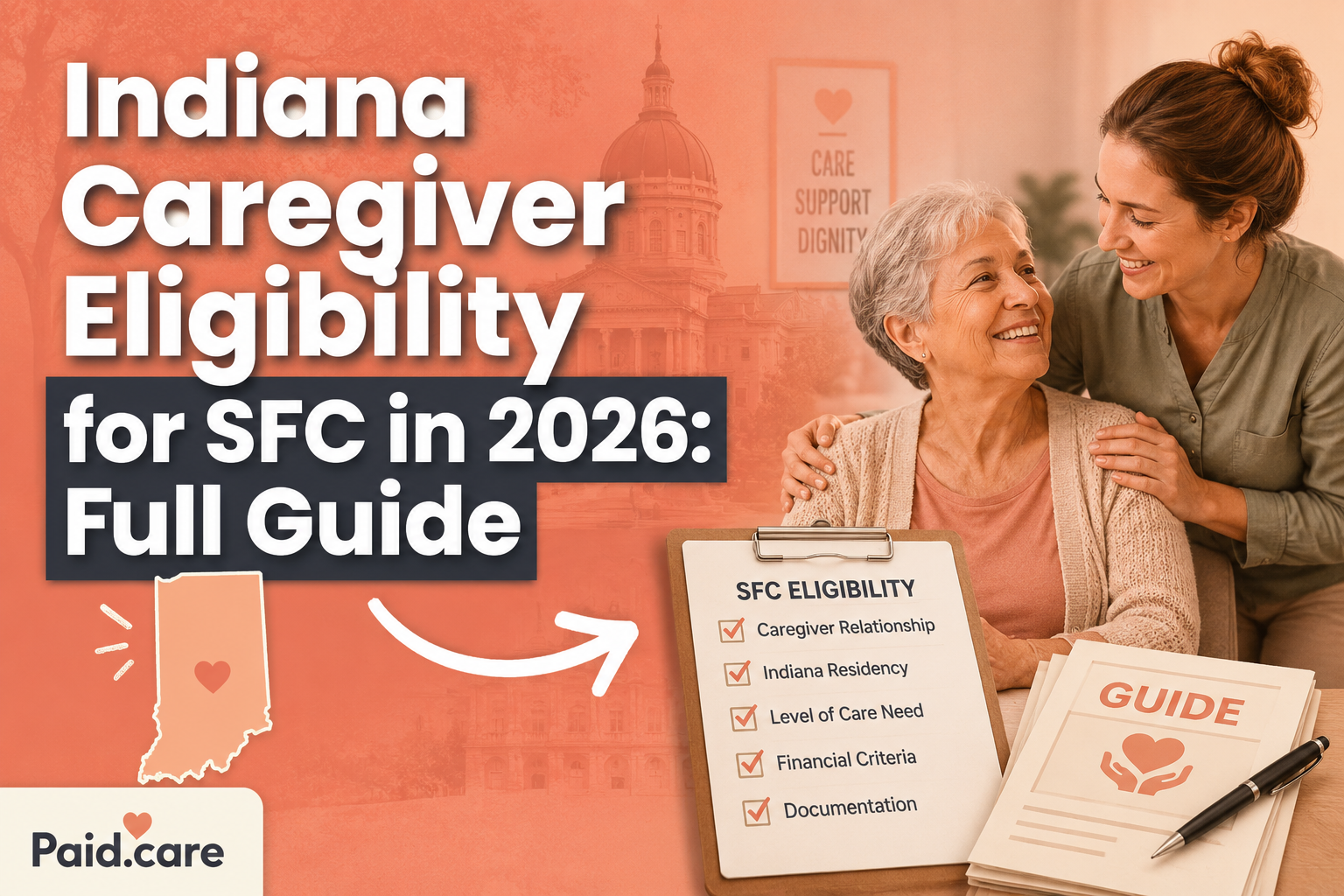
Indiana caregiver eligibility structured family caregiving 2026 rests on two simultaneous approvals: the care recipient must qualify for an Indiana Medicaid home and community-based services waiver, and the caregiver must live full time in the same home, be 18 or older, pass a criminal background check, and be legally authorized to work in the United States. The daily stipend paid through the program is excluded from federal income tax under IRS Notice 2014-7 because the caregiver and care recipient share a residence, which gives it a direct financial advantage over hourly wage programs. Spouses and certain legally responsible relatives are generally barred from serving as the paid SFC caregiver and are directed toward other Indiana waiver services instead. The care recipient must demonstrate a nursing-home level of need through a state functional assessment, and their countable assets must fall under Indiana Medicaid limits, currently set at $2,000 for a single applicant. Most denials come down to fixable documentation gaps rather than hard disqualifications, and many reverse once the missing piece is supplied or the assessment is repeated.
To get paid through Structured Family Caregiving in Indiana, you have to meet eligibility on two fronts at once: your loved one has to qualify for the right Medicaid waiver, and you have to qualify as their live-in caregiver. Indiana caregiver eligibility for Structured Family Caregiving in 2026 hinges on that second piece, and it's where most families either move quickly or stall out for months. The good news is the requirements are clear once someone lays them out plainly.
This walks you through who qualifies, what documents you'll need, and the order to do things in so you're not stuck waiting on a step you could have finished weeks earlier. Structured Family Caregiving (often shortened to SFC) pays a daily stipend to a caregiver who lives with the person they care for, runs through Indiana's Medicaid waivers, and is administered by a contracted agency. The pay is tax-free under IRS Notice 2014-7 when the caregiver and care recipient share a home. Let's get into the actual eligibility.
Step 1: Confirm the care recipient qualifies for an Indiana Medicaid waiver
Before any caregiver question matters, the person receiving care has to be on the right track. SFC is funded through Indiana's home and community-based services waivers, so your loved one needs to be eligible for one of them. The main path in 2026 runs through the Pathways for Aging program for people 60 and older, and the Health and Wellness or Aged and Disabled-track waivers for younger adults with qualifying disabilities.
Two things have to be true. First, financial eligibility: the care recipient's income and countable assets have to fall under Indiana Medicaid limits. For a single applicant, the asset limit sits at $2,000 in countable resources, and income limits track the federal benefit rate for waiver eligibility. The exact thresholds shift each year, so check the current figures in the Indiana Medicaid income and eligibility breakdown before you assume anyone is over the line. A house you live in and one vehicle usually don't count against you.
Second, functional eligibility: the care recipient has to need a nursing-home level of care, meaning they require hands-on help with daily activities like bathing, dressing, transferring, toileting, or medication management. A state assessor confirms this through a needs assessment. If your loved one can do everything independently, they won't qualify, and SFC won't be an option no matter how strong your caregiver paperwork is.
The care recipient's eligibility is the foundation. If they don't qualify for the waiver, there is no caregiver payment to apply for.
Step 2: Get on the waiver and clear the waiting list
Indiana's waivers have historically carried waiting lists, and the shift to Pathways for Aging changed how slots are managed. Apply through the Indiana Family and Social Services Administration. You can start the process by contacting your local FSSA office or the aging division, which routes applications and handles the intake. Where waiting lists still apply, you'll want to get the application in early because your spot is tied to your application date, not the day you finally complete every form.
While the waiver application moves, the Medicaid financial application runs in parallel. These are two separate approvals: clinical eligibility (the level-of-care assessment) and financial eligibility (the income and asset review). Both have to land before SFC pay can begin. Families who treat them as one step often lose time discovering one approval came through and the other is still pending.
If a wait list is holding things up, it's worth reviewing the current status of Indiana's waiver waiting lists so you know whether to expect days or months. Plan around the slower of the two timelines.
Step 3: Check that you meet the caregiver eligibility requirements
Here's where the Indiana caregiver eligibility rules for Structured Family Caregiving get specific. To be the paid caregiver, you have to clear several bars at once:
- You live with the care recipient. This is the rule that defines SFC. The caregiver and care recipient share a residence full time. If you don't already live together, one of you has to move in before pay starts. A caregiver who lives across town and visits daily does not fit SFC, though they may fit Indiana's Attendant Care program instead.
- You are 18 or older. The paid caregiver must be a legal adult.
- You can legally work in the U.S. You'll provide documentation during onboarding.
- You pass a background check. Indiana requires a criminal history screening. Certain offenses can disqualify a caregiver, though the rules are nuanced; if you have a record, get a clear answer before you build your plans around the income. The walkthrough on whether a past conviction blocks caregiver pay covers how this is handled.
- You are physically and mentally able to provide the care. SFC caregivers handle real daily tasks, so you have to be capable of doing them.
One question that comes up constantly: can a spouse be the paid caregiver? Under SFC, the answer is generally no for spouses and certain legally responsible relatives, because Medicaid treats spousal care differently. Adult children, siblings, other relatives, and even close friends who live with the care recipient usually qualify. If you're a spouse, look at Indiana's other waiver services rather than SFC, and confirm before assuming.
Step 4: Choose your program lane, SFC or Attendant Care
Indiana pays family caregivers through two main routes, and which one fits depends on the living arrangement. Picking the right lane up front saves you from filling out the wrong paperwork.
| Factor | Structured Family Caregiving | Attendant Care |
|---|---|---|
| Living arrangement | Caregiver must live with care recipient | Caregiver does not have to live in the home |
| Payment type | Daily tax-free stipend | Hourly wage for documented hours |
| Spouse can be paid | Generally no | Often allowed |
| Best fit | Full-time live-in care | Care given on a scheduled hourly basis |
If you live with your loved one and provide round-the-clock support, SFC's daily stipend is usually the stronger choice because the pay isn't capped by an hourly clock and the income is tax-free when you share a home. If you don't live together, or you're a spouse, the Attendant Care program is the lane to look at. You can compare both side by side in the full guide to getting paid as an Indiana family caregiver.
Step 5: Gather your documents before onboarding
Pulling paperwork together ahead of time is the single biggest thing you can do to speed up approval. Onboarding moves fast once an agency has everything; it crawls when you're hunting for a document. Have these ready:
- Government-issued photo ID for the caregiver
- Social Security card or proof of work authorization
- Proof you and the care recipient share an address (a lease, utility bill, or mortgage statement listing both names, or matching addresses on separate documents)
- The care recipient's Medicaid approval and waiver enrollment confirmation
- The care recipient's level-of-care assessment results
- Banking information for direct deposit of your stipend
If you're unsure what proof of shared residency counts, err on the side of more. Two or three documents that all point to the same address are more convincing than one that's a little ambiguous.
Step 6: Pick an SFC agency and complete onboarding
You can't get SFC pay directly from the state. The program runs through contracted agencies, and you choose one to be your employer of record. The agency handles the care plan, payroll, training, and the monthly documentation Medicaid requires. Pay rates and support vary between agencies, so this choice matters more than families expect.
Onboarding generally includes a short caregiver orientation or training, a home visit or care plan review, and setup of your payment method. Once your loved one's waiver and Medicaid are both approved and your caregiver paperwork clears, the agency activates your case and pay begins. From there, you'll log daily notes or check-ins on the care you provide, which is how Medicaid verifies the service is happening.
If you'd rather have someone handle the heavy lifting, the step-by-step qualification and onboarding process exists to move families from unsure to paid without the guesswork. Paid.care works specifically with Indiana families through Structured Family Caregiving and Attendant Care, and the team can tell you in one conversation whether you qualify.
Step 7: Understand how your stipend is paid and taxed
SFC pays a daily stipend, and the amount scales with the care recipient's level of need; higher need generally means a higher daily rate. Because you live with the person you care for, the payment qualifies as a difficulty-of-care payment excluded from federal income tax under IRS Notice 2014-7. That exclusion is one of the biggest financial advantages SFC has over hourly programs, and it's worth understanding fully before you file. The distinction between a tax-free stipend and a taxable wage changes what lands in your pocket.
Two things to plan around. If you receive SSI, SSDI, or your own Medicaid, caregiver income can interact with those benefits, sometimes harmlessly and sometimes not; map it out before your first check rather than after. And the tax-free status, while a benefit at filing time, means SFC stipends don't build Social Security credits the way a taxable wage would. Neither is a reason to skip the program, but both are reasons to plan once the money starts arriving.
Common reasons Indiana caregivers get denied
Most denials trace back to one of a handful of fixable issues rather than a hard no. The care recipient doesn't meet the level-of-care standard, so the functional assessment comes back too low. Assets sit just over the Medicaid limit, often because of a vehicle or account no one realized was countable. The caregiver and care recipient can't prove they share a residence. Or a spouse applies for SFC without realizing spousal care usually routes through a different service.
If you're denied, you have appeal rights, and many denials reverse once the missing piece is supplied or the assessment is redone. Don't treat a first no as final, especially if it came down to documentation.
Frequently asked questions
Who qualifies for Indiana caregiver eligibility under Structured Family Caregiving in 2026?
An adult who lives full time with a Medicaid waiver-eligible care recipient, passes a background check, and can legally work and physically provide care. The care recipient must qualify for an Indiana HCBS waiver financially and need a nursing-home level of care. Spouses and certain legally responsible relatives generally cannot be the paid SFC caregiver, though they may qualify under other Indiana programs.
Can I get paid through SFC if I don't live with my loved one?
No. Living together full time is the defining requirement of Structured Family Caregiving. If you provide care but live elsewhere, Indiana's Attendant Care program pays an hourly wage instead and doesn't require shared residency, which makes it the right lane for many families.
How long does it take to get approved?
It depends on the slower of two approvals: the care recipient's Medicaid and waiver eligibility, and your caregiver onboarding. Waiver waiting lists, the level-of-care assessment, and document gathering all affect the timeline. Submitting applications early and having your paperwork ready before onboarding is the fastest route, since your application date often sets your place in line.
Is the SFC stipend taxable in Indiana?
The stipend is excluded from federal income tax under IRS Notice 2014-7 because the caregiver lives with the care recipient. This is a real advantage of SFC over hourly wage programs. Talk to a tax preparer about how it interacts with any other income, and keep in mind it won't build Social Security credits the way taxable wages do.
What's the difference between SFC and the Attendant Care program?
Structured Family Caregiving pays a daily tax-free stipend and requires the caregiver to live with the care recipient. Attendant Care pays an hourly wage for documented hours and doesn't require shared residency, and it more often allows spouses to be paid. Live-in, full-time caregivers usually do better with SFC; scheduled hourly care fits Attendant Care.
Indiana caregiver eligibility for Structured Family Caregiving in 2026 comes down to confirming the waiver, proving you live together, clearing a background check, and choosing the right agency. The fastest way to find out where you stand is to have someone review your specific situation against the current rules, so reach out through the Indiana Structured Family Caregiving program and get a straight answer on whether you qualify before you start filling out forms.

