
The Complete 2025 Guide: How Much Do Family Members Get Paid for Caregiving in Indiana?

If you live in Indiana and spend your days caring for an aging parent, a spouse, or a child with disabilities, you are doing one of the most important jobs in the world. It is a role defined by love, patience, and sacrifice. But as any family caregiver knows, love doesn’t pay the mortgage. It doesn’t buy groceries, put gas in the car, or cover the rising cost of utilities.
For thousands of Hoosiers, caregiving is a full-time job without the paycheck. You might have reduced your hours at work, turned down promotions, or left the workforce entirely to ensure your loved one is safe and cared for at home. The financial strain can be just as heavy as the emotional toll.
But here is the good news: In Indiana, you can get paid to provide care for your family members.
Many families are shocked to discover that the state of Indiana, through specific Medicaid programs, offers robust financial support to keep loved ones at home rather than in nursing facilities. This isn't a scam, and it isn't "too good to be true." It is a state-sponsored initiative designed to reward you for the work you are already doing.
As we move through 2025, understanding the financial specifics is vital. The rules have shifted slightly, pay rates have adjusted, and knowing which program fits your specific family dynamic is the key to maximizing your income. This guide will walk you through everything you need to know about getting paid to care in Indiana, from the specific dollar amounts to the eligibility requirements.
The Two Paths to Payment: Understanding Your Options
In Indiana, there isn't just one single "caregiver payment." Instead, there are two primary Medicaid programs that allow family members to earn money. The amount you get paid depends entirely on which of these two paths you take.
Your relationship to the person you are caring for and your living situation will dictate which path is right for you.
Path 1: Structured Family Caregiving (SFC)
This is the most common path for live-in caregivers. It is designed for those who provide constant, round-the-clock support and live under the same roof as the care recipient.
Best for: Spouses, parents of minor children (under specific conditions), and live-in adult children.
Payment Model: A tax-free daily stipend.
Path 2: Attendant Care (via Medicaid Waiver)
This path operates more like a traditional job. You are hired as an hourly employee to perform specific tasks.
Best for: Adult children, siblings, or relatives who might not live in the same home, or who only need to provide care for a few hours a day.
Payment Model: An hourly wage.
Let’s break down the finances of each program in detail so you can see exactly what your earning potential looks like.
Deep Dive: Structured Family Caregiving (SFC) Pay Rates
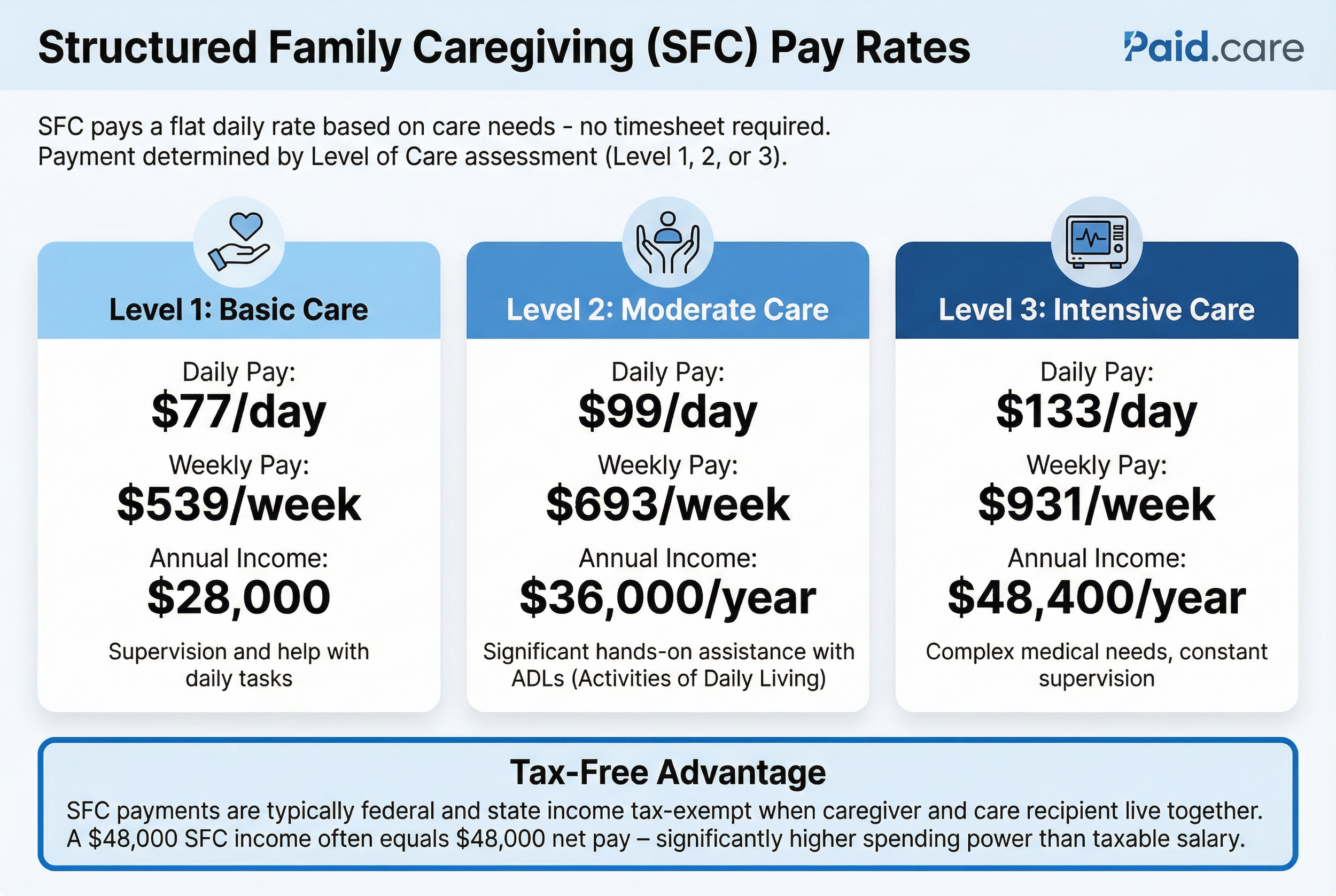
Structured Family Caregiving (SFC) is often the best financial option for families where the need for care is high and continuous. Because the state recognizes that you are "on call" 24/7 when you live with your loved one, they do not ask you to log hours on a timesheet. Instead, they pay you a flat daily rate.
The amount of that daily rate is determined by a "Level of Care" assessment. A nurse or case manager will evaluate your loved one's health needs to see how much assistance they require. Based on that assessment, they are assigned to Level 1, Level 2, or Level 3.
Level 1: Basic Care
This level is generally for individuals who need supervision and some help with daily tasks but aren't totally dependent.
Daily Pay: Approximately $77 per day.
Weekly Pay: This adds up to roughly $539 per week.
Annual Income: Over a full year, a Level 1 caregiver can expect to earn around $28,000.
Level 2: Moderate Care
This level is for individuals who need significant hands-on assistance with multiple activities of daily living, such as bathing, dressing, and mobility.
Daily Pay: Approximately $99 per day.
Weekly Pay: This increases your weekly draw to about $693.
Annual Income: A Level 2 caregiver earns approximately $36,000 per year.
Level 3: Intensive Care
This is the highest tier, reserved for individuals with complex medical needs or behavioral health challenges that require constant, intensive supervision and aid.
Daily Pay: Approximately $133 per day.
Weekly Pay: This provides a substantial weekly income of around $931.
Annual Income: Level 3 caregivers can earn roughly $48,400 per year.
The "Tax-Free" Advantage
When looking at these numbers, it is crucial to understand the tax implications. Under IRS Notice 2014-7, Medicaid waiver payments for care provided in the caregiver's home to a care recipient living in that same home are typically federal and state income tax-exempt.
This is a massive financial advantage. In a traditional job, a $48,000 salary might result in only $38,000 of take-home pay after taxes. In the SFC program, if you qualify for the exemption, that $48,000 is often your net pay. This makes the spending power of an SFC stipend significantly higher than a comparable taxable salary.
Deep Dive: Attendant Care Pay Rates
The second option is Attendant Care. This program is fundamentally different because it is based on an employer-employee relationship. You are technically hired by a home health agency (like Paid.Care) to go into the home and perform specific duties.
Because this is an hourly role, your total pay depends on two factors: the hourly wage the agency pays you, and the number of hours Medicaid authorizes for your loved one.
The Hourly Rate
The state of Indiana pays agencies a set amount, and the agency then pays the caregiver. Rates can vary wildly between different agencies.
Average Agency Rate: Many agencies in Indiana pay their family caregivers between $13.00 and $15.00 per hour.
The Paid.Care Rate: At Paid.Care, we believe in maximizing the money that goes to the family. We pay our Attendant Caregivers $16.00 per hour.
Calculating Your Potential Earnings
Medicaid will authorize a specific number of hours per week for your loved one based on their medical necessity. Let’s look at a common scenario to understand the earning potential.
If your loved one is approved for 20 hours of care per week:
At $16.00 per hour, you would earn $320 per week.
Over the course of a year, this totals $16,640 gross pay.
If your loved one has higher needs and is approved for 30 hours per week:
At $16.00 per hour, you would earn $480 per week.
This results in an annual income of $24,960.
Important Notes on Attendant Care
Unlike the SFC stipend, Attendant Care wages are typically taxable income (unless you live with the recipient and meet specific IRS criteria, but this is less common for Attendant Care setups). Additionally, recent rule changes in Indiana generally prevent spouses and parents of minor children from using this hourly model; those family members are usually directed toward the SFC program described above.
However, Paid.Care offers a unique benefit for Attendant Caregivers: a $1,000 sign-on bonus. We break this bonus up over your first year of employment to provide little boosts of financial support just when you need them.
Eligibility: Who Can Actually Get Paid?
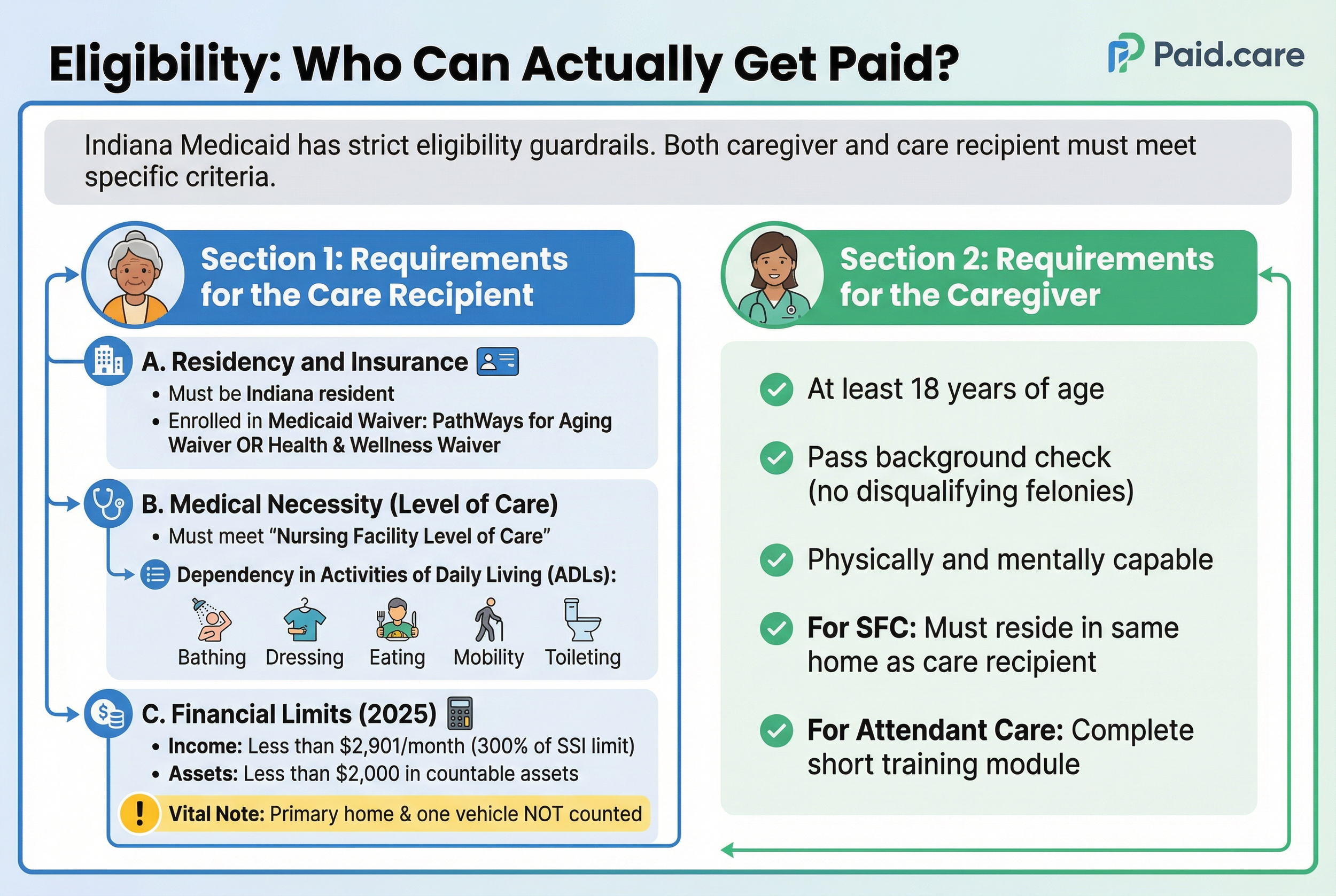
Knowing the pay rates is exciting, but the next logical question is: "Do I qualify?" Indiana Medicaid has strict eligibility guardrails to ensure these funds go to families who truly need them. To start earning, both you (the caregiver) and the person you care for (the recipient) must meet specific criteria.
1. Requirements for the Care Recipient
Your loved one is the center of this process. To have their care funded by the state, they must meet the following three pillars of eligibility:
A. Residency and Insurance They must be a resident of Indiana and eligible for Medicaid. Specifically, they need to be enrolled in (or eligible for) one of Indiana's Medicaid Waivers, such as the PathWays for Aging Waiver (formerly the Aged and Disabled Waiver) or the Health & Wellness Waiver (formerly the TBI waiver).
B. Medical Necessity (Level of Care) They must meet what the state calls "Nursing Facility Level of Care." This sounds intimidating, but it doesn't mean they need to be in a hospital bed. It simply means that without help, they would be unable to manage their daily lives safely. The state looks for dependency in Activities of Daily Living (ADLs), including:
Bathing: Do they need help getting in and out of the shower or washing themselves?
Dressing: Can they put on clothes, button shirts, or tie shoes without help?
Eating: Do they need help cutting food or feeding themselves?
Mobility: Do they need support walking, or transferring from a bed to a chair?
Toileting: Do they need assistance with personal hygiene or incontinence care?
C. Financial Limits Because this is a Medicaid program, there are income caps. Generally, for 2025, the care recipient must have an income lower than $2,901 per month (which is 300% of the SSI limit). They must also have less than $2,000 in countable assets.
Vital Note: The state does not count their primary home or one vehicle toward this $2,000 limit. If their income is slightly higher than the limit, don't panic. We can often help families set up a "Miller Trust" (Qualified Income Trust) to legally help them qualify.
2. Requirements for the Caregiver
The requirements for you, the family member, are much simpler. To be hired as a paid caregiver, you generally must:
Be at least 18 years of age.
Pass a standard background check (no disqualifying felonies).
Be physically and mentally capable of providing the necessary care.
For SFC, you must reside in the same home as the care recipient.
For Attendant Care, you must complete a short training module, which Paid.Care provides.
Can I Work Another Job? (Employment Flexibility)
One of the biggest concerns family members have is whether becoming a paid caregiver locks them out of the rest of the workforce. The answer is generally no—you have options, but they differ by program.
If you are in the Structured Family Caregiving (SFC) program, you are receiving a daily stipend. The state expects you to provide the necessary care, but because you aren't "clocking in" hours, you are permitted to hold another job (part-time or even full-time) as long as it does not interfere with the care your loved one needs. For example, if your loved one mostly needs help in the mornings and evenings, you might be able to work a remote job or a shift during the day while they are resting or engaged in other activities.
If you are in the Attendant Care program, you are an hourly employee. You cannot be paid for caregiving during the exact same hours you are working another job. However, you can certainly work another job around your caregiving schedule. For instance, you could provide paid care for your mother from 8:00 AM to 12:00 PM, and then go to a retail job from 1:00 PM to 5:00 PM.
Will This Affect My Loved One’s Benefits?
This is a critical question for financial safety. Many seniors and individuals with disabilities rely on Social Security (SSI or SSDI) to survive.
The good news is that the money earned through these programs is paid to you, the caregiver. It is your income, not theirs. Therefore, the payments generally do not count as income for the care recipient and should not threaten their Social Security checks.
However, the care recipient’s Medicaid eligibility is always subject to review based on their own assets and income. As long as their financial situation remains within the Medicaid limits mentioned earlier (under $2,000 in assets), their health coverage remains safe.
The "Hidden Value" of Getting Paid
We have talked a lot about numbers—$77 a day, $16 an hour—but the value of these programs goes beyond the bank account.
When you are an unpaid caregiver, you are often paying for things out of pocket. You are buying extra gas for doctor visits, purchasing special dietary foods, picking up over-the-counter medical supplies, and paying for home modifications like grab bars or ramps.
When you start receiving a stipend or a paycheck through Paid.Care, that money acts as a reimbursement for these "hidden costs." It stabilizes your household budget. It allows you to breathe a little easier when the utility bill arrives.
Furthermore, working with an agency like Paid.Care gives you access to support that money can't buy. We provide Care Coaching, giving you a professional sounding board to discuss the stress and emotional complexity of caring for a family member. We help you navigate the burnout that so often plagues unpaid caregivers, ensuring you can keep going for the long haul.
A Look Ahead: Training and Certification in 2025
The landscape of caregiving in Indiana is evolving, and Paid.Care is moving right along with it. We know that many family caregivers want to feel more confident in their medical skills. They want to know the right way to lift someone without hurting their back, or the best way to manage medication schedules.
That is why, starting in 2025, Paid.Care is launching Family HHA (Home Health Aide) and CNA (Certified Nursing Assistant) training programs.
These programs will allow family caregivers to receive professional-grade training and certification at no cost. Not only does this education make you a safer, more effective caregiver for your loved one, but it also opens doors for your future career. Plus, certified caregivers may be eligible for higher reimbursement rates in the future as state policies evolve.
How to Get Started
The process of getting approved for paid caregiving in Indiana typically takes between 30 to 60 days. It involves assessments by the state, paperwork for Medicaid, and enrollment with an approved agency.
It can feel like a maze of bureaucracy, but you do not have to navigate it alone. Paid.Care was built specifically to handle the heavy lifting for Indiana families. We communicate with the Area Agencies on Aging (AAA) on your behalf. We handle the billing. We ensure the paperwork is filed correctly the first time.
If you are already doing the work—waking up early to help your mom dress, cooking meals for your spouse, or ensuring your child is safe—you deserve to be recognized and compensated for that labor.
Your Next Step:
Don’t leave this financial support on the table for another month. Find out exactly which program you qualify for and how much your family could be earning right now.
Let us help you get Paid to Care.
FAQs
-
The Basics: To get paid, your family member must be enrolled in an Indiana Medicaid Waiver program (either "PathWays for Aging" if they are 60+, or the "Health & Wellness Waiver" if they are younger).
The Requirement: Once they are approved for the waiver, you must sign up with a state-approved provider agency. You cannot be paid directly by the state; the state pays the agency, and the agency pays you.
-
If you live together (Structured Family Caregiving): You receive a daily tax-free stipend. As of 2025, agencies must pay you a minimum of roughly $46 to $80 per day, depending on the level of care your loved one requires (Level 1, 2, or 3).
If you don't live together (Attendant Care): You are paid an hourly wage. Most agencies pay between $15 and $18 per hour. However, overtime is usually capped at 40 hours per week.
-
The Rule: Yes, but generally only under the Structured Family Caregiving (SFC) program.
The Detail: Indiana rules now require most spouses and parents of minor children to use the SFC model (daily stipend) rather than the hourly model. This is beneficial because the SFC stipend is typically tax-free for live-in relatives.
-
For Live-In Caregivers (SFC): Usually, no. If you live in the same home as the care recipient, these payments typically qualify as "difficulty of care" payments, which are exempt from federal and state income taxes.
For Hourly Caregivers (Attendant Care): Yes. If you work hourly and do not live with the recipient, this is treated as regular job income, and you will receive a W-2 at the end of the year.
-
Step 1: Your loved one must apply for Medicaid and the Waiver through your local Area Agency on Aging.
Step 2: A case manager will assess their health to see if they qualify for Level 1, 2, or 3 care.
Step 3: Choose a caregiver agency (like Paid.Care or a local home health company) that offers "Structured Family Caregiving" and complete their orientation.

