
Live-In Caregiver Rules: Understanding Overtime, Sleep Time, and Room-and-Board Credits for Paid Family Caregivers
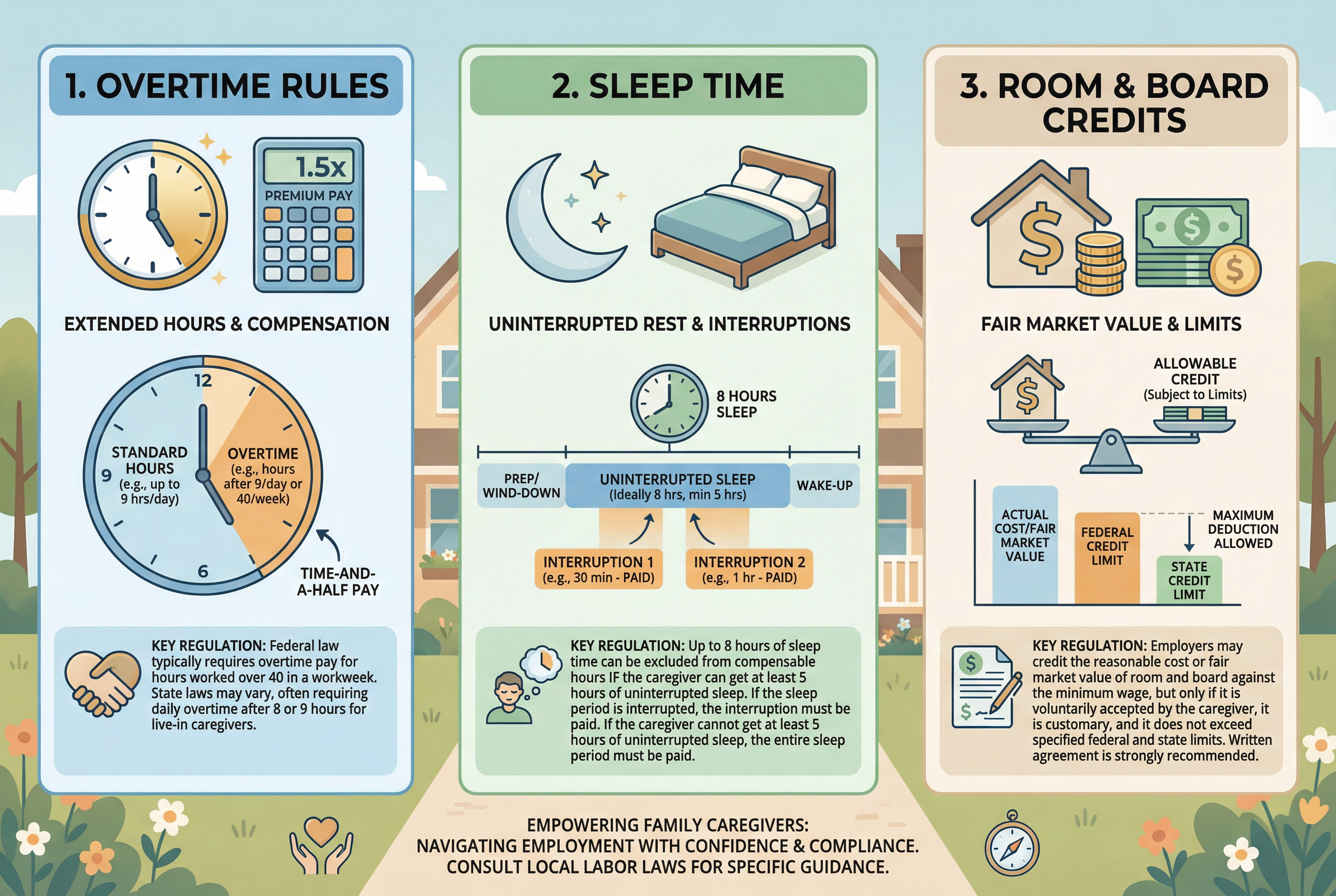
Live-in caregivers provide around-the-clock support that can include personal care, medication reminders, meal assistance, and companionship, and these duties intersect with wage-and-hour rules that determine overtime, sleep time pay, and allowable room-and-board credits. This article explains how federal regulations under the Fair Labor Standards Act (FLSA) treat live-in domestic service employees, why sleep time and room-and-board can change gross and net pay, and how Medicaid HCBS waivers and veteran-directed programs can enable family members to be paid legally. Readers will learn the definitions, the practical criteria for exemptions, step-by-step calculation examples, and the document templates and recordkeeping practices that protect both caregivers and families. The guide covers federal rules, practical state-level differences for Indiana, Michigan, and Illinois, and procedural steps for applying to public programs that can pay family caregivers. Throughout the article you’ll find short checklists, comparison tables, and clear examples to help families and household employers make compliant decisions about overtime, sleep time, and housing credits.
What Are the Federal FLSA Overtime Rules for Live-In Caregivers?
Under the FLSA, overtime pay is generally required at one and one-half times an employee’s regular rate for hours worked over 40 in a workweek, but certain domestic-service and companionship exemptions can change that outcome for some live-in caregivers. The live-in domestic service employee concept and the companionship services exemption are narrow and depend on specific facts — residence in the employer’s home, the nature of duties, and whether the worker is paid a wage or receives noncash lodging. Understanding the exemptions requires documenting the arrangement clearly, because misclassification can lead to back wages and penalties. The following subsections define the legal categories and illustrate when overtime typically must be paid to live-in caregivers.
The FLSA’s overtime mandate creates clear responsibilities for household employers: track hours, establish whether the caregiver is a covered employee, and apply the correct rate when overtime applies. The next subsection defines the exemptions and the criteria that determine whether a live-in caregiver is eligible for overtime protections.
How Does the FLSA Define Live-In Domestic Workers and Overtime Exemptions?
A live-in domestic service employee is generally someone who resides in the household where they work and performs duties such as cooking, cleaning, personal care, or companionship for the household members. The FLSA distinguishes between employees who are bona fide live-in domestic workers and those who perform companionship services; each category has specific criteria that shape overtime treatment. Key factors include whether the worker truly resides in the employer’s home, whether the employer provides lodging as part of the employment arrangement, and whether the worker’s primary duties fit the companionship or household services descriptions. Accurate classification requires written documentation of duties and living arrangements and consistent recordkeeping of hours worked.
While some live-in arrangements may meet exemption criteria, many family caregivers will still be covered employees entitled to overtime when hours exceed 40 in a week. Proper documentation and transparent wage statements help clarify status and avoid disputes, and these recordkeeping practices lead naturally into the next subsection showing practical eligibility examples and calculation illustrations.
When Are Live-In Caregivers Eligible or Exempt from Overtime Pay?
Eligibility for overtime depends on factual circumstances: a live-in caregiver who performs substantial household labor for a private household and does not fall within the narrowly drawn companionship or live-in exemptions is generally entitled to overtime pay. By contrast, a worker whose duties are primarily companionship services and who meets the statutory conditions for that exemption might not be eligible for overtime under the FLSA. Family-member caregivers can complicate the analysis because some state programs or family arrangements affect employer-employee status; each case requires evaluating whether the relationship creates an employer who controls hours and wages. When overtime is owed, calculate pay as one and one-half times the regular hourly rate for hours over 40 in the workweek and maintain clear payroll records showing hours, rates, and any noncash lodging credits.
How Do Caregiver Sleep Time Regulations Affect Pay and Work Hours?
Sleep time rules address when an overnight period can be treated as nonworking time and therefore not counted as payable hours; the FLSA allows deductions for bona fide sleep periods when certain conditions are met, and interrupted sleep or required wakefulness converts sleep time into compensable work time. Employers and families must understand the mechanism: a bona fide sleep period generally requires an agreement, adequate sleeping facilities, and the opportunity for a specified uninterrupted rest period, and any interruption for duties means those interrupted minutes are payable. Proper scheduling and written agreements reduce disputes, and consistent timekeeping that logs interruptions ensures accurate wage calculations. The next subsection lists the typical conditions necessary to deduct sleep time under federal guidance.
Before showing state differences, consider the specific FLSA conditions below that commonly determine whether sleep time is unpaid or must be paid in full.
The FLSA sleep time guidance centers on whether the employee can sleep for an uninterrupted stretch and whether the employer provides adequate facilities and agreement terms.
Mutual Agreement: The employer and employee agree in writing to count a qualifying sleeping period as nonworking time.
Adequate Facilities: The employer provides private, safe, and appropriate sleeping accommodations on the premises.
Uninterrupted Sleep Threshold: The employee is permitted an uninterrupted sleep period (commonly considered several hours) and is not required to remain awake or on call except for occasional interruptions.
These conditions protect both parties by clarifying expectations; if sleep is frequently interrupted, those interruptions must be recorded and paid as working time, which leads to the practical examples in the next subsection.
What Are the Conditions for Deducting Sleep Time Under FLSA?
A bona fide sleep period can be excluded from hours worked only when the employer and employee mutually agree in advance, suitable sleeping facilities are provided, and the employee can generally have an uninterrupted sleep period. If the worker is frequently called to perform duties, the time spent awake and providing services is compensable, and employers must keep time records showing interruptions. Drafting a concise written agreement that specifies the sleep period, expected on-call responsibilities, and compensation for interruptions helps families comply with wage laws and reduces the risk of contested claims. Good recordkeeping practices include logging start and end times for sleep periods and noting any interruption, which also supports payroll accuracy and potential program audits.
When sleep time is unpaid under these conditions, employers should still report paid hours accurately for tax and program compliance, and the next subsection compares how some states treat sleep time differently from the federal baseline.
How Do State Laws Differ on Sleep Time Compensation for Live-In Caregivers?
States can adopt rules that are stricter than the federal baseline, creating varying results for whether sleep time can be unpaid and how interruptions are counted, so caregivers and families should consult their state labor department for official guidance. Indiana, Michigan, and Illinois generally follow federal FLSA principles for live-in domestic service, but enforcement practices, wage thresholds, and administrative interpretations can differ and affect practical outcomes. Families in states with consumer-directed Medicaid programs should confirm both labor rules and program rules because program payment structures can influence total compensation and scheduling. Understanding state details helps families align caregiver schedules, living arrangements, and payroll practices with both labor law and public-program requirements.
What Are California’s Stricter Sleep Time Rules Compared to Federal Law?
California’s domestic worker protections and wage orders often provide broader coverage and stricter interpretations of on-call and sleep time compared with federal minimalist standards, treating more overnight periods as compensable work or requiring clearer documentation before deducting sleep time. California guidance tends to emphasize the worker’s ability to rest without interruption and places greater burdens on employers to justify any unpaid sleep periods, and enforcement mechanisms can result in wage orders being applied more broadly. California readers should consult state resources and legal counsel for exact requirements because the state’s wage orders and domestic worker rules create materially different obligations for household employers. These stricter rules serve as a reminder that following federal guidance alone may not be sufficient in some jurisdictions.

What Are Room and Board Credits and How Do They Impact Caregiver Compensation?
Room-and-board credits allow an employer to credit a reasonable retail value for lodging and meals provided to an employee against minimum wage obligations in limited circumstances under FLSA Section 3(m), but credits are tightly constrained and rely on voluntary agreement and accurate valuation. The credit can reduce the cash wages required to reach minimum wage, but it cannot be used to justify paying below applicable minimums or to avoid overtime obligations when they apply. Families must use a fair-value calculation, document a voluntary written agreement that details the nature and estimated value of lodging and meals, and ensure all deductions comply with state wage laws and IRS rules regarding noncash compensation. The following subsection lists the typical components of a valid room-and-board arrangement and shows a brief calculation example.
Understanding the required elements of a lawful room-and-board credit helps households avoid unauthorized deductions and tax issues, and the next list explains necessary agreement elements.
Voluntary Written Agreement: The caregiver must freely agree in writing to receive lodging and meals as part of compensation.
Primary Benefit to Employee: Lodging must be provided for the employer’s convenience and primarily for the employee’s use as part of employment.
Reasonable Valuation and Compliance: The fair market or reasonable retail value must be used and the deduction cannot reduce wages below minimum wage after credit.
Using these elements in a signed agreement and keeping records of the valuation, payments, and the employee’s acceptance helps support compliance in payroll records and potential agency reviews.
Under What Conditions Can Employers Deduct Room and Board from Caregiver Pay?
Employers may apply room-and-board credits only when the caregiver voluntarily agrees in writing, when the lodging is primarily for the employee’s use in the context of employment, and when the value assigned is reasonable and documented for wage calculations. A simple example calculation: if an applicable minimum wage is $10/hour and a caregiver works 40 hours, the weekly minimum cash wage obligation is $400; if monthly lodging and meals are valued at an equivalent of $100 per week by a reasonable method and the caregiver agreed in writing, that $100 can be credited toward the cash wage requirement, leaving $300 payable in cash. Families must ensure that credits never reduce wages below the applicable minimum and should include the agreed credit on pay statements to maintain transparency. Proper documentation supports both wage-law compliance and any eligibility audits for public benefit programs that reimburse caregiver wages.
What Are the Legal and Tax Implications of Room and Board Deductions?
Noncash benefits like lodging and meals have tax implications: they can be taxable or nontaxable depending on IRS rules, whether the lodging is on the employer’s premises for the employer’s convenience, and whether inclusion is required under tax law. Employers should classify the value of room and board accurately on payroll records and consult tax guidance for reporting household employment taxes, with attention to whether the caregiver is paid as a W-2 employee under a consumer-directed program or classified differently. Additionally, state wage laws may restrict deductions regardless of federal allowances, so families should confirm that applying a credit complies with both state and federal requirements. Clear recordkeeping—signed agreements, valuation methodology, and itemized payroll statements—reduces legal and tax risk and helps when reconciling payments from public programs.
Paid.care provides guidance and practical tools to help families calculate fair room-and-board credits and remain tax- and wage-compliant; their platform includes a pay calculator and recordkeeping support to document lodging valuations and hours worked. Paid.care’s mobile application also supports hour tracking and communication between families and caregivers, which can simplify documenting sleep-time interruptions and lodging credits for payroll reconciliation. For families considering paid caregiver arrangements, using such tools can reduce errors and ensure consistent weekly payments while maintaining compliance.
Which State-Specific Overtime and Wage Laws Apply to Live-In Caregivers in Indiana, Michigan, and Illinois?
State law nuances influence how the federal baseline applies in practice: Indiana, Michigan, and Illinois generally follow FLSA principles but differ in enforcement focus, administrative guidance for domestic workers, and the interaction between state labor departments and Medicaid program rules. These differences affect overtime thresholds, permissible room-and-board deductions, and expectations for sleep-time documentation; therefore, caregivers and household employers should reference state labor department resources and the administrative guidance for consumer-directed Medicaid programs. Paid.care currently serves families in Indiana, Michigan, and Illinois, offering eligibility checks and coaching to align state-specific program rules with compliant pay practices.
How Do Indiana’s Caregiver Overtime Rules Compare to Federal Standards?
Indiana generally applies the federal FLSA framework for live-in domestic service employees and overtime calculations, meaning overtime is due after 40 hours unless a narrowly defined exemption applies. Administrative guidance and employer practice in Indiana emphasize careful timekeeping and written agreements for sleep time and lodging because state audits rely on documentary evidence to resolve disputes. Families should maintain contemporaneous records of hours worked, sleep interruptions, and any room-and-board agreements to align with both federal and state expectations. When in doubt, leaning toward paying overtime where the factual picture is ambiguous reduces enforcement risk and supports caregiver financial stability.
Clear recordkeeping assists families in reconciling payroll with state program reimbursements and aligns with consumer-directed program requirements, which the next subsection further addresses for Michigan and Illinois.
What Are Michigan and Illinois Regulations on Live-In Caregiver Pay and Hours?
Michigan and Illinois largely conform to FLSA standards for overtime and sleep time treatment but may differ in administrative detail, such as the level of documentation required for room-and-board credits and how interruptions during sleep are interpreted in practice. Both states emphasize accurate payroll records and transparent communication between household employers and caregivers; they may scrutinize whether lodging valuations were reasonable and whether a written voluntary agreement existed. For families using state Medicaid consumer-directed programs, program rules can impose additional documentation and payroll procedures that affect how wages are calculated and reimbursed. Practical tips include maintaining signed agreements, itemized wage statements, and detailed time logs to demonstrate compliance to state agencies and program administrators.

How Can Family Caregivers Qualify for Paid Caregiving Programs Through Medicaid and Veteran Benefits?
Medicaid HCBS waivers and consumer-directed programs, along with VA veteran-directed care, create pathways for family members to be paid for in-home caregiving by authorizing wages under specific program rules, care plans, and eligibility criteria. Typical steps include confirming care recipient eligibility for an HCBS waiver or the VA program, documenting the assessed need for paid caregiving, identifying whether consumer-directed models allow hiring family members, and completing required paperwork such as enrollment forms, provider applications, and background checks where required. Timelines vary by state and program but generally involve assessment, enrollment, and payroll setup, and families should prepare documentation such as medical assessments, functional assessments, and proof of relationship when required. The checklist below outlines common eligibility elements and preparatory documents that streamline applications for paid family caregiving.
The checklist below helps families gather the core items commonly required to apply for Medicaid HCBS waivers and veteran-directed programs.
Care recipient eligibility confirmation: Proof that the care recipient meets Medicaid or VA medical and financial criteria.
Assessment of needs: A functional or clinical assessment showing the level of assistance required for daily living activities.
Program enrollment forms: Completed consumer-directed or program-specific enrollment paperwork and caregiver provider applications.
Documentation and background checks: Identification, tax forms, any required criminal background or training records as required by the program.
Following this checklist prepares families for the assessment and enrollment steps and reduces delays during program intake.
After explaining program mechanics, Paid.care can serve as an actionable next step: Paid.care helps family caregivers receive payment for providing in-home care by streamlining the pathway through eligibility checks, personalized care coaching, caregiver training, and consistent weekly payments. Paid.care offers an eligibility check to determine whether a family’s situation fits state Medicaid HCBS waivers, consumer-directed programs, or veteran-directed care, then supports families with coaching through enrollment and payroll setup. Their mobile application assists with hour tracking and communication, which simplifies timekeeping and documentation required for program compliance; Paid.care also offers free coaching, round-the-clock support, competitive pay rates, caregiver training, and a $1,000 sign-on bonus for qualified W2 caregivers in markets where Paid.care operates. For families in Indiana, Michigan, and Illinois, Paid.care’s coordinated services aim to reduce administrative friction and help caregivers begin receiving lawful weekly payments.
What Are the Eligibility Criteria for Medicaid Paid Family Caregiving Programs?
Common Medicaid paid family caregiving programs require that the care recipient be eligible for Medicaid waiver services, that the assessment documents a need for personal care or supports, and that the state program’s consumer-directed model expressly permits hiring family members. Typically, states require an assessment from a case manager or clinician, enrollment in a consumer-directed option if available, and completion of provider paperwork for the family member who will be paid. Some programs impose restrictions on which family members may be hired or require alternative caregivers for backup, so families should verify program rules during the eligibility check. Clear documentation of the care plan, number of authorized hours, and agreed hourly rate helps establish compliant payroll and reimbursement flows.
How Do Veteran-Directed Care Programs Support Paid Family Caregivers?
VA veteran-directed care programs permit veterans to receive flexible supports and sometimes use VA-authorized funds to pay family caregivers when veterans qualify for the program and the local VA or participating agency authorizes such arrangements. These programs typically include an assessment of needs, allocation of a flexible budget, and a consumer-directed structure that allows veterans or their representatives to hire and pay family members as caregivers under specific program rules. Payment flows and payroll setup vary by VA program and local implementation, and families should document assessments, care plans, and payroll arrangements carefully to satisfy both VA program requirements and employer-tax obligations. Using an organized payroll process and clear service agreements supports sustainable payments and program compliance.
What Are Common Questions About Live-In Caregiver Pay, Overtime, and Benefits?
Families commonly ask whether sleep time must be paid, when overtime applies, and whether room-and-board can legally reduce wages; clear, concise answers grounded in FLSA and state practices help households make compliant decisions. This section provides short, actionable answers to the most frequent questions and offers practical next steps for families uncertain about classification, pay calculations, or program eligibility. Answers below are phrased for quick reference and are designed to guide the reader to documentation and recordkeeping actions that reduce legal and program risk. After this set of FAQs, a brief next-step paragraph outlines how families can check eligibility for paid caregiver programs and access coaching.
Do Live-In Caregivers Get Paid for Sleep Time?
Yes — sometimes. Under federal guidance, live-in caregivers can have bona fide sleep periods treated as nonworking time if there is a written agreement, adequate sleeping facilities, and the employee is ordinarily permitted an uninterrupted sleep period; however, any interruptions to perform work convert that time into compensable working hours. If a caregiver is required to remain awake or to perform frequent duties, the sleep period cannot be deducted as nonworking time and must be recorded and paid. For practical compliance, families should include explicit sleep-period terms in written agreements and maintain time logs documenting interruptions to avoid underpayment claims. State rules may be more protective, so state guidance should also be consulted to determine whether additional compensation is required beyond federal minimums.
Can Employers Deduct Room and Board from Caregiver Wages?
Yes — but only under strict conditions set by FLSA Section 3(m) and applicable state laws; deductions for lodging and meals are permissible when the caregiver voluntarily agrees in writing, the lodging is provided for the convenience of the employer and primarily for the employee’s use, and the valuation used to compute the credit is reasonable and documented. Employers must ensure that after applying any room-and-board credit, the caregiver’s cash wages meet or exceed applicable minimum wage requirements, and any deductions must comply with state wage-law limits. Accurate payroll records that show the value assigned to lodging and the signed voluntary agreement reduce disputes and support tax reporting. When in doubt, err toward transparency: itemize any non-cash credits on wage statements and keep signed documentation in personnel records.
Paid.care can help families who still have questions about classification, sleep time documentation, or room-and-board valuation by offering an eligibility check and free coaching to explain next steps and help set up compliant payroll and time tracking. Paid.care’s support includes personalized guidance, training for caregivers, and tools to track hours and communicate schedules, which can simplify the recordkeeping required to comply with wage and program rules.
Paid.care invites families who want to explore paid caregiver options to start with an eligibility check and coaching session; their services focus on helping family caregivers navigate Medicaid HCBS waivers, consumer-directed models, and veteran-directed care, and they support pay setup, weekly payments, and caregiver training. Paid.care offers free coaching and round-the-clock support to answer implementation questions, a mobile app for hour tracking and communication to keep records accurate, competitive pay rates to support caregiver retention, and a $1,000 sign-on bonus for qualified W2 caregivers in participating markets. Families in Indiana, Michigan, and Illinois can use Paid.care’s eligibility check and coaching to understand whether their household qualifies, what documentation is required, and how to set up compliant payments that respect overtime, sleep time, and room-and-board requirements.
FAQs
-
A live-in caregiver is someone who resides in the client’s home as their primary or frequent place of lodging while providing care. This can include family members who move in (or stay most nights) to provide support. Being a “live-in” matters because federal and state labor laws may treat live-in domestic workers differently from hourly, non-live-in aides—especially around overtime, sleep time, and what hours are payable. However, the label isn’t enough: how often the caregiver sleeps there, how schedules are set, and whether they really have off-duty time all factor into how the rules apply.
-
It depends on the law and how the job is structured:
Under federal law, true live-in domestic workers must be paid at least minimum wage for all hours worked, but some can be treated differently for overtime than non-live-in workers.
Many states have stricter rules and do require overtime for live-in caregivers after a certain number of hours per day or week.
If the caregiver is paid through a Medicaid self-directed program, agency, or VA benefit, those programs often have their own timekeeping and overtime rules that must be followed.
Because overtime rules are highly state-specific, families should assume that long weeks may trigger overtime and confirm details with a state labor agency or employment attorney instead of guessing.
-
Sleep time is one of the most confusing parts of live-in care. In general:
If a caregiver is on a 24-hour or longer shift, up to 8 hours of scheduled sleep time can sometimes be excluded from paid hours if:
The caregiver has adequate sleeping facilities
There is a real opportunity for uninterrupted sleep
There is a written agreement about excluding sleep time
If the caregiver’s sleep is frequently interrupted (for example, to help to the bathroom, manage behavior, or handle medical issues), the interrupted time must usually be counted and paid, and if interruptions are too frequent, the whole sleep period may become payable.
If the caregiver is on duty for less than 24 hours, many rules treat the entire period as working time, even if the caregiver is allowed to sleep.
Because the rules are technical and can differ by state, it’s important to document overnight duties, interruptions, and any sleep-time agreement in writing.
-
Room-and-board credits (sometimes called “in-kind” or “lodging and meals” credits) are when the value of housing and food provided to a caregiver is counted as part of their compensation for minimum-wage purposes. In many places, you can only use a lodging or meals credit if:
The caregiver voluntarily accepts the room and/or meals
The lodging is primarily for the caregiver’s benefit (safe, reasonable, not just a corner of the living room)
The value credited is reasonable and records are kept
The arrangement complies with federal and state wage laws, which may cap or limit credits
For family caregivers paid through Medicaid or other public programs, room and board credits may not work the same way and can conflict with benefit rules. Never assume room and board can simply replace wages—check with the program and a knowledgeable tax or legal professional.
-
To reduce legal and financial risk:
Put everything in writing: duties, hourly rate, schedule, overnight expectations, sleep time, and any room-and-board arrangement.
Track actual hours worked, including overnight interruptions, instead of guessing or using flat “live-in” stipends.
Make sure pay meets federal and state minimum wage and overtime rules, not just what “seems fair.”
If you are a household employer, get an EIN, issue pay stubs, and handle taxes correctly (W-2, Schedule H, etc.).
If care is funded by Medicaid, VA, or a fiscal intermediary, follow their documentation and EVV rules exactly.
When in doubt, consult a local employment attorney, elder law attorney, or tax professional who understands home-care and domestic worker laws.
A clear, well-documented live-in arrangement protects both the caregiver and the family, reduces the chance of back-pay claims, and helps preserve eligibility for Medicaid and other benefits.

