
Household Employer Setup for Family Care: How to Get an EIN, Complete Forms, and Manage Payroll

Household employer setup is the practical process that lets families pay a caregiver legally while meeting tax and payroll obligations, protecting both the caregiver and the household from misclassification and tax penalties. This guide explains why establishing household employer status matters, when an Employer Identification Number (EIN) is required, which federal and state forms you must collect and file, and how payroll taxes like FICA and FUTA apply to family caregivers. You will also learn how Medicaid waiver and consumer-directed programs can enable family caregiver pay, what legal compliance steps to follow, and practical checklists to keep records organized. The article maps a stepwise workflow from obtaining an EIN, to completing W-4s, issuing W-2s and Schedule H, understanding payroll tax responsibilities, verifying Medicaid program rules, and maintaining compliant employment agreements. Throughout, target terms such as EIN, caregiver payroll, household employer, W-4 for family caregivers, and Schedule H household employment are used to help you find the exact steps you need to act on today.
Paid.care can act as a practical partner during this setup process by validating eligibility for state programs that pay family caregivers and by simplifying technical steps like EIN applications and payroll setup. If you want hands-on support, Paid.care offers eligibility checks for Medicaid waiver and consumer-directed programs, coaching on documentation, and operational help that reduces the administrative burden so you can focus on care.
How Do You Obtain an EIN for Your Family Caregiving Household Employer?
An Employer Identification Number (EIN) is a tax ID issued by the IRS that identifies a household as an employer for payroll and reporting purposes, enabling you to file W-2s and Schedule H without using a household member’s Social Security number. Securing an EIN separates personal SSNs from payroll reporting, simplifies tax deposits, and is necessary when your household meets employer thresholds requiring Social Security and Medicare withholding. Knowing when your caregiving arrangement reaches the threshold for household employer status is the first step, and obtaining an EIN streamlines subsequent payroll tasks and state registrations. The following subsections explain what an EIN is and provide step-by-step application instructions to get your household employer correctly registered.
What Is an EIN and Why Is It Required for Household Employers?
An EIN is a unique nine-digit number the IRS issues to identify business and employer entities for tax reporting, and for households it functions the same way when you employ someone, including a family caregiver. The IRS requires an EIN when you must withhold and pay employment taxes on behalf of a caregiver, because it allows you to file federal forms like Form W-2 and Schedule H without exposing the caregiver’s Social Security number in employer records. Practically, getting an EIN protects both the caregiver and the employer by clarifying tax responsibilities and keeping personal and payroll reporting separate. Understanding this makes the application process straightforward and prepares you to register for any required state employer accounts that follow receipt of the EIN.
What Are the Step-by-Step Instructions to Apply for an EIN?
Follow these numbered steps to apply for an EIN and prepare for household employer responsibilities:
Gather basic information: Have the primary taxpayer’s name, Social Security number, mailing address, and the caregiver’s name and SSN available.
Select employer type: Identify yourself as a "Household Employer" when asked for the reason for applying.
Choose application method: Apply by phone (where available), by mail with Form SS-4, or via the IRS online application if eligible; expect immediate issuance online or several weeks by mail.
Record and use the EIN: Keep the EIN with your payroll records and use it for filing W-2s, Schedule H, and any state employer registrations that follow.
After you receive the EIN, the next steps include obtaining applicable state tax IDs and setting up payroll processes and timesheet records to support accurate tax filings.
What Are the Essential Tax Forms for Household Employers Paying Family Caregivers?
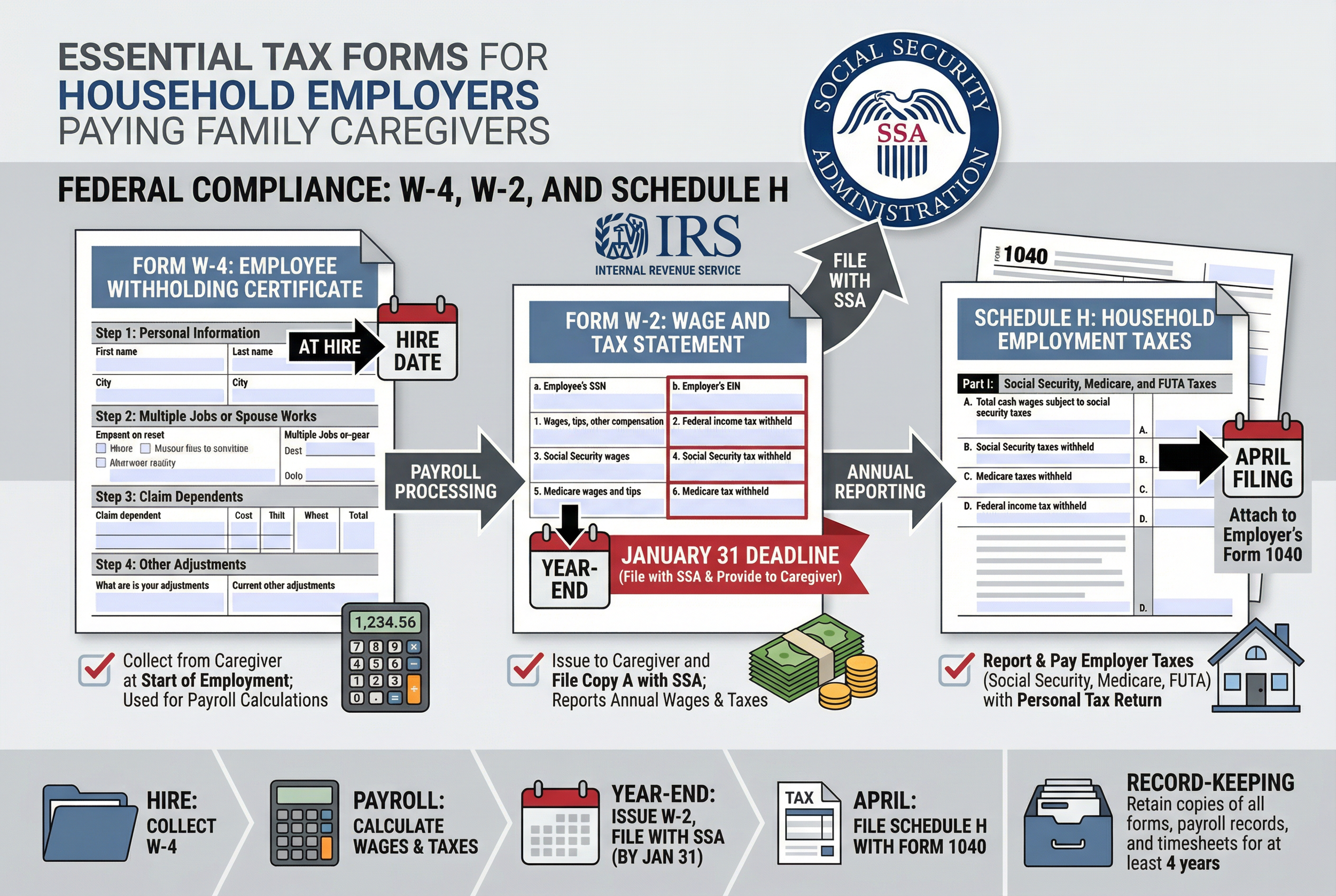
Household employers must collect, prepare, and file a specific set of tax forms that document withholding, wages paid, and employer tax liabilities; the core federal documents are Form W-4 for withholding, Form W-2 for wage reporting, and Schedule H attached to Form 1040 for household employment taxes. Collecting an accurate W-4 from the caregiver establishes federal income tax withholding and affects payroll calculations, while issuing W-2s and filing Schedule H reconcile the year’s wages with Social Security, Medicare, and any FUTA obligations. Other forms can include state withholding registrations and, in some cases, I-9 verification where federal or state rules require it; the table below compares the main forms, when to use them, and a caregiving example to clarify timing and filing requirements. After the table, you’ll find practical guidance on completing W-4s and filing W-2s and Schedule H.
How Do You Complete and Use Form W-4 for Family Caregivers?
Form W-4 tells the employer how much federal income tax to withhold from a caregiver’s pay and should be completed by the caregiver at hire and updated whenever withholding status changes. Caregivers commonly complete the personal information and marital filing status sections and may use the multiple-job or deduction worksheets when applicable; employers should keep the W-4 on file but must not distribute its sensitive data. For many family caregiving situations, withholding may be minimal if the caregiver claims allowances or higher deductions, but employers should run sample pay calculations to confirm paycheck withholdings before issuing the first payroll. Collecting an accurate W-4 reduces year-end surprises and makes it easier to prepare W-2s and reconcile Schedule H entries.
Reviewing and updating W-4s when life events occur helps maintain accurate withholding and prevents underpayment or overpayment issues when filing annual returns.
When and How Should You File Form W-2 and Schedule H?
Form W-2 must be issued to the caregiver and filed with Social Security Administration copies following federal deadlines, while Schedule H is attached to the household employer’s Form 1040 to report Social Security, Medicare, and any withheld federal income taxes. Employers should prepare W-2s at year-end showing total wages and withheld amounts, distribute copies to the caregiver by the statutory date, and file the companion transmittal with the SSA; concurrently, Schedule H documents the household employment tax liabilities calculated from the wages. Keep payroll ledgers and timesheets to support reported numbers and use them to calculate employer shares of FICA and any FUTA owed, which you will reconcile on Schedule H. Accurate record-keeping makes W-2 and Schedule H filing straightforward and supports any state-level reconciliation that may be required.
Timely preparation and retention of W-2s and Schedule H entries are essential because they form the basis for both federal and state employer tax records and audits.
How Do Caregiver Payroll Taxes Work for Household Employers?
Caregiver payroll taxes for household employers combine federal payroll taxes—FICA (Social Security and Medicare) and FUTA—with potential state unemployment and withholding obligations; understanding who pays which share and when deposits or annual filings are required is essential. FICA is split between employee and employer shares for Social Security and Medicare, while FUTA is an employer-only tax subject to wage thresholds and credits. State unemployment insurance and withholding rules vary by state and may require separate registration and contribution processes; knowing the 2025 thresholds and running example calculations help you estimate employer liability and determine deposit schedules. The next subsections break down FICA and FUTA mechanics and offer a state-obligation overview with examples to clarify responsibilities.
What Are FICA and FUTA Taxes and How Do They Apply to Family Caregivers?
FICA taxes fund Social Security and Medicare and are withheld from employee paychecks while the employer must also remit an equal employer share, and these combined amounts are reported on Schedule H for household employers. FUTA is an employer-only tax that supports federal unemployment programs and is calculated on a limited wage base; employers often receive credits for state unemployment contributions, which reduce the effective FUTA rate. For a caregiving household, this means withholding the employee share from wages, calculating the corresponding employer share, and preparing to deposit or report those amounts using the schedules required for household employment. Understanding these mechanics allows you to prepare accurate paychecks and reconcile totals on your annual return.
Knowing how to calculate FICA and FUTA leads naturally to considering state-level obligations and where to register as an employer with the state workforce agency.
What Are State Tax Obligations and Wage Thresholds for Household Employers?
State obligations commonly include unemployment insurance contributions and, in some states, state income tax withholding and state employer tax IDs; thresholds and registration requirements vary by state and must be verified with the state agency. For households in Indiana, Michigan, and Illinois—states where consumer-directed Medicaid programs may enable paid family caregiving—you will typically need to register with the state unemployment agency if wages exceed the state threshold and may have withholding obligations if state income tax applies. Employers should consult state employer registration pages or contact state labor offices to confirm thresholds, determine deposit frequencies, and check workers’ compensation requirements where applicable. Keeping state registration documents organized ensures that federal and state reporting align and prevents late-registration penalties.
After confirming federal and state tax obligations, households should adopt payroll processes and records that support accurate withholdings and timely deposits.
How Can Medicaid Waiver Programs Support Paid Family Caregiving?
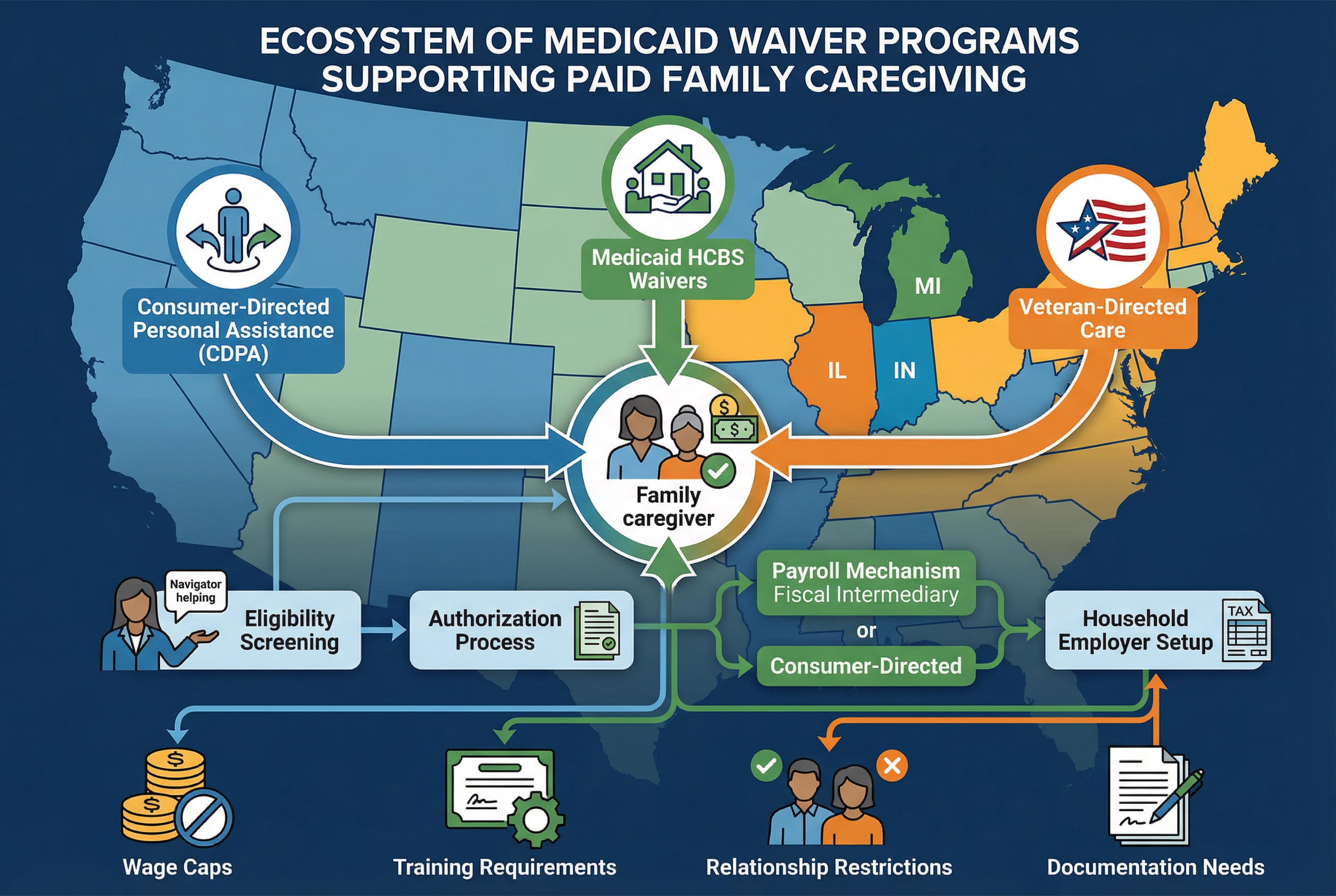
Many Medicaid waiver and consumer-directed programs allow participants to hire and pay family members as caregivers, subject to program rules, eligibility, and state variations; these programs can provide the funding source that makes formal household employment feasible. Consumer-directed personal assistance and veteran-directed care models frequently include mechanisms to authorize payments to family caregivers, but states differ on who qualifies, wage caps, and required training. Mapping the program’s authorization process into your employer setup is important because program enrollment can affect how wages are verified and when funds are disbursed to support payroll. The following table summarizes program types, typical eligibility, and notes on whether family pay is commonly allowed, with state examples to illustrate differences.
Which Medicaid Waiver and Consumer-Directed Programs Allow Family Caregiver Pay?
Common program types that permit family caregiver pay include consumer-directed personal assistance, certain Medicaid waivers for home and community-based services, and veteran-directed care programs, each with eligibility screens, authorization steps, and payroll flows. Eligibility often requires that the care recipient qualify for services under the state’s waiver, designate a participant representative or employer, and complete required paperwork to authorize family member pay. Payments under these programs can be routed through state-authorized fiscal intermediaries or consumer-directed payroll mechanisms, which affect how you report wages and manage withholding. For families in Indiana, Michigan, and Illinois, program availability for paying family caregivers exists but practical enrollment and payroll procedures must be checked with the state or a program navigator.
Confirming program-specific payment flows helps ensure that the wages you report as a household employer align with how the Medicaid program authorizes and disburses funds.
How Do State Variations Affect Medicaid Waiver Family Caregiver Payments?
State variations influence who can be paid, allowable wage rates, required training or certification for paid caregivers, and documentation that supports payroll and tax reporting, so it is important to verify program rules in your state before formalizing household employment. Some states disallow payment to spouses or legally responsible individuals, others set wage limits tied to program budgets, and many require caregiver enrollment steps such as background checks or competency training. These differences affect the timing of authorization for payroll, verification the employer must keep, and whether the consumer-directed funds can be used to cover employer-side taxes. When in doubt, contact the state Medicaid office or use an eligibility navigator to confirm program rules and how payroll should be structured to comply with both program and tax requirements.
Understanding state-specific program rules informs your payroll decisions and ensures that wage payments are both permitted by the program and reportable under tax rules.
What Legal and Compliance Steps Must Household Employers Follow to Pay Family Caregivers Legally?
Household employers must follow a compliance checklist that includes correctly classifying workers, creating employment agreements, collecting required forms, tracking hours and wages, and retaining records for tax and audit purposes, all of which reduce the risk of misclassification and penalties. Classifying a caregiver as an employee versus an independent contractor hinges on control over work, scheduling, and supervision; most family caregivers are household employees when the household dictates work terms. Employment agreements should document duties, pay rates, schedule expectations, and agreed benefits, while timesheets and payroll ledgers provide the primary evidence for wage totals used in W-2 and Schedule H filings. The bulleted checklist below outlines essential compliance elements to adopt when you plan to pay a family caregiver.
Start by implementing these minimum compliance steps before running the first payroll, and keep these records organized for tax filing.
Collect required forms: Obtain the caregiver’s Form W-4 and any state withholding forms before the first paycheck.
Establish employment agreement: Create a written agreement specifying duties, pay rate, schedule, and termination terms.
Track hours and wages: Maintain timesheets and a payroll ledger with dates, hours, and gross pay for each pay period.
Register with state agencies: If thresholds are met, register for state unemployment and withholding accounts as required.
Retain records: Keep payroll records, timesheets, W-4s, W-2s, and tax filings for the recommended retention period.
Following this compliance checklist ensures your household is prepared to report wages accurately and withstand potential inquiries or audits; the next section explains worker classification nuances in more detail.
How to Distinguish Between Household Employees and Independent Contractors?
The distinction between a household employee and an independent contractor centers on the degree of control the household exerts over the caregiver’s work schedule, duties, and supervision, with employees typically subject to regular hours and household direction. IRS guidance emphasizes factors like who sets schedules, who provides supplies, and whether services are integral to household functioning; caregivers paid to perform ongoing personal care under the family’s direction usually qualify as employees. Misclassification risks include back taxes, penalties, and liability for unpaid employment taxes, so using a decision checklist and documenting the nature of supervision and scheduling is essential. When classification is uncertain, treating the worker as an employee and following household employer rules reduces legal exposure and aligns with typical caregiving arrangements.
Clear documentation of schedules, supervision, and payment arrangements helps substantiate the chosen classification and supports accurate tax reporting.
What Are the Required Employment Agreements and Record-Keeping Practices?
Employment agreements for household caregivers should be written documents that outline job duties, pay rate and frequency, start date, confidentiality or safety expectations, and termination terms to create a clear employer-employee relationship for tax and program compliance. Records to retain include signed W-4s, timesheets, payroll registers, copies of issued W-2s, and the employer’s copies of Schedule H and any state filings; retain these for the period recommended by tax authorities. Digital tools and apps can simplify record-keeping by storing timesheets and payroll histories securely, helping you produce documentation for year-end filings and any program audits. Organized record-keeping not only supports tax compliance but also helps bridge the administrative connection between Medicaid authorization, wage payments, and the household’s payroll processes.
Good record-keeping practices reduce administrative friction and create an auditable trail that aligns care program payments with reported wages and taxes.
How Does Paid.care Simplify Household Employer Setup and Caregiver Payroll?
Paid.care provides an integrated set of supports that directly address the steps this guide outlines: eligibility checks for Medicaid waiver and consumer-directed programs, assistance with EIN and payroll setup, free care coaching, and operational tools that simplify ongoing payroll and documentation tasks. Paid.care’s approach bundles an eligibility check to determine program fit, dedicated support staff to guide paperwork and onboarding, a mobile app for managing timesheets and payments, and weekly pay options to give caregivers consistent, timely compensation. Paid.care serves families in Indiana, Michigan, and Illinois and emphasizes features like the highest pay rates where available, 24/7 support, and a $1,000 sign-on bonus for qualified W2 caregivers; these elements reduce financial and administrative friction for household employers. Below are the core benefits and the simple next steps to apply for Paid.care services if you want help moving from setup to the first paycheck.
Paid.care’s onboarding follows a clear three-step process—Qualification, Dedicated Support, Weekly Pay—that aligns directly with EIN acquisition, form collection, payroll setup, and payment distribution to get caregivers paid efficiently.
What Unique Support and Tools Does Paid.care Offer Family Caregivers?
Paid.care offers a combination of services designed to reduce administrative burden and improve caregiver pay, including free care coaching, 24/7 support, a mobile app to manage timesheets and payroll, weekly pay distribution, and operational assistance with W-2 issuance and Schedule H filing. The service emphasizes higher pay rates in program-eligible situations and provides a $1,000 sign-on bonus for qualified W2 caregivers, which can be an immediate financial incentive for eligible participants. Support staff help with eligibility checks for state Medicaid waivers and consumer-directed programs in Indiana, Michigan, and Illinois and guide families through documentation and enrollment steps. These tools and supports help caregivers focus on care rather than paperwork, while household employers receive operational help to stay compliant.
By bundling coaching, app-based records, and payroll services, Paid.care reduces the time and expertise households need to become compliant employers and to ensure caregivers receive timely compensation.
How Can You Apply for Paid.care Services to Get Paid as a Family Caregiver?
To apply for Paid.care services, begin by checking eligibility for consumer-directed or Medicaid waiver programs that support family pay, gather basic care recipient and caregiver documentation, and complete a qualification step to confirm program fit and geographic availability. After qualification, Paid.care assigns dedicated support to assist with EIN applications, W-4 collection, payroll setup, and any state registrations required, and helps onboard caregivers into the mobile app for timesheets and weekly pay distribution. Expect a structured onboarding timeline that moves from eligibility confirmation to paperwork completion and then to regular payroll cycles, with staff available for questions throughout the process. If you prefer hands-on assistance with the employer setup and payroll administration, applying with Paid.care streamlines the pathway from program authorization to the caregiver’s first paycheck.
This application pathway helps convert the procedural steps in this guide into a supported workflow so families can focus on care delivery while Paid.care manages payroll and compliance logistics.
FAQs
-
You’re a household employer when you hire and pay someone to provide services in your home—like personal care, housekeeping, or caregiving—and you control what work is done, when, and how. If you pay a family member or non-relative to care for a loved one in your home and they meet the rules for being an employee (not a contractor), you may have payroll and tax responsibilities just like any small employer. That can include getting an EIN, withholding Social Security and Medicare, and filing year-end forms.
-
A Household Employer EIN is separate from your Social Security number and is used on payroll and tax forms. To get one, you generally:
Apply online with the IRS using the EIN Assistant (fastest method)
Or submit Form SS-4 (Application for Employer Identification Number) by mail or fax
The EIN is usually issued quickly and is then used on Form W-2, Schedule H, and any payroll tax filings tied to your household employment. Don’t use your personal SSN as the employer ID if you can avoid it—an EIN helps keep records clearer and offers better privacy.
-
Exact requirements vary by state, but many household employers will need to:
Collect a Form W-4 (or state equivalent) from the caregiver to set withholding elections
Track gross pay, hours worked, and any withholdings each pay period
Issue a Form W-2 to the caregiver by the January deadline and send copies to the Social Security Administration
File Schedule H (Household Employment Taxes) with your federal income tax return if you owe Social Security, Medicare, or federal unemployment tax
Register with your state tax and unemployment agencies, if required, and file any state wage, withholding, and unemployment forms
Some families use a household payroll service to handle these details and avoid missed filings.
-
Household payroll for family care usually involves:
Setting a pay rate and schedule (hourly or salary, weekly/bi-weekly).
Calculating gross pay based on hours worked.
Determining whether you’ll withhold federal and state income tax (with the caregiver’s W-4 and any state forms).
Calculating and paying the employer share of Social Security and Medicare (and, if applicable, federal/state unemployment taxes).
Keeping accurate records of hours, pay, and taxes for each pay period.
Making tax deposits (if required) and filing any quarterly or annual reports.
You can do this manually, use tax software, or hire a household payroll provider that specializes in nanny/caregiver taxes.
-
To avoid trouble with the IRS and state agencies:
Classify your caregiver correctly as an employee vs. contractor based on control and duties.
Get an EIN and register with any required state agencies before or soon after you start paying wages.
Use written timesheets and pay records so everything matches what you report on W-2 and Schedule H.
Review IRS rules on household employment and your state’s labor and unemployment requirements.
Consider using a household payroll service and/or working with a tax professional (CPA or enrolled agent) or elder law attorney who understands caregiver pay.
Getting the setup right from the beginning makes it much easier to manage caregiver payroll, protect the caregiver’s benefits, and keep your family in good standing with both tax and caregiving programs.

