
Illinois Community Care Program (CCP): How It Works & How Family Caregivers Get Paid
Key Takeaways
The Illinois Community Care Program is a Medicaid-funded initiative administered by the Illinois Department on Aging that helps seniors 60+ remain at home instead of moving to a nursing home, paying family caregivers up to about $20 per hour.
As of April 2026, spouses are explicitly eligible to be paid caregivers under CCP if they meet training and background check requirements and the care recipient qualifies.
Main eligibility requires Illinois residency, age 60+, risk of nursing home level care, a Determination of Need score of at least 29 points, and non-exempt assets under $17,500 (primary home and one vehicle excluded).
CCP services include in home care, adult day service centers, emergency home response systems, and care coordination through local Care Coordination Units.
Paid.care helps Illinois families enroll in CCP at no cost, get trained as paid caregivers, and receive weekly W-2 pay.
Introduction: What Is the Illinois Community Care Program?
The Illinois Community Care Program, established in 1979, is a home and community-based services program designed to help older adults avoid or delay nursing home placement. Administered by the Illinois Department on Aging, CCP funds in home services, adult day services, and safety technologies that allow seniors to age in place.
More than half of CCP participants use Medicaid funding, though some non-Medicaid seniors can receive services through a sliding-fee contribution based on monthly income. The program operates statewide through local Care Coordination Units, which assess needs, authorize service hours, and connect families with provider agencies.
Paid.care partners with CCP provider agencies to help Illinois families get qualified, enrolled, and paid for caregiving—all at no cost to the family.
How the Illinois Community Care Program Helps Seniors Stay at Home
The core goal of CCP is keeping older adults living safely at home rather than in a Medicaid-funded nursing facility. The program targets seniors who would otherwise face nursing home placement within 30 to 90 days without additional support.
CCP coordinates a mix of services to fill care gaps: homemaker aides (often family members), adult day care programs, and emergency backup systems. These supports can be combined with Medicare home health, VA benefits, or private-pay services when needed.
Care plans are person-centered, built around the senior’s preferences, documented health conditions, daily routines, and specific mobility limitations. This flexibility helps families create sustainable long-term care arrangements.
Eligibility for the Illinois Community Care Program
CCP has functional, age, residency, and financial requirements determined during an in-home assessment. Individuals interested in the CCP should contact the Illinois Department on Aging or their local Area Agency on Aging for assessment and application.
Basic criteria include:
At least 60 years old
Illinois resident
U.S. citizen or eligible non-citizen for Medicaid-funded services
Assessed as at risk of nursing home placement
Need assistance with daily living activities such as bathing, dressing, and transferring
Applicants must agree to an in-home evaluation by a care coordinator from their local CCU. Those already in a nursing facility may still be screened under the “Choices for Care” process to determine if they can safely return to the community with CCP services.
Financial Requirements and Asset Limits
While CCP serves both Medicaid and some non-Medicaid seniors, financial rules affect eligibility and cost-sharing.
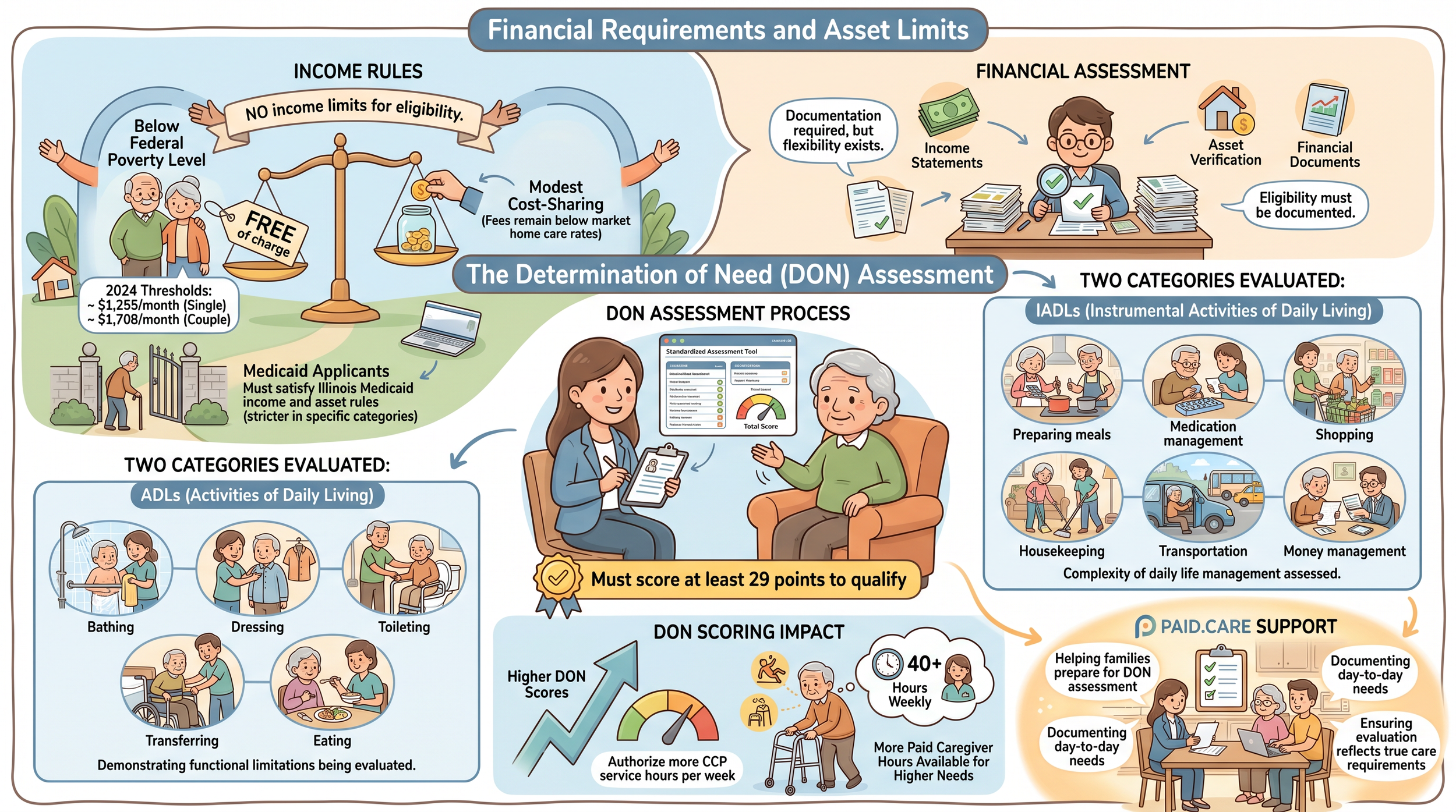
The Illinois Community Care Program does not impose income limits for eligibility, but those with income below the federal poverty level may receive services free of charge. For 2024, that threshold was approximately $1,255 per month for singles and $1,703 per month for couples.
Higher incomes may require modest cost-sharing, though fees remain below market home care rates. Medicaid applicants must also satisfy Illinois Medicaid income and asset rules, which can be stricter in specific categories.
The Determination of Need (DON) Assessment
Eligibility for the Community Care Program is determined through a functional assessment known as the Determination of Need assessment. To qualify, applicants must score at least 29 points on this standardized tool.
Areas evaluated include:
ADLs: bathing, dressing, toileting, transferring, eating
IADLs: preparing meals, medication management, shopping, housekeeping, transportation, money management
Higher DON scores authorize more CCP services hours per week, directly affecting how many paid caregiver hours are available. A senior with significant safety risks and mobility limitations may qualify for 40 or more hours weekly.
Paid.care can help families prepare for the DON assessment by documenting what help is actually needed day-to-day, ensuring the evaluation reflects true care requirements.
CCP Benefits and Services in Illinois
The CCP offers various non-medical services to support independence for seniors. Services provided are tailored to each participant’s needs and authorized by their CCU.
Homemaker and Personal Care Services:
Assistance with personal care tasks: bathing, grooming, dressing, toileting
Help with household tasks: cleaning, laundry, running errands
Meal support: preparing meals, shopping, accommodating special diets
Adult Day Service Centers: Adult day services are designed for older adults who cannot be left alone during the day due to impairments. These professionally staffed support centers provide:
Health monitoring and medication supervision
Social activities and companionship
Nutritious lunches and therapeutic diets
Personal care assistance
Emergency Home Response Systems: The Emergency Home Response Service provides a 24-hour emergency communication system linking users to a professionally staffed support center. An activation device worn on the body allows seniors to summon help immediately after a fall or medical emergency. The base unit connects to a call center that can automatically link to emergency services or designated family members.
Additional Supports: Automated Medication Dispensers are mechanical systems that remind participants to take medications and notify caregivers if doses are missed.
Care Coordination and Choices for Care
Care Coordination Units are local agencies under contract with the Illinois Department on Aging to manage CCP assessments and care plans. CCP case managers help individuals identify services that enable them to continue living in their own homes or communities, discussing daily activities that can be managed independently versus those requiring assistance.
Case managers are typically based in local agencies known as Care Coordination Units, which can be located through local Area Agencies on Aging or the Senior Helpline. The role of case managers includes conducting assessments to determine the needs of older adults and developing a Plan of Care that utilizes available resources and family support.
The “Choices for Care” mechanism screens individuals in hospitals or nursing facilities before long-term Medicaid-funded admission. Hospital coordinators discuss options with families, including returning home with CCP services instead of nursing home placement.
Periodic CCU re-assessments ensure the plan stays appropriate as conditions change within the client’s geographic area.
Family Caregivers and Pay Through Illinois CCP
CCP generally allows certain relatives and friends to be hired as paid caregivers through licensed provider agencies. This means families can choose a trusted loved one rather than relying solely on unfamiliar staff.
The Illinois Community Care Program pays family caregivers up to $20 per hour for providing care to elderly or disabled loved ones at home. Prior to the recent policy update, spouses were not allowed to be hired as paid caregivers under the Illinois Community Care Program, which limited compensation options for many families.
As of April 2026, spouses are explicitly eligible to be paid caregivers under the Illinois Community Care Program, allowing them to earn up to $20 per hour for their caregiving services. This change aligns Illinois with broader trends in family-paid home and community-based services.
Who Can Be a Paid Caregiver Under CCP?
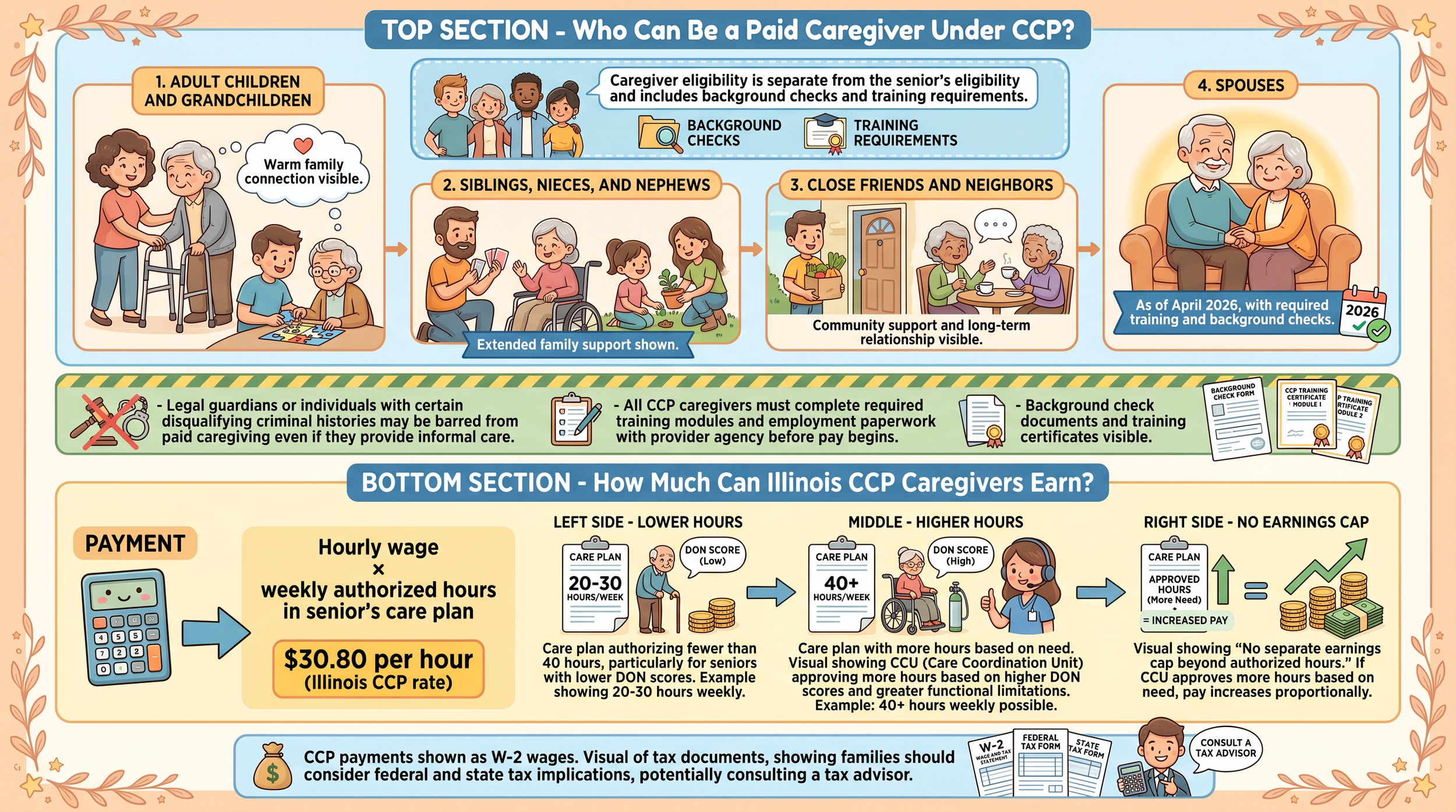
Caregiver eligibility is separate from the senior’s eligibility and includes background checks and training requirements.
Commonly eligible caregivers:
Adult children and grandchildren
Siblings, nieces, and nephews
Close friends and neighbors who regularly provide care
Spouses (as of April 2026, with required training and background checks)
Legal guardians or individuals with certain disqualifying criminal histories may be barred from paid caregiving even if they provide informal care. All CCP caregivers must complete required training modules and employment paperwork with the provider agency before pay begins.
How Much Can Illinois CCP Caregivers Earn?
CCP pay is calculated as an hourly wage multiplied by weekly authorized hours in the senior’s care plan.
Some care plans authorize fewer than 40 hours, particularly for seniors with lower DON scores. There is no separate earnings cap beyond authorized hours—if the CCU approves more hours based on need, pay increases proportionally.
CCP payments are W-2 wages, so families should consider federal and state tax implications, potentially consulting a tax advisor.
How to Apply for the Illinois Community Care Program
Families typically begin by contacting their local CCU or the Senior Helpline to request an assessment.
Primary contact options:
Senior Helpline: 800-252-8966 (voice) or 888-206-1327 (TTY)
Local Area Agency on Aging
Illinois Department on Aging website
Paid.care offers a streamlined online pre-screen where Illinois families can check likely Medicaid and CCP eligibility before calling agencies. Gather basic information in advance: Social Security numbers, Medicaid or insurance cards, income and asset details, and a list of daily activities the senior needs help with.
The CCP Enrollment and Assessment Process
Here’s what happens after you initiate a CCP inquiry:
Intake screening: CCU or Paid.care staff ask about age, residence, Medicaid status, and care needs
In-home DON assessment: A case manager visits the home, evaluates ADLs/IADLs, and completes scoring
Care plan authorization: Based on DON score, CCU sets weekly hours and recommends services
Provider and caregiver selection: Family chooses a CCP provider agency and identifies their preferred family caregiver
Caregiver onboarding: Background checks, employment forms, training hours, and payroll setup
The Illinois Community Care Program does not have a waiver waitlist, allowing families to start receiving payments within 30 to 60 days after enrollment and assessment.
How Paid.care Supports Illinois CCP Family Caregivers
Paid.care is a tech-enabled service that partners with CCP provider agencies to help unpaid family caregivers become trained, W-2 paid caregivers through state-funded programs.
What Paid.care provides:
Medicaid eligibility verification
CCP rules guidance and CCU coordination
Care coaching to document ADL needs for DON assessments
Financial coaching around caregiver pay and budgeting
Mobile app to track hours and manage caregiving shifts
Weekly W-2 payroll with transparent pay summaries
Compliance support to meet state documentation requirements
All services are provided at no cost to Illinois families. If you’re caring for an older or disabled loved one, check your CCP eligibility through Paid.care and start the enrollment process today.
FAQs
-
Unlike many Medicaid waiver programs, CCP typically does not use a formal waitlist. If Medicaid and DON eligibility are met and funding is available, families move directly from assessment to service authorization. Local capacity issues—such as caregiver shortages in a specific service area—can sometimes delay start dates, but this differs from a statewide waiver waitlist. Ask your local CCU or Paid.care contact for realistic timing expectations in your county.
-
Yes, CCP can often be combined with Veteran Affairs benefits, Medicare home health services, and private caregivers. The key is coordinating total hours to prevent duplicate billing. CCP pays only for its authorized services, while other programs or private funds can cover additional hours or specialized care that CCP doesn’t fund. Work with your CCU and a Paid.care coach to build a blended care plan.
-
CCP eligibility can follow the participant within Illinois, but the administering CCU may change when moving to a new county. The new CCU may re-assess needs, revisit the DON score, and potentially adjust authorized hours. Notify your current CCU and provider agency before moving so services can transfer with minimal interruption.
-
Illinois CCP generally cannot pay for caregiving hours provided before the official authorization date and completion of caregiver onboarding. Some agencies may process pay back to the service authorization start date once everything is approved, but not for months or years of prior unpaid care. Start the enrollment process as soon as possible to avoid losing potential paid hours.
-
CCP services are flexible. If a senior’s condition improves, authorized hours may be reduced at the next CCU reassessment. If health declines or care needs increase, families can request an earlier reassessment to potentially increase hours or add services like adult day care or emergency response systems. Keep notes about new care needs, falls, hospitalizations, or medication changes to share during reassessments.

