
How to Get Paid by the State as a Caregiver (Medicaid, VA & More)
Key Takeaways
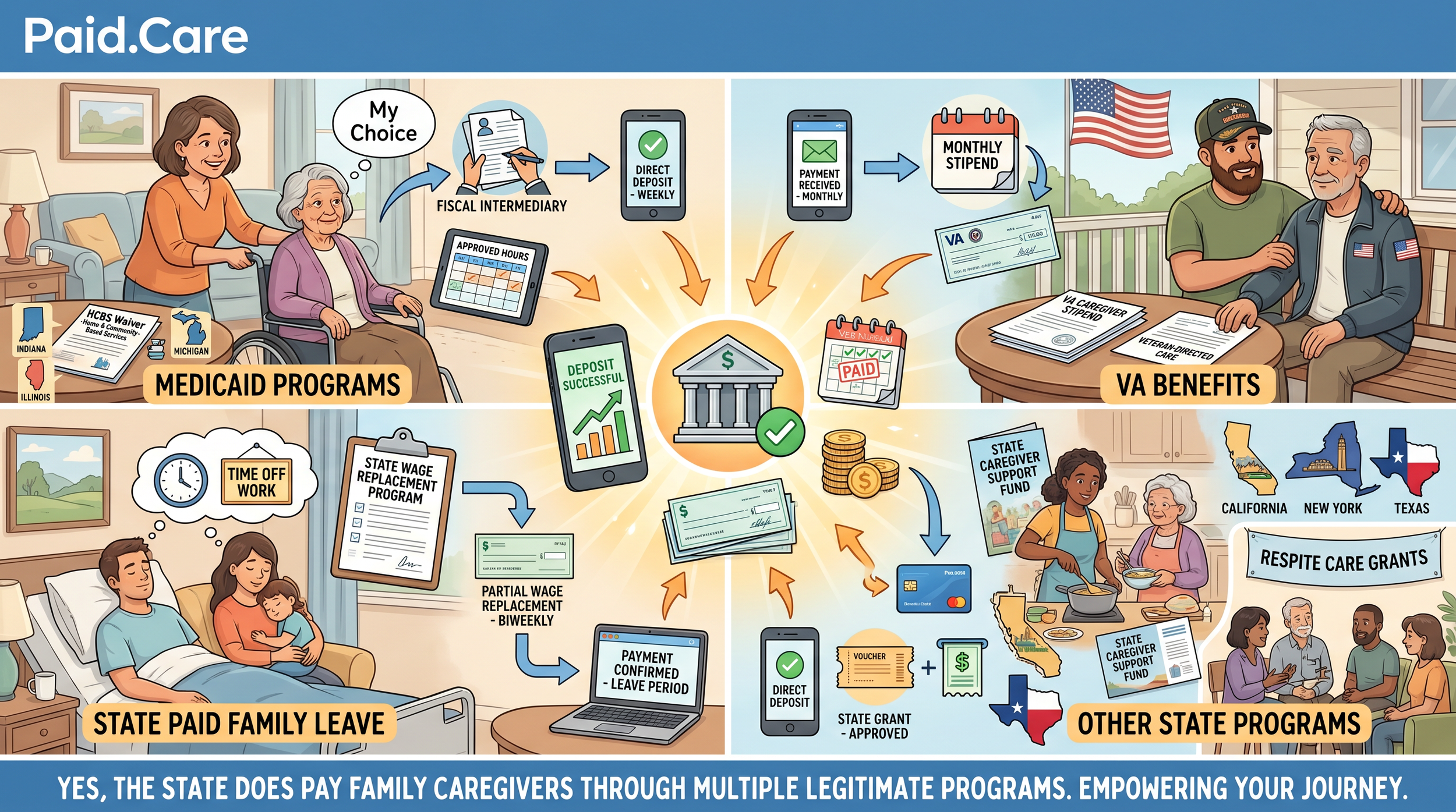
Family caregivers can often get paid through Medicaid Home and Community Based Services waivers, VA benefits, paid family leave, and personal care agreements—Paid.care helps family members in Indiana, Michigan, and Illinois get qualified and paid through these state-funded programs.
All 50 states and the District of Columbia offer some type of Medicaid-funded consumer-directed personal care assistance program, allowing care recipients to hire relatives as caregivers.
Eligibility requirements and pay rates vary by state and program, with compensation typically ranging from $13 to $18 per hour or more depending on location.
The fastest path to becoming a paid caregiver is usually through a state Medicaid consumer directed or structured family caregiving program where you’re hired as an in-home aide.
This article walks step-by-step through how to check eligibility, apply, complete training requirements, and begin receiving weekly payments.
Introduction: Why Getting Paid as a Family Caregiver Is So Hard (and So Important)
More than 53 million Americans provide care to aging parents, spouses, children with disabilities, or close friends—often while losing wages and watching their own financial stability erode. If compensated at market rates, this unpaid labor would be valued at over $600 billion annually. Yet most family caregivers absorb out of pocket costs exceeding $7,000 per year on medical supplies, home modifications, and therapies.
Government programs to pay informal caregivers do exist, but they’re fragmented across Medicaid programs, VA benefits, state paid family leave laws, and private contracts. Each works differently depending on where you live. Navigating this maze is why so many caregivers never receive financial assistance they’re entitled to.
Paid.care is a tech-enabled service that helps family caregivers in Indiana, Michigan, and Illinois cut through these barriers. The platform guides you through eligibility, training, and enrollment so you can receive weekly pay for the care you’re already providing.
Here are the main ways to get paid by the state as a caregiver:
Consumer directed and self directed services programs
VA caregiver programs (PCAFC, Aid & Attendance, Veteran Directed Care)
State paid family leave programs
Structured family caregiving models
1. How to Get Paid by Medicaid as a Family Caregiver
Medicaid—the joint federal-state health care program serving over 82 million low-income and disabled individuals—is the primary route for most family caregivers to receive state payment. Unlike Medicare (federal insurance for those 65+), which does not reimburse relatives for caregiving, Medicaid explicitly funds personal care services and in home care through various pathways.
Every state runs Medicaid differently. Program names, eligibility thresholds, and whether spouses or an adult child can be paid vary widely. The two main Medicaid pathways are:
Traditional personal care/attendant services through Medicaid State Plans
Home and Community Based Services (HCBS) waivers that fund in-home care as an alternative to nursing home placement
These are paid as W-2 wages through an agency or fiscal intermediary, with taxes withheld. The compensation amount depends on the specific program and the state where you live.
1.1 Medicaid Consumer-Directed and Self-Directed Care Programs
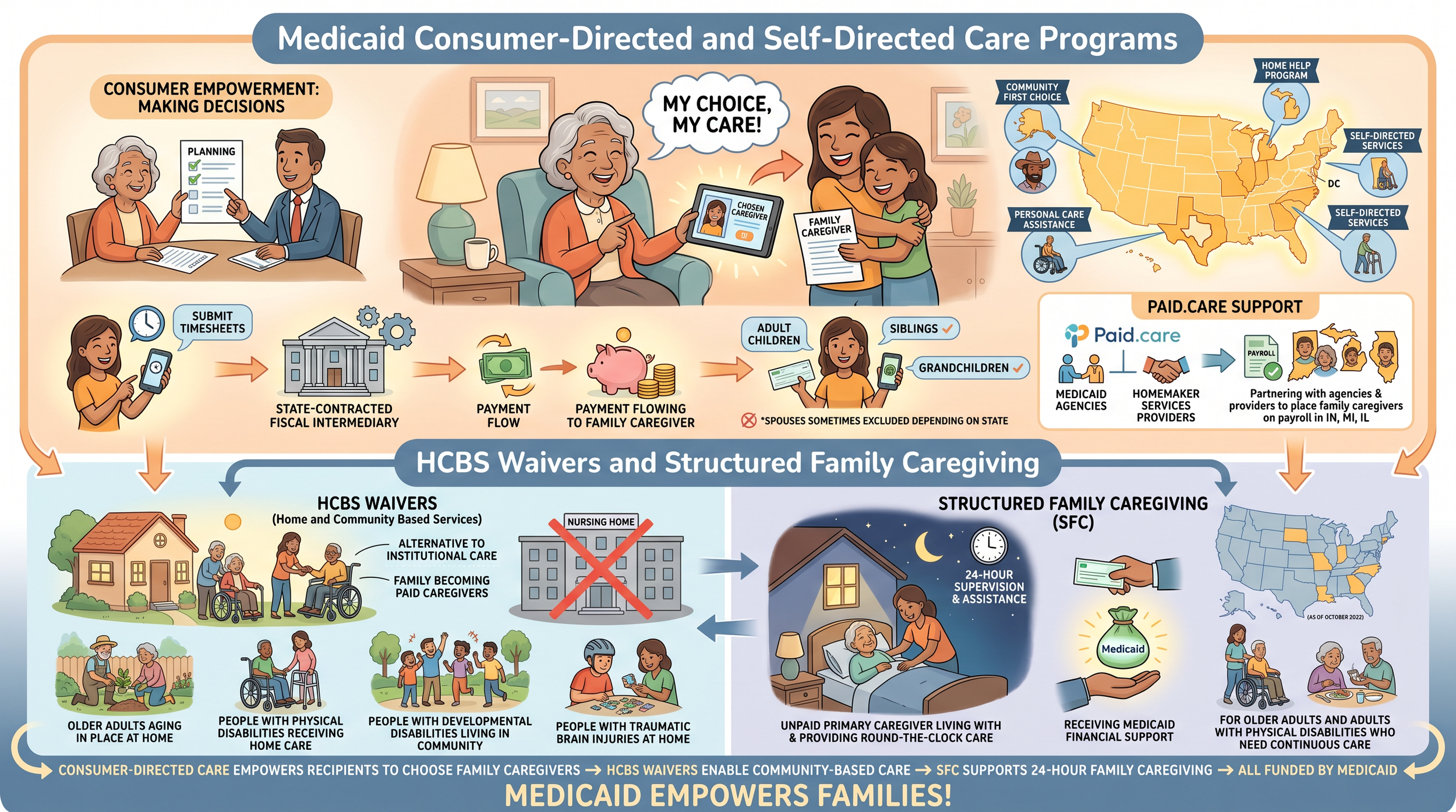
Consumer directed care (also called self directed services) puts the care recipient in charge. They—or their representative—choose and manage their caregiver, often a relative or close friend. All 50 states and the District of Columbia offer some type of Medicaid-funded consumer-directed personal care assistance program, allowing family members to be compensated for their services.
Program names vary by state:
Community First Choice (operational in 9 states including Alaska and Texas)
Personal Care Assistance
Self-Directed Personal Assistance Services
Home Help Program (Michigan)
Under these programs, you’re hired as a worker, submit timesheets via app or phone, and receive payment from a state-contracted fiscal intermediary. Most state Medicaid programs allow adult children, siblings, or grandchildren to be paid for caregiving while often excluding spouses or legal guardians from compensation. Each state has unique rules regarding caregiver compensation, including differences in policies for spouses.
Paid.care partners with Medicaid agencies and homemaker services providers to place family caregivers on payroll in Indiana, Michigan, and Illinois through these consumer-directed models.
1.2 HCBS Waivers and Structured Family Caregiving
Home and Community Based Services Medicaid Waivers allow states to provide community-based services as an alternative to institutional care, enabling family members to become paid caregivers in many states. These waivers target specific populations—older adults, people with physical disabilities, developmental disabilities, or traumatic brain injuries.
Structured Family Caregiving (SFC) is a Medicaid-funded benefit that provides financial support to unpaid primary caregivers in exchange for providing 24-hour supervision and assistance with daily living activities. As of October 2022, seven states—Connecticut, Georgia, Indiana, Louisiana, Missouri, North Carolina, and Rhode Island—offer Structured Family Caregiving as a Medicaid benefit for older adults and adults with physical disabilities. South Dakota has since joined this list.
SFC requirements typically include:
Shared residence between caregiver and care recipient
Documented care plan covering assistance with ADLs (bathing, dressing, toileting)
Regular nurse or care coach visits
Home safety compliance
In SFC programs, caregivers may receive training and respite care, and the caregiver and care recipient must live together to qualify. Paid.care’s care coaching and app-based time tracking align directly with these SFC and HCBS program requirements in Midwest states.
1.3 Medicaid Income, Asset, and Care-Need Eligibility
To unlock Medicaid-funded caregiving, the care recipient—not the caregiver—must qualify based on income, assets, and medical need. To be eligible for Medicaid, care recipients must meet specific income and asset limits, which vary by state and program, typically requiring a monthly income below $2,982 and assets not exceeding $2,000 for seniors.
Eligibility for family caregivers to receive compensation through Medicaid often requires that the care recipient has a significant need for assistance with daily living activities, which must be assessed and documented. A nurse or social worker evaluates how many ADLs the person needs help with—activities like meal preparation, personal hygiene, and transferring.
Contact your local area agency on Aging, a Medicaid planner, or Paid.care (in IN, MI, IL) to understand your state’s financial requirements and documentation needs.
2. Step-by-Step: Becoming a Paid Family Caregiver Through Medicaid
This section provides a practical roadmap most states loosely follow, even though exact forms and program names differ. The application process generally involves:
Confirming Medicaid eligibility
Getting a care needs assessment
Enrolling with an approved program
Completing training
Submitting timesheets to start pay
Paid.care offers an online eligibility check and guided application for caregivers in Indiana, Michigan, and Illinois—reducing approval times from the typical 4 months to around 6 weeks.
Timelines range from a few weeks to several months depending on state backlogs. Keep written records (doctor notes, hospital discharge summaries, medication lists) to speed approval.
2.1 Confirming Medicaid and Program Eligibility
Start by checking whether your loved one is already a Medicaid recipient. If not, apply through your state’s health department or online portal.
Documents typically needed:
Proof of identity and Social Security number
Income proof for the last 30–90 days
Bank statements
Disability or Social Security award letters
Insurance company cards
Once Medicaid is approved, specifically ask about personal care services, attendant care, or HCBS waivers that pay family caregivers. To become an authorized provider through a state Medicaid program, steps include assessing the care recipient and enrolling as a vendor.
2.2 Completing the Care Needs Assessment
A nurse, case manager, or social worker visits the home (or conducts a video assessment) to determine authorized weekly hours. Assessors look for difficulty with:
Bathing and personal care
Dressing and personal hygiene
Walking and transferring
Managing medications
Meal preparation
Staying safe alone
Be honest and specific on assessment day. Avoid minimizing challenges or doing tasks for your loved one during the visit. The assessor’s report generates a Person-Centered Service Plan specifying funded hours and billable tasks. Authorization typically requires annual renewal.
2.3 Getting Approved as the Paid Caregiver
Once hours are authorized, the care recipient can nominate you as their loved one’s caregiver. Family caregivers may need to meet certain training and certification requirements set by their state, which can include background checks, to qualify for compensation.
Common caregiver requirements:
Caregivers generally must be at least 18 years old
Pass a criminal background check (FBI/sex offender registries)
Legal authorization to work in the U.S. (I-9 verification)
Physically able to perform care tasks
Many states require caregivers to complete 40–75 hours of training or certification before they can be paid. This may include infection control, CPR, and dementia care modules. Paid.care provides digital onboarding and live coaching so family caregivers in supported states move from approval to first paycheck quickly.
2.4 Training, Time Tracking, and Getting Your First Paycheck
Once enrolled, you’ll log hours and tasks daily or weekly via timesheets, phone systems, or a mobile app. Pay rates are set by state contracts—typically not negotiable—but overtime or weekend differentials may apply.
Payment is usually weekly or biweekly as W-2 wages with taxes withheld through an agency or fiscal intermediary. Many states have established Medicaid waiver programs that allow family members to receive compensation for providing personal care services, with the monthly stipend amount depending on the specific program requirements and hours provided.
Keep personal notes on tasks performed and condition changes for quality of care and potential state audits. Paid.care’s app allows Indiana, Michigan, and Illinois caregivers to track shifts, see upcoming monthly payments, and communicate with coaches about documentation.
3. How to Get Paid by the U.S. Department of Veterans Affairs (VA)
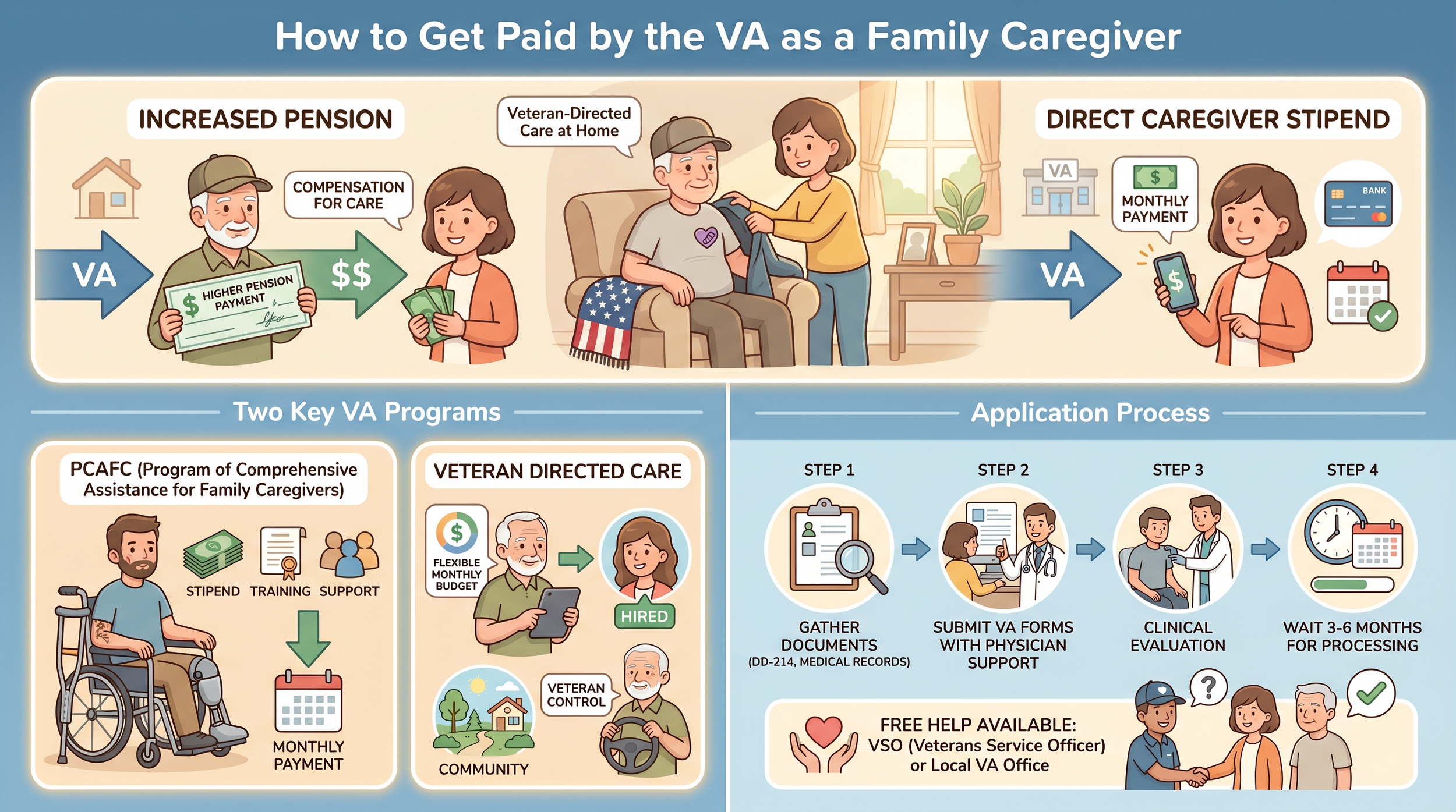
The VA offers separate government programs from Medicaid to support veterans with service-connected disabilities or limited income who require assistance with daily living. Veterans affairs benefits may pay the eligible veteran more in pension (which they can use to compensate family), or pay caregivers directly via stipends.
Veterans can sometimes combine VA benefits with Medicaid-funded caregiving, but coordination is complex. Contact a Veterans Service Officer (VSO) for free application assistance through the official VA Caregiver Support website.
While Paid.care does not administer VA benefits, their care coaching can complement VA-funded care for families who also qualify for state Medicaid programs.
3.1 Key VA Programs That Can Help Pay Family Caregivers
The VA offers several programs that compensate family caregivers:
The Program of Comprehensive Assistance for Family Caregivers (PCAFC) provides stipends, training, and comprehensive assistance for caregivers of veterans with service-connected disabilities. PCAFC covers post-9/11 veterans and certain pre-1975 veterans with serious injuries.
Veteran Directed Care gives eligible veterans a flexible monthly budget to hire caregivers—including certain family members—in community settings. Spouses are excluded from some pension-based payments but can be paid under PCAFC if eligibility criteria are met.
3.2 Steps to Apply for VA Caregiver and Support Programs
Basic eligibility requires: veteran enrolled in VA health care, documented need for personal care, and service or income-related qualifications.
Application steps:
Gather DD-214 (discharge papers), medical records, VA rating decisions
For A&A/Housebound: Submit VA Form 21-2680 with physician support
For PCAFC: Complete VA Form 10-10CG with clinical evaluation
Expect 3–6 month processing time
Use resources like the Elizabeth Dole Foundation, American Legion, or local VSO offices for free help with forms and appeals. The Family Caregiver Alliance also offers guidance for navigating VA programs.
4. Other Ways Family Caregivers Can Be Paid (Beyond Medicaid and VA)
Beyond Medicaid and VA, several additional payment avenues provide income or reimbursement for caregiving. These can sometimes layer with other benefits, but always check for conflicts affecting eligibility.
Many options are state-specific and change frequently—verify current rules before proceeding. Paid.care focuses on state-funded Medicaid and related home healthcare programs, but understanding these tools helps build a complete financial plan.
4.1 State Paid Family and Medical Leave Programs
As of mid-2026, 14 states plus Washington, DC have paid family leave programs providing partial wage replacement when taking unpaid leave becomes unsustainable. These typically pay 60–67% of wages for 6–12 weeks, funded by payroll taxes.
Key steps:
Confirm your state has a paid family leave law
Check employer eligibility rules
File a claim before or soon after leave begins
Submit required medical certification
Paid family leave is temporary—not a long term care insurance solution—but bridges gaps while applying for Medicaid or VA programs.
4.2 Long-Term Care Insurance (LTCI) Policies
Long term care insurance is a private insurance company product paying for home care, assisted living facilities, or skilled nursing when the insured needs ADL help. Only about 7 million older adults hold these policies, but some plans allow payments to family members who provide care.
Review policy language for terms like “informal caregiver” and whether care must come from a licensed agency. Payments may go directly to caregivers or reimburse the policyholder. Consult an elder law attorney if uncertain how payments affect taxes or future Medicaid eligibility.
4.3 Personal Care Agreements and Direct Payment from Your Loved One
A personal care agreement (caregiver contract) is a written legal document where a family member agrees to provide care for set hours at an agreed rate. Have it signed, dated, and reviewed by an elder law attorney to comply with tax and Medicaid spend-down rules.
These contracts legitimize payments, document hours, and reduce sibling conflicts over inheritance. Pay rates should match local home care market wages ($20–$30/hour in many areas) to be considered reasonable during Medicaid’s five-year look-back period for asset transfers.
4.4 Tax Credits, Deductions, and Reimbursements
Federal tax rules may allow claiming an elderly parent or disabled relative as a dependent if income and support tests are met, creating tax credits opportunities. Caregivers who itemize can sometimes deduct qualified medical expenses paid on behalf of the care recipient.
Some states offer caregiver-specific credits offsetting caregiving costs. Consult a CPA familiar with elder care—tax treatment interacts with Medicaid and VA rules. Keep receipts, mileage logs for medical trips, and documentation of who paid expenses.
5. State-Specific Caregiver Programs and Why Rules Differ So Much
Each state builds its own mix of Medicaid waivers, state-funded programs, and licensing rules. What works in New Hampshire may not exist in North Dakota. This fragmentation explains why getting paid feels so complicated.
Notable state initiatives include:
Colorado’s Family CNA (trains relatives as Certified Nursing Assistants)
Arizona’s AHCCCS (pays parents for medically complex children)
Massachusetts complex care aides ($25/hour post-training)
Adult foster care programs in multiple states
While Paid.care currently operates in Indiana, Michigan, and Illinois, the concepts—HCBS waivers, self directed services, structured family caregiving—exist nationwide under different names. Contact your local area agency on Aging, state Medicaid office, or disability rights center to locate programs paying family caregivers in your area.
5.1 Examples of Innovative State Family Caregiver Models
Colorado’s Family CNA program has trained over 5,000 relatives since 2021 to become certified aides earning $20+/hour. Florida, Arizona, Massachusetts, and New Hampshire certify parents or relatives as health aides for medically complex children or adults—training often provided free.
These models share common features:
Formal certification process
Work through licensed agencies
Ongoing supervision
Higher skilled-care rates
Check whether your state has launched new family aide or structured family caregiving initiatives since 2024. Paid.care aligns with this trend, offering coaching and technology integrating with new state programs as they expand.
6. How Paid.care Helps Family Caregivers Turn Unpaid Work into a Paycheck
Paid.care is a technology-enabled service helping family caregivers in Indiana, Michigan, and Illinois access Medicaid-funded payment options. The program offers:
Eligibility screening
Guided application support
Care coaching
Mobile app for time tracking
Weekly payments via partner agencies
Paid.care works within existing state Medicaid, HCBS, and waiver programs—it’s not an insurance product but a bridge simplifying the process. The service is designed for relatives and close friends already providing regular care to an elderly or disabled loved one who want to become a paid caregiver.
Ready to check if you qualify? Visit Paid.care to complete an eligibility quiz or schedule a brief phone consultation.
6.1 What the Paid.care Process Looks Like for a New Caregiver
The journey typically follows these steps:
Online eligibility questionnaire - Quick screening to assess fit
Medicaid status review - Confirming your loved one’s coverage
Program matching - Identifying the right state waiver
Digital onboarding - Partner agency enrollment and I-9 completion
Training and coaching - Meeting state certification requirements
Weekly pay begins - Track shifts via app, receive direct deposit
Paid.care coaches explain paperwork and program rules in clear language—no legal jargon. The mobile app lets you clock in/out, view schedules, and track pay so you focus on care, not administration. Financial coaching helps understand taxes, plan for income changes, and own care decisions.
There’s no obligation just for checking eligibility—explore options before deciding.
FAQs
-
Some state Medicaid consumer-directed programs allow spouses as paid caregivers; others explicitly exclude spouses but permit adult children or other relatives. VA programs, especially PCAFC, can pay spouses if the veteran meets eligibility criteria. Check your specific state’s rules or speak with Paid.care (if in IN, MI, IL) to confirm. Personal care agreements with spousal payment are usually legal but can affect future Medicaid eligibility if not structured correctly.
-
In most cases, Medicaid or agency payments for caregiving are treated as taxable income. You’ll receive a W-2 or 1099 depending on your arrangement. Certain Medicaid-funded payments may qualify for “difficulty of care” exclusions under IRC 131 in specific situations, changing tax treatment. Keep pay stubs and consult a tax professional who understands caregiver income. Failing to report income causes problems with taxes and future benefit eligibility.
-
Timelines vary significantly. If the care recipient already has Medicaid with an authorized care plan, onboarding may take a few weeks. If they must first apply for Medicaid and a waiver, expect several months. Factors include: paperwork completeness, medical documentation, state backlogs, and HCBS waiver waiting lists (200,000+ nationally). Apply early—services like Paid.care reduce avoidable delays by ensuring forms reach the right program first time.
-
Some Medicaid programs and state initiatives pay parents to care for medically complex or disabled children; others only allow non-parent caregivers. Ask specifically about pediatric HCBS waivers, “medically fragile children” programs, or family licensed health aide options. School-based IDEA services don’t pay parents directly. Consult your state Medicaid office or children’s hospital social worker for current pediatric caregiver payment options.
-
In some situations, veterans receive both Medicaid-funded home care and VA caregiver benefits, but coordination rules are complex. Double payment for the same hours is generally prohibited. If a veteran already receives VA Aid and Attendance or PCAFC, inform Medicaid caseworkers so benefits coordinate correctly. Work with both a VSO and Medicaid case manager to design a care plan using the strongest benefit first while protecting future eligibility. Always follow written program rules—informal arrangements risk fraud allegations.

