
Health First Colorado is the state’s Medicaid program that determines eligibility for long-term services and supports, and this guide explains Colorado Medicaid income limits, asset rules, and the waiver pathways that can allow family caregivers to get paid. Readers will learn how MAGI and non-MAGI rules differ, which Home and Community Based Services (HCBS) waivers permit paid family caregiving , and the practical steps for applying and arranging payroll under consumer-directed options. Many families struggle to navigate income thresholds, resource counting, and the assessment steps that determine authorization for paid care; this article clarifies those rules and maps them to actionable steps. The guide also highlights specific waiver programs such as Consumer Directed Attendant Support Services (CDASS) and summarizes how Health First Colorado supports in-home care, while offering information on how Paid.care can help with eligibility screening, coaching, and payment facilitation. Sections cover 2025 income and asset limits, waiver comparisons, a step-by-step application checklist, benefit descriptions, Paid.care service details, and concise answers to the most common questions about caregiver payment and home ownership rules.
What Are the 2025 Colorado Medicaid Income and Asset Limits?
Colorado Medicaid eligibility uses two broad income methodologies: MAGI (Modified Adjusted Gross Income) for most children, pregnant individuals, and adults, and non-MAGI rules for long-term services and supports such as nursing facility or HCBS waiver enrollment. Understanding which methodology applies is critical because MAGI counts household income using tax concepts, while non-MAGI eligibility evaluates individual income and countable assets against long-term care thresholds. The immediate benefit of this distinction is clarity on whether a family’s combined household income will impact a care recipient’s waiver eligibility, which in turn affects whether paid family caregiver arrangements are allowable.
How Do Income Limits Vary by Household Size and Care Type in Colorado Medicaid?
Income limits scale with household size under MAGI rules, which treat dependents and tax filers as the household unit, while non-MAGI long-term care determinations focus on the applicant’s income and the resource rules for institutional or waiver services. For MAGI programs, a family of four will have a higher annual income ceiling than a single adult because the Federal Poverty Level scales with household size, directly affecting Health First Colorado eligibility. For non-MAGI waivers and nursing home eligibility, an individual’s monthly income and countable assets are the primary drivers; spousal impoverishment rules often protect a community spouse’s share of assets and income. Understanding whether a care recipient will be evaluated under MAGI or non-MAGI is therefore the first analytic step families should take when estimating eligibility and caregiver pay possibilities.
What Are the Asset Limits for Medicaid Eligibility in Colorado?
Asset limits differ by pathway: MAGI-based Health First Colorado programs generally do not apply an asset test, whereas non-MAGI long-term services and supports require applicants to fall under specific resource ceilings to qualify for waivers or institutional care. Common countable assets include bank accounts, investment accounts, and certain excess vehicles, while typical exemptions include the primary residence (subject to equity limits), one vehicle for transportation, and pre-paid burial arrangements in many cases. Families should perform a resource inventory before applying and note that asset thresholds can change, so consulting official HCPF guidance is advisable. If questions remain about whether a specific asset is countable, caregivers can seek an eligibility screening to clarify how estate, home equity, and spousal protection rules may apply.
Which Colorado Medicaid Waiver Programs Support Paid Family Caregivers?
Colorado offers several waiver pathways that permit consumer-directed care and, under defined conditions, payment to family members who provide care. The most prominent option is Consumer Directed Attendant Support Services (CDASS), which emphasizes consumer control over hiring and managing attendants, including certain family members when allowed. Other HCBS waivers and veteran-directed options may permit family payments with program-specific restrictions, such as limits on which relatives can be paid or prohibitions when the caregiver is a legally responsible spouse.
How Does the Consumer Directed Attendant Support Services Program Work?
CDASS is a consumer-directed program that puts the participant—the person receiving care—in charge of hiring, scheduling, and supervising attendants, which may include eligible family members under program guidelines. A fiscal/employer agent typically handles payroll, tax withholding, and employer-of-record responsibilities, allowing participants to focus on directing care rather than administrative compliance. CDASS budgets are assigned based on assessed needs and authorize a set number of hours or funds that the participant can allocate to attendants; this model enables personalized care plans and flexible use of paid family caregivers where permitted. Because participant control is core to CDASS, families should plan for employer responsibilities and ensure caregivers complete required training and documentation before payroll begins.
What Other HCBS Waivers Allow Family Caregiver Payments in Colorado?
Beyond CDASS, certain HCBS waivers and state programs may allow family members to be paid for services when the care aligns with the participant’s care plan and the family member meets provider qualifications. Restrictions commonly include prohibitions on paying legally responsible relatives in specific circumstances or limits on payment for spousal caregivers, and programs may require background checks, mandatory training, or documented competency. Each waiver spells out eligible services—personal care, homemaker tasks, and respite—and which provider relationships are allowed, so families must consult program rules during enrollment. For complex cases, targeted eligibility screening can determine which waiver best fits a care recipient’s needs and whether hiring a family member is feasible under the waiver’s constraints.

How to Apply for Colorado Medicaid as a Family Caregiver?
Applying for Medicaid waiver services in Colorado follows a sequence of steps that begins with an eligibility screening and ends with authorization and payroll setup if consumer direction is chosen. The process requires verifying income and assets, completing a functional needs assessment to document care requirements, choosing a service delivery option like CDASS when eligible, and submitting enrollment paperwork to Health First Colorado or the administering agency. Preparing documents in advance and understanding timelines for assessments and approvals can reduce delays and ensure caregivers are ready to begin once authorization is issued. The compact checklist below organizes the main application steps and the documents commonly required to support each stage so families can approach the process methodically.
- Eligibility screening : Confirm program applicability and MAGI vs non-MAGI determination.
- Functional needs assessment : Schedule and complete the assessment that documents care needs.
- Select delivery option : Choose consumer-directed services like CDASS if eligible and desired.
- Submit enrollment paperwork : Provide identification, income, asset, and medical documentation.
- Authorization and setup : Complete fiscal agent enrollment and payroll arrangements once approved.
This numbered checklist clarifies sequencing and reduces confusion by showing which tasks must be completed before the next step proceeds.
What Are the Step-by-Step Application Requirements and Documents?
Document preparation is a decisive factor in smooth Medicaid and waiver enrollment; common documents include proof of identity, Social Security numbers, recent pay stubs or tax returns, bank statements, medical records that justify functional need, and any guardianship or power of attorney papers if applicable. Waiver applications typically require a completed needs assessment and possibly a service plan signed by a provider or case manager, while long-term care pathways may need additional financial verification and spousal asset documentation. Organizing documents into labeled folders—income, assets, medical, legal—streamlines submission and follow-up and reduces the risk of requests for additional information.
Where and How Can Caregivers Submit Their Medicaid Applications in Colorado?
Applications and follow-up can be managed through multiple channels—state Medicaid enrollment centers, local county human services offices, phone intake for screening, or by working with a designated case manager who submits paperwork on behalf of the applicant. Typical timelines include initial eligibility screenings within days to weeks, functional assessments scheduled within a few weeks depending on availability, and waiver authorization potentially taking several weeks after submission due to documentation review and care plan approvals. Tracking application status through the assigned case manager or enrollment contact helps families stay informed and respond promptly to requests for additional information. For caregivers seeking practical assistance, organizations that specialize in caregiver enrollment support can help coordinate document collection, assessment scheduling, and submission logistics.
Paid.care can assist here by providing eligibility checks, helping collect and organize paperwork, and supporting submission logistics for families pursuing consumer-directed waivers. Their support is designed to reduce administrative burden, and they also offer care coaching and training to prepare family caregivers for employer responsibilities when paid.
What Benefits Does Health First Colorado Provide for Care Recipients and Caregivers?
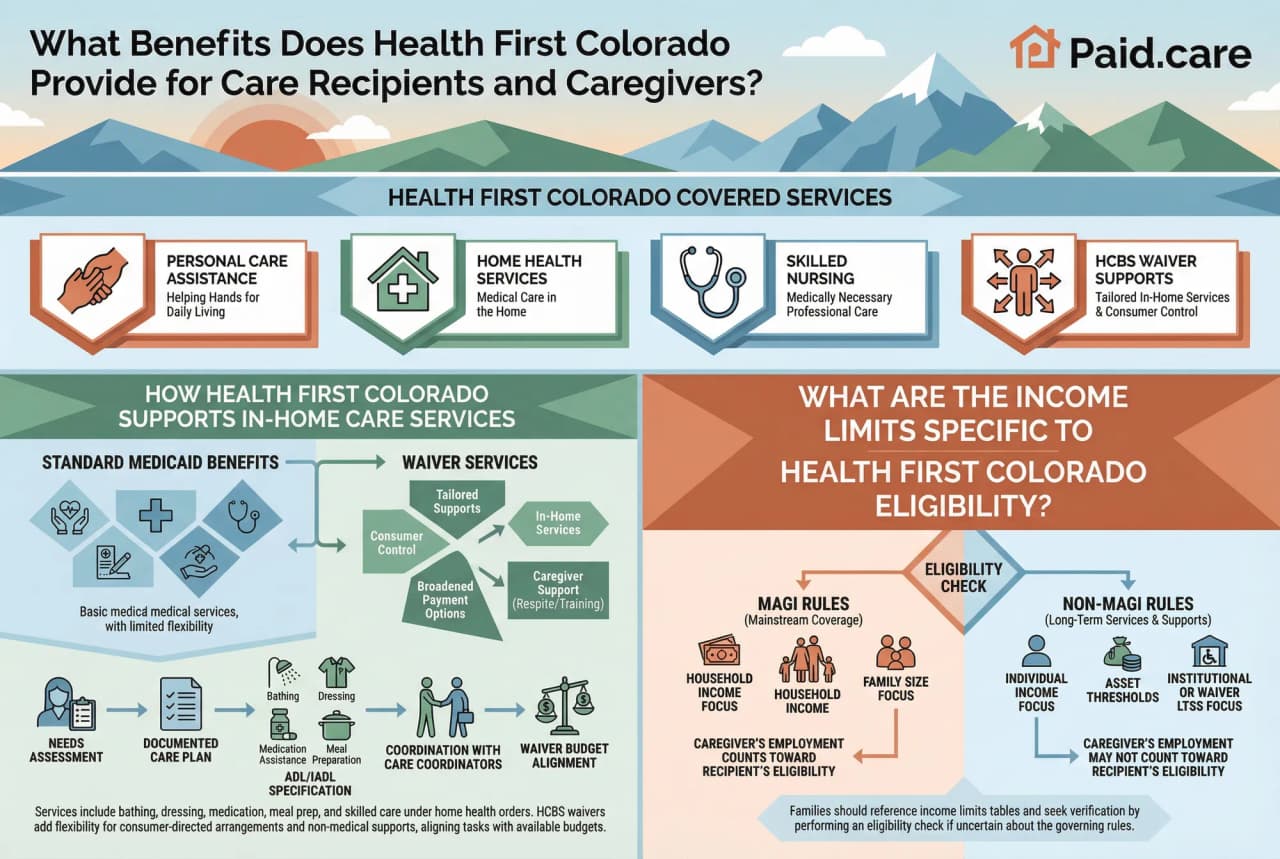
Health First Colorado funds a range of services aimed at enabling in-home care, preserving community living, and supporting caregivers through training and respite options where available. Covered services commonly include personal care assistance, home health services, skilled nursing when medically necessary, and HCBS waiver supports that enable tailored in-home services. For caregivers, waivers can authorize payment for eligible services and may provide access to training or respite resources that reduce burnout and improve care quality. Distinguishing between standard Medicaid benefits and waiver services is important because waivers are designed to tailor supports to individual needs and can allow consumer control that broadens payment options.
How Does Health First Colorado Support In-Home Care Services?
Health First Colorado authorizes in-home services based on a documented care plan that demonstrates the medical and functional need for assistance with activities of daily living or instrumental tasks required for safe community living. Services can include bathing, dressing, medication assistance, meal preparation, and skilled care under home health orders, with HCBS waivers adding flexibility for consumer-directed arrangements and non-medical supports. Authorization commonly requires a needs assessment and a care plan that specifies tasks, hours, and goals, and the participant or their representative works with care coordinators to align services with available waiver budgets. These mechanisms allow families to maintain care recipients at home when appropriate while ensuring services are clinically justified and properly documented.
What Are the Income Limits Specific to Health First Colorado Eligibility?
Health First Colorado applies MAGI income rules to most mainstream Medicaid coverage categories, which means household income and family size determine eligibility for those programs, while long-term services and supports use non-MAGI rules that focus on individual income and asset thresholds. This difference affects whether a caregiver’s employment or household income counts toward a care recipient’s eligibility, particularly for waivers that rely on non-MAGI determinations. Understanding which pathway applies—MAGI for many standard benefits, non-MAGI for institutional or waiver LTSS—is essential when estimating qualification and planning for caregiver pay. Families should reference the income limits table earlier in this article and seek verification by performing an eligibility check if uncertain which rules govern a given case.
How Does Paid.care Assist Colorado Family Caregivers in Getting Paid?
Paid.care supports family caregivers by streamlining eligibility screening, providing free care coaching, and facilitating weekly payments when caregivers are eligible for consumer-directed programs. Their services align with Medicaid waiver mechanics by offering initial eligibility checks to identify suitable waivers, coaching to prepare caregivers for employer responsibilities, and a dedicated mobile app to manage scheduling, timesheets, and payment records. Paid.care also emphasizes competitive pay rates where programs allow and offers care coaching support to resolve administrative questions and ensure caregivers receive timely weekly payments. This operational support reduces friction between authorization and compensation, helping families move from plan approval to paid caregiving efficiently.
- Eligibility screening to identify applicable Medicaid waivers and consumer-directed options.
- Care coaching and training to prepare family members for caregiver responsibilities and compliance.
- Weekly payment facilitation and payroll support through a caregiver management app.
These services are designed to complement Medicaid program mechanics by reducing administrative burden and ensuring caregivers are prepared to meet provider requirements and start receiving pay promptly once authorization is in place.
What Services Does Paid.care Offer for Eligibility Checks and Caregiver Training?
Paid.care’s eligibility checks assess whether a care recipient’s needs and family circumstances align with waivers that permit paid family caregivers, clarifying MAGI vs non-MAGI applicability and identifying documentation gaps before formal submission. The care coaching and training components include practical modules on timesheet completion, basic caregiving skills required by care plans, and employer compliance topics to prepare family members for payroll responsibilities. Caregivers who use these services receive hands-on guidance through the enrollment process and support in gathering necessary documents, which decreases delays and improves readiness for the fiscal agent onboarding that precedes payments. This combination of screening and training helps bridge program rules with day-to-day caregiving tasks.
How Does Paid.care Facilitate Weekly Payments and Care Management?
Once a caregiver is authorized and enrolled under a consumer-directed option and the fiscal agent is engaged, Paid.care helps manage the payment flow by coordinating timesheet submission, validating approved hours, and facilitating weekly payment disbursements to caregivers. The platform’s app functionality supports secure recordkeeping, scheduling, and communication between the participant, caregiver, and payroll administrators, which simplifies compliance and audit trails. Regular weekly payments reduce cash flow stress for family caregivers and ensure accurate tracking of billed hours against authorized budgets. By handling payroll logistics and documentation, Paid.care lowers administrative overhead and helps caregivers focus on delivering quality in-home support.
What Are the Frequently Asked Questions About Colorado Medicaid Income Limits and Caregiver Payment?
This FAQ section answers high-priority questions about whether family members can be paid, how home ownership affects eligibility, and how income limits apply to different programs. Each answer is concise and designed to address common decision points while guiding readers to perform eligibility checks or seek enrollment assistance for complex situations. The responses summarize program mechanics and point to the waiver and assessment steps families will encounter when pursuing paid caregiving under Health First Colorado.
Can Family Members Get Paid for Caregiving Through Colorado Medicaid?
Yes—some Colorado Medicaid waivers, notably CDASS and certain HCBS programs, permit family members to be paid when the care is documented in a care plan and the family member meets provider qualifications; however, program rules vary by waiver and may restrict payment to non-legally responsible relatives or impose spouse limitations. The key caveats are the waiver’s specific provider eligibility rules, required training, and the fiscal agent’s payroll requirements, which together determine when a family member can receive compensation. To proceed, families should perform an eligibility screening, complete the needs assessment, and confirm whether the chosen waiver explicitly allows payment to the intended family caregiver. If questions arise about restrictions or documentation, targeted enrollment support can clarify options and next steps.
How Does Home Ownership Affect Medicaid Eligibility in Colorado?
A primary residence is often treated differently from other countable assets in Medicaid resource calculations and may be partially or fully exempt depending on equity limits, spousal impoverishment rules, and program specifics; however, the house can affect eligibility in certain circumstances, such as when equity exceeds program thresholds or when transfers of ownership affect asset calculations. In long-term care pathways, rules protect a community spouse’s interest while also considering home equity caps that can impact resource eligibility. Families should document home ownership details and consult eligibility guidance to determine whether their residence will be counted, exempted, or subject to recovery rules. When in doubt, seeking an eligibility screening or financial counseling can illuminate how home ownership interacts with waiver and Medicaid rules.
This article has covered the principal income and asset distinctions for 2025, how household size and care type change eligibility, the waiver programs that can support paid family caregiving, the step-by-step application process with required documents, Health First Colorado’s in-home benefits, and ways Paid.care can assist caregivers with eligibility checks, training, and weekly payment facilitation. For families navigating caregiver pay options, structured eligibility assessment and organized documentation are the most effective next steps to move from planning to paid caregiving.
FAQs
1. What is the income limit to qualify for the Community HealthChoices (CHC) Waiver in 2025?
The Limit: For 2025, the gross monthly income limit for an individual applicant is $2,901 . This follows the federal standard (300% of the Federal Benefit Rate).
2. What happens if my income is higher than $2,901/month?
The Challenge: Pennsylvania is stricter than many states regarding income caps for waivers. If your income exceeds $2,901, you may not qualify for the standard waiver category.
3. Can a spouse be the paid caregiver in Pennsylvania?
The Rule: Generally, no . Under the standard Community HealthChoices (CHC) waiver and its "Services My Way" (participant-directed) option, spouses are typically excluded from being hired as paid caregivers.
4. How much does the "Services My Way" program pay family caregivers?
The Rates: In the participant-directed model ("Services My Way"), the care recipient acts as the employer and sets the wage. As of 2025, state budget adjustments have targeted a minimum wage floor for these workers of approximately $15.00 per hour or higher, though exact rates depend on the specific managed care organization (MCO) and the participant's budget.
5. What is the asset limit for Pennsylvania waivers?
The Limit: Pennsylvania is unique. For applicants with income under the $2,901 limit, the asset limit is $8,000 (a $2,000 federal limit plus a $6,000 state disregard).