
Common Mistakes on Caregiver Program Applications and How to Avoid Them
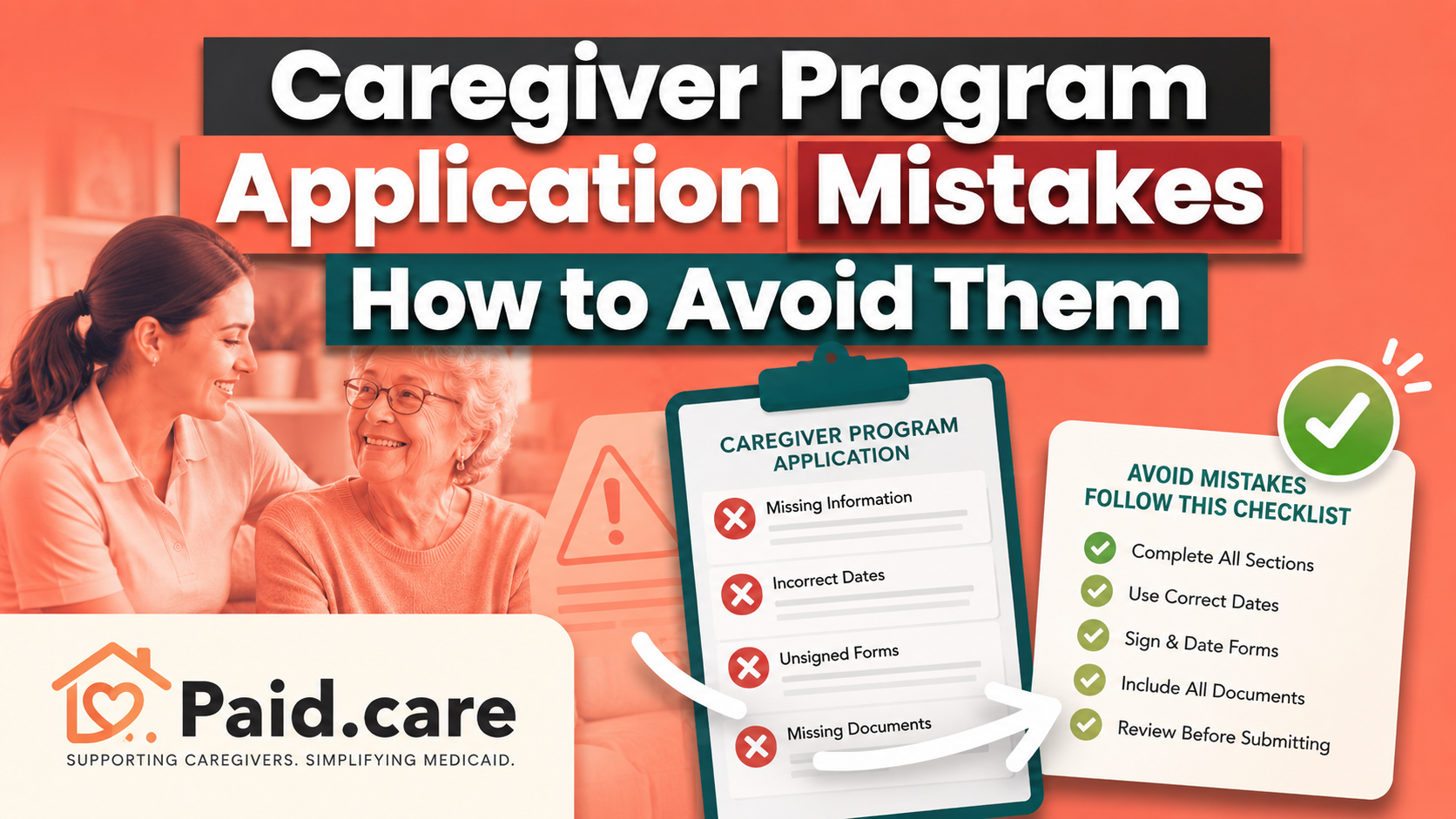
Caregiver program application mistakes rarely come from outright denials. They come from a missing signature, a mismatched Social Security number, or a care recipient whose needs assessment was never completed. These programs run through Medicaid, which means the person receiving care must qualify before the caregiver can be paid, and that sequencing trips up most families. Under-reporting care needs during the assessment locks in low approved hours that take months to appeal, and going silent after submission turns a single stalled document into a closed file. Families who get paid fastest are the ones who check current income and asset limits before applying, document the full weight of daily care tasks ahead of the assessment, and follow up every two weeks until the first check arrives.
The fastest way to lose months on a paid caregiver application isn't getting denied. It's getting bounced back for a missing signature, a wrong income figure, or a care recipient who never finished their assessment. Most caregiver program application mistakes aren't dramatic rejections. They're small paperwork gaps that stall your file while you wait for a check that never comes.
If you're applying through Medicaid in Indiana, Michigan, or Illinois to get paid for caring for a loved one, the application is where families lose the most time. Below are the errors that trip people up most often, why each one happens, and exactly how to keep your file moving.
Why Caregiver Program Application Mistakes Stall the Process in the First Place
These programs sit on top of Medicaid, which means two people are being evaluated at once: the care recipient (for medical and financial eligibility) and you (as the paid caregiver). When families think of it as one application, they miss that the care recipient's qualification almost always has to clear first. A caregiver can be perfectly eligible and still wait, because the person they care for hasn't finished their needs assessment or hasn't been confirmed as Medicaid-eligible.
The second reason files stall is that the paperwork crosses several offices. In Indiana you might be dealing with the Family and Social Services Administration, a managed care entity, and a structured family caregiving agency all at once. Michigan routes Home Help through a caseworker and the CHAMPS billing system. Illinois runs the Community Care Program through the Department on Aging and a Care Coordination Unit. A form that's fine for one office can be incomplete for another, and nobody tells you until the file sits.
So the goal isn't just filling out the form correctly. It's understanding which approval has to come first, who's reviewing what, and where a small omission turns into a six-week delay.
Income and asset mistakes that sink the care recipient's eligibility
The single most common reason a paid caregiver application goes nowhere is that the care recipient doesn't qualify for Medicaid, and the family didn't catch it before applying. Medicaid in every state has income and asset limits, and they're stricter for long-term care services than for regular health coverage.
Here's where families slip:
- Reporting gross instead of countable income. Not every dollar counts the same way. Certain deductions and disregards apply, and listing a raw monthly total can make someone look over the limit when they're not.
- Forgetting about recent transfers. Moving money or property to a family member before applying can trigger a look-back penalty. Medicaid reviews transfers going back years, and an innocent gift can delay eligibility.
- Missing the asset clock entirely. A second car, a life insurance policy with cash value, or a savings account can push a care recipient over the limit. Families often assume only the home matters.
Before you submit anything, pull the actual numbers for your state. Each state sets its own thresholds, and they change. Indiana's figures are laid out in the 2025 Indiana Medicaid income and eligibility breakdown, and Michigan families can check the current limits in the Michigan Medicaid income guide. If the care recipient is close to a threshold, that's not a reason to give up. It's a reason to talk to someone about a spend-down or a Medicaid-compliant planning step before you apply, not after a denial lands.
Skipping or rushing the needs assessment
The needs assessment determines how many paid hours (or what daily stipend) gets approved. Rush it, and you can lock in a low number that takes months to appeal upward. Skip prepping for it, and you risk the care recipient being found ineligible for the level of care the program requires.
What goes wrong here is almost always under-reporting. On the day a nurse or assessor visits, families instinctively present their loved one at their best. The person rallies, answers questions clearly, walks to the kitchen unassisted. The assessor writes down what they see, and the approved hours come back far lower than the real daily need.
Document the hard days before the assessment, not the good ones. Write down what an average week looks like: how often you help with bathing, dressing, toileting, medication, transfers, eating. Note the night wakings, the falls, the times your loved one can't be left alone. Bring that list to the assessment and reference it. If the assessor only sees a snapshot, your job is to fill in the full picture accurately. Tracking activities of daily living over a couple of weeks beforehand gives you something concrete to point to, and the caregiver duties checklist is a useful starting frame for what to record.
Paperwork errors that cause an automatic bounce-back
Some application mistakes don't even get reviewed on the merits. They fail at intake. These are the most frustrating because they're entirely preventable, and they're also the easiest to fix once you know the pattern.
Mismatched names, dates, and Social Security numbers
If the name on the application doesn't exactly match the Social Security card, or a birth date is transposed, the system can't verify identity and the file holds. Use legal names exactly as they appear on official documents. A nickname or a maiden name in one field and a legal name in another is enough to stall verification.
Missing signatures and dates
Multi-page applications have signature lines buried in the middle and at the end. Both the care recipient (or their authorized representative) and the caregiver often need to sign in different places. An unsigned page is treated as an incomplete application, full stop, and the clock doesn't start until it's corrected.
Documents that expire or don't match
Bank statements older than the requested window, an expired ID, proof of residency that lists a former address, or an income document that contradicts what you wrote on the form. Reviewers cross-check, and any contradiction generates a request for more information, which adds weeks. Submit current documents, and make sure every number on a supporting document matches what you entered.
Make a copy of everything you submit before it leaves your hands. When an office says a page is missing, your copy is the difference between re-sending one sheet and rebuilding the whole packet.
Choosing the wrong program or the wrong caregiver relationship
Not every program pays every relative, and applying to the wrong one wastes weeks. Spouses face restrictions in some programs that don't apply to adult children. Some programs pay through an agency model with a set daily stipend; others pay an hourly wage through consumer-directed care. Picking the structure that doesn't fit your situation means starting over.
A few relationship rules that catch families off guard:
- Spouses. Whether a spouse can be paid varies by program and state. In Illinois, the rules around spousal caregivers are specific enough that it's worth confirming before you apply, which the guide on spouse caregiver eligibility in Illinois walks through.
- Live-in caregivers. If you live with your loved one, special tax and hour rules apply that change how pay is calculated and reported.
- Power of attorney. Holding POA doesn't automatically disqualify you from being paid, but it can create paperwork wrinkles around who signs what.
Match the program to your state and your relationship before you fill out a single form. Indiana families generally route through Structured Family Caregiving or Attendant Care, Michigan through the Home Help program, and Illinois through the Community Care Program. The overview of how the qualification and payment process works lays out the path so you apply to the right door the first time.
Going silent after you submit
The application isn't the finish line. Files routinely sit waiting on one missing document or one verification, and the office may send a request that lands in a pile of mail or an email you don't check. Miss the response window, and some programs close the file and make you start over.
Treat the weeks after submission as active, not passive. Call to confirm the application was received and ask what the next step is. Write down the date, who you spoke with, and any reference number. If they say they're waiting on a verification from another office, ask which one and follow up with that office directly. Caregivers who check in every couple of weeks tend to clear faster than those who wait for a letter, because they catch the stalled-on-one-document problem early instead of months later.
The families who get paid fastest aren't the ones with perfect first drafts. They're the ones who follow up, keep copies, and fix the small gaps before those gaps become a closed file.
A pre-submission checklist to avoid the most common errors
Before you send your application, run through these. Each one targets a specific failure point covered above:
- Confirm the care recipient meets your state's current Medicaid income and asset limits, with countable income, not gross.
- Check for any asset or property transfers in the look-back window and address them first.
- Prepare for the needs assessment with two weeks of documented daily care tasks.
- Match the program and payment model to your state and your relationship to the care recipient.
- Verify every name, date, and Social Security number matches official documents exactly.
- Sign and date every required line, for both the caregiver and the care recipient or representative.
- Attach current, non-expired supporting documents that match the figures on your form.
- Copy the entire packet before submitting.
- Confirm receipt and log a follow-up date within two weeks.
Working through that list ahead of time turns the most common caregiver program application mistakes into non-issues. If you'd rather not guess at which state rules apply or whether your loved one's income clears the line, that's exactly the kind of thing a care coach can sort out with you before anything gets submitted. The team at Paid.care helps families in Indiana, Michigan, and Illinois get qualified, prepare for the assessment, and keep the file moving so the first check arrives without the avoidable delays. You can also browse the full library of caregiver guides to dig into your state's specific program before you start.
Frequently asked questions
What is the most common reason a caregiver program application gets denied?
The most common caregiver program application mistakes involve the care recipient not meeting Medicaid's income or asset limits, often because the family reported gross income instead of countable income or overlooked a recent asset transfer. Because these programs run through Medicaid, the person receiving care has to qualify before the caregiver can be paid. Checking your state's current thresholds and addressing any look-back transfers before applying prevents most denials at this stage.
How long does a paid caregiver application usually take?
It varies by state and program, but the timeline stretches most when files stall on a missing document or an incomplete needs assessment rather than the review itself. Confirming receipt, keeping copies of everything you submit, and following up every couple of weeks tends to move things faster, because you catch a stalled-on-one-document problem early instead of after the office has already closed the file.
Can I fix a mistake on my caregiver application after I submit it?
Usually yes, if you respond quickly. Most offices send a request for missing or corrected information and give you a window to reply. The danger is missing that window, since some programs close the file and require you to reapply. This is why logging a follow-up date and checking your mail and email closely after submission matters as much as the original paperwork.
Does it matter which caregiver program I apply to?
It matters a great deal. Programs differ on who can be paid, especially for spouses and live-in caregivers, and on whether they pay an hourly wage or a daily stipend. Applying to a program that doesn't fit your state or your relationship to the care recipient means starting over. Indiana generally uses Structured Family Caregiving or Attendant Care, Michigan uses the Home Help program, and Illinois uses the Community Care Program.
Do I need a lawyer to apply for a paid caregiver program?
No, most families apply without one. A lawyer or financial planner becomes worth considering only when the care recipient is close to Medicaid's asset limit and needs a spend-down or compliant planning step before applying. For the application itself, a care coach who knows your state's program can guide you through the assessment prep and paperwork at no cost.

