
States with the Highest Medicaid Caregiver Pay Rates in 2026
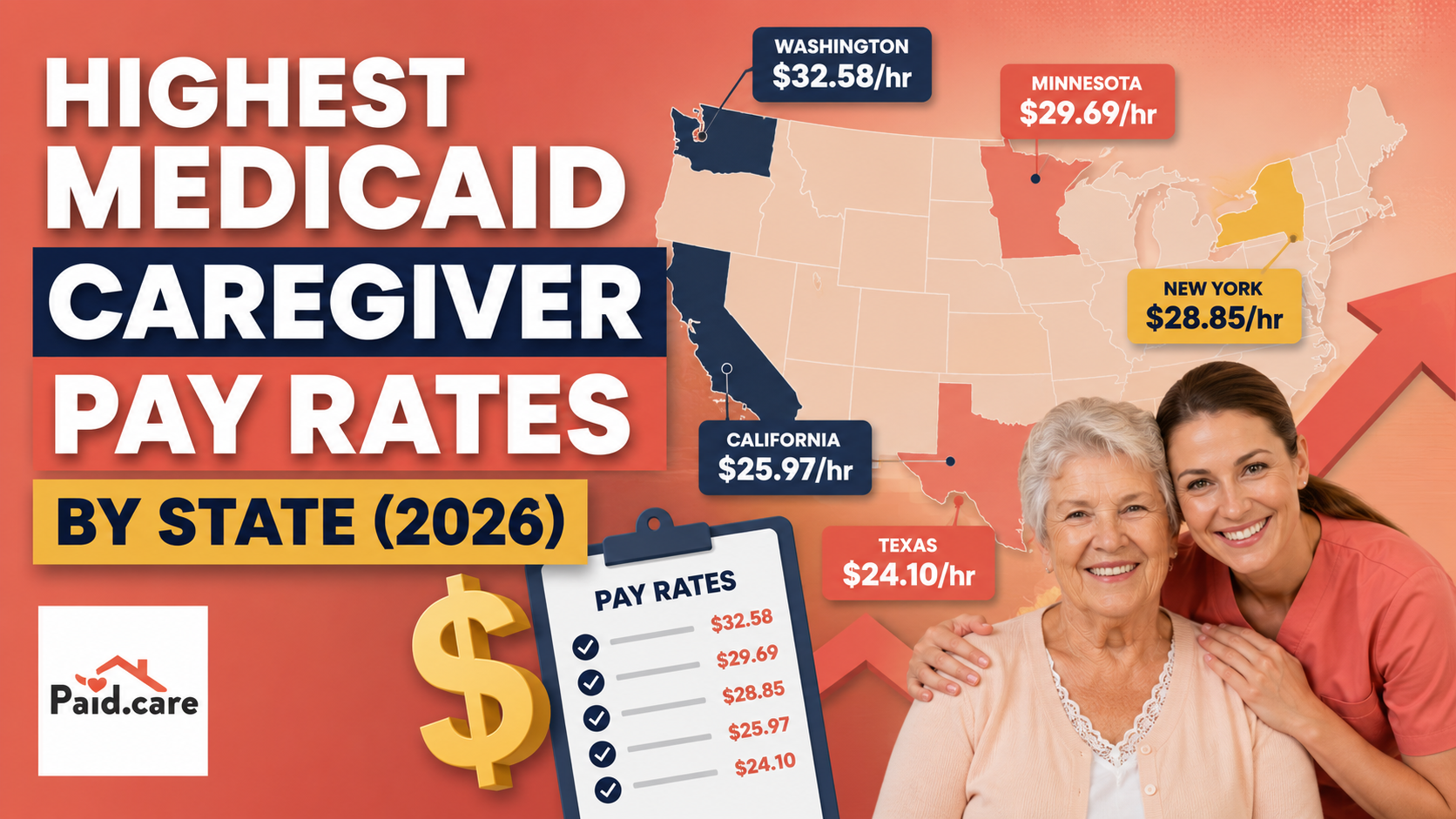
Two caregivers doing identical work, one in Boston and one in Birmingham, can be paid wildly different amounts by the same federal program. That gap is what makes the question of the highest Medicaid caregiver pay rates by state worth asking carefully, because the answer depends less on which state you live in than on which program inside that state you enroll through.
This ranking looks at state programs that pay family members, not agency employees hired off the street. Rates come from what programs and providers publish, and the list weighs three things: the published pay range, whether relatives (including spouses and adult children) can be hired, and how quickly a caregiver can move from application to first paycheck. A state that advertises a high hourly rate but keeps families on a five-year waiting list did not make the cut.
One warning before the list. A lot of the "highest paying state" content floating around online mixes two very different numbers without saying so: what a home health aide earns working for an agency, and what a family caregiver earns under a consumer-directed or structured caregiving program. Those are not the same job, not the same funding stream, and not the same paycheck. Where the distinction matters below, it is called out.
The Highest Medicaid Caregiver Pay Rates by State Are Set Within Federal Rules Tied to Cost of Living and Minimum Wage
Medicaid is a federal-state partnership, which means Washington sets the outer rules and each state builds its own program on top. Your pay comes out of a state's Home and Community Based Services budget, and that budget is shaped by cost of living, state legislative appetite, minimum wage law, and the reimbursement rate the state agrees to pay providers.
Three program structures dominate:
- Consumer-directed care. The Medicaid recipient becomes the employer and chooses their own caregiver, often a relative. New York's CDPAP and California's IHSS are the best-known versions. Pay is hourly, and hours are set by an assessment of care needs.
- Structured family caregiving. A live-in family caregiver receives a daily stipend rather than an hourly wage, usually tied to the recipient's assessed care level. Indiana, Georgia, and South Dakota all run versions of this.
- Attendant or personal care services. The caregiver is hired as an employee of a provider agency but assigned to their own family member. Pay is hourly, taxes are withheld, and the caregiver gets a W-2.
The structure matters more than the sticker rate. A $26 hourly rate approved for 20 hours a week pays less than a $20 rate approved for 40. When you compare states, compare annualized income and approved hours, not headline numbers. The state-by-state compensation breakdown lays out how those pieces fit together for every program type.
Alaska's extreme cost of living and provider scarcity push caregiver pay to the low-to-mid twenties
Alaska sits at the top of nearly every published comparison, with rates for personal care attendants commonly quoted in the low-to-mid twenties per hour. GoodRx has grouped Alaska with California, Massachusetts, and Washington in roughly the $24 to $26 range for caregiver pay in past comparisons, at last check, and other state guides list narrower bands closer to $18 to $20 for certain program types.
Why so high? Cost of living in Alaska runs far above the national average, and the state's provider network is thin outside Anchorage and Fairbanks. Medicaid has to pay competitively or the care simply does not happen. Alaska's Personal Care Assistance program allows family members other than spouses and legal guardians to be paid, and the consumer-directed track gives the recipient direct hiring authority.
The catch is access. Rural placement, long assessment timelines, and limited provider agencies mean the gap between the advertised rate and a caregiver's actual first paycheck can be months. Alaska rewards patience.
Massachusetts offers the strongest combination of rate and program maturity for family caregivers
Massachusetts is the strongest state in the country for family caregiver pay when you weigh rate against program maturity. Care.com's data has placed Massachusetts caregiver pay near $25 an hour in recent state comparisons, roughly $4,330 a month, the highest figure in their comparison set.
The state runs a well-established personal care attendant program where the consumer is the employer of record and can hire relatives, along with an adult foster care model that pays a family caregiver a daily stipend for a live-in arrangement. Two workable paths, both open to family, is unusual.
Massachusetts also benefits from strong home care worker organizing, which has pushed reimbursement rates up over the last several years. That is worth understanding as a caregiver: in states where home care workers bargain collectively, family caregiver rates tend to rise alongside agency rates, because both draw from the same reimbursement schedule.
New York's CDPAP allows relatives and skilled tasks most states reserve for licensed nurses
New York's CDPAP is the most permissive family caregiver program in the country on the question of who can be paid. Adult children, siblings, grandchildren, and friends all qualify, and the program allows skilled tasks that most states restrict to licensed nurses. Published rate ranges land in the upper teens to mid-twenties per hour depending on region, with New York City rates at the top of that spread.
What separates New York from the rest of this list is hours. Care plans for high-need recipients can be approved for many more weekly hours than comparable plans elsewhere, and in some cases for live-in coverage. The breakdown of New York pay scales and CDPAP eligibility gets into how those hour approvals work in practice.
New York has also been consolidating CDPAP administration under a single statewide fiscal intermediary, which changed enrollment paperwork for a lot of families. If someone told you CDPAP was going away, they were wrong. The pay structure survived; the middleman changed.
California's county-by-county wage negotiation pays more family caregivers than any single program nationally
California's In-Home Supportive Services program pays more family caregivers than any other single program in the United States, and county-level wages put much of the state in the low-to-mid twenties per hour. Some coastal counties sit higher still, because IHSS wages are negotiated county by county rather than set once at the state level.
That county structure is the thing most comparisons miss. The same program pays meaningfully different rates in San Francisco than in a rural inland county, and the difference is not small. Parents can also be paid to care for minor children with disabilities under specific conditions, which very few states allow. The details on IHSS wages, benefits, and who qualifies cover both the county variation and the parent-caregiver rules.
California's weakness is administrative load. IHSS enrollment involves county social services, a timesheet system, and a separate provider enrollment process. The money is good. The paperwork is a project.
Washington recognizes family caregivers as a workforce with training pathways and health coverage access
Washington belongs in the top five for a reason that has nothing to do with its hourly rate, though that rate is competitive and lands in the same upper band as Alaska and California. Washington treats individual providers, including family caregivers, as a recognized workforce with training pathways, paid training time, and access to health coverage at sufficient hours.
That changes the math on what a caregiving job is worth. An hourly rate is one number; an hourly rate plus health insurance plus retirement contributions is a different job entirely. If you are weighing whether paid caregiving can replace outside employment, benefits belong in the comparison, and Washington is one of the few states where they meaningfully do.
Spouses face restrictions in some Washington program tracks, so the specific waiver you enroll through determines whether a husband or wife can be the paid caregiver.
Oregon's consumer-directed model and registry system simplify family hiring above the national midpoint
Oregon consistently appears in the higher tier of published rate comparisons, and its homecare worker registry system makes family hiring administratively cleaner than in most states. Rates sit above the national midpoint, and Oregon's consumer-directed model gives recipients real authority over who provides their care.
The state also runs a spousal pay program, which is rare. Most states carve spouses out entirely on the theory that marriage already implies a duty of care. Oregon does not, which matters enormously for older couples where one spouse has become a full-time caregiver and lost their own income doing it.
Where Oregon lags is hour volume. Assessed hours tend to be more conservative than New York or California for comparable care needs, so the annual total can come in below what the hourly rate suggests.
Indiana's structured family caregiving stipend can match or exceed hourly rates when calculated daily
Indiana earns its place here on speed and structure rather than on being a high cost-of-living state. Attendant Care pay through the state's waiver programs runs in the $19 to $20 per hour range (as of publication, so check the current rate before relying on it), and Structured Family Caregiving pays a daily stipend, with published rates in the $77 to $133 per day band depending on the recipient's assessed care level; confirm the current figure with the program, as these rates can change.
Run the stipend math. At the upper end of that daily range, a live-in family caregiver clears more annually than an hourly caregiver in a higher-rate state who only gets approved for 25 hours a week. The Structured Family Caregiving stipend is also generally excludable from federal taxable income under IRS Notice 2014-7 when the caregiver lives with the recipient, which pushes the take-home value higher again. That interaction between stipend structure and tax treatment is covered in the comparison of how stipends and wages hit your tax return.
Indiana also moves fast. Enrollment through the Structured Family Caregiving and Attendant Care programs can put a caregiver on weekly pay in a matter of weeks rather than months, and qualified W-2 caregivers may be eligible for a sign-on bonus on top of the regular rate, see current offer details at this bonus page.
Michigan's home help pay delivers strong purchasing power relative to the state's cost of living
Michigan's Home Help program is one of the most accessible family caregiver programs in the Midwest, and Care.com data has put Michigan caregiver pay around $21 an hour in recent comparisons, roughly $3,609 a month. That is respectable for a state with Michigan's cost of living, and it means the real purchasing power of a Michigan caregiver paycheck compares favorably to higher-rate coastal states.
Home Help allows spouses, adult children, and other relatives to be paid, and enrollment runs through the state adult services network rather than requiring a waiver slot to open up. That distinction is significant. Waiver programs have capped enrollment and waiting lists; state plan programs like Home Help generally do not.
Hours are assessed by a caseworker using a functional needs review, and the approved total tends to be tighter than families expect. Documenting every task you already perform, before the assessment, is the single best thing you can do for your own rate. The walkthrough of Home Help eligibility and application steps covers what the assessment looks at, and Michigan families can enroll directly through the Home Help agency track.
Illinois combines middle-tier rates with broad relative eligibility and age-specific program design
Illinois rounds out the list through the Community Care Program, administered by the Illinois Department on Aging for residents 60 and older, alongside the Home Services Program for adults with disabilities. Rates sit in the middle of the national range, but Illinois combines two things that many higher-paying states do not: broad relative eligibility and a program built specifically around keeping people out of nursing facilities.
The Community Care Program uses a determination-of-need score to set service hours, which means a well-documented care situation directly increases approved hours and therefore income. Illinois also permits payment to some spouses under specific circumstances, which is worth checking before you assume you are excluded.
Families in Cook County and the collar counties tend to have the fastest access to provider agencies, while downstate enrollment can take longer. Program mechanics for both tracks are laid out in the overview of the Community Care Program and IDHS Home Services Program.
Approved hours, program maturity, and eligibility matter far more than the headline rate
Chasing the top rate is usually the wrong move, and moving states to get it almost always is. Medicaid eligibility is state-specific, waiting lists reset when you cross a border, and your care recipient has to re-qualify from scratch. A family that relocates for a higher rate can lose a year of income during the transition.
Four factors matter more than the rate itself:
- Approved hours. A high rate on 15 approved hours is worse than a modest rate on 40. Hours come from the needs assessment, not from the rate schedule.
- Relative eligibility. Many states exclude spouses and legal guardians. Check this before anything else, because it can disqualify the specific person doing the caregiving.
- Tax treatment. Payments that qualify under the difficulty-of-care exclusion are worth substantially more per dollar than fully taxable wages.
- Time to first payment. Waiver waiting lists in some states run years. State plan programs and structured caregiving tracks generally move faster.
The best state for you is the one where your loved one already qualifies for Medicaid, where you are eligible to be the paid caregiver, and where the program can start paying you this quarter rather than next year.
Rate schedules also shift. Minimum wage increases, legislative sessions, and reimbursement adjustments all move the numbers, and what changed across caregiver pay programs this year tracks where those adjustments have landed.
Confirm your loved one's Medicaid status and eligible program before comparing state rates
Start with your loved one's Medicaid status, not with the rate table. If they are already enrolled in Medicaid and receiving or eligible for home and community based services, you are much closer to a paycheck than you probably think, regardless of where your state ranks.
Then confirm three things in writing: which program in your state pays family caregivers, whether your specific relationship qualifies, and how many hours or what stipend level your loved one's assessment supports. Those three answers determine your income far more than your state's position on any list.
If you live in Indiana, Michigan, or Illinois, the fastest route is to have someone check your eligibility against the actual program rules rather than piecing it together from state websites. If you're also comparing pay across states, it helps to know the highest Medicaid caregiver pay rates by state before you commit to a plan. The qualification and enrollment process walks through what documentation you need, how the assessment works, and how weekly pay starts, with care coaching included at no cost while you get set up.
Frequently asked questions
Which state has the highest Medicaid caregiver pay rates?
Alaska and Massachusetts consistently top published comparisons of the highest Medicaid caregiver pay rates by state, with rates commonly quoted in the mid-twenties per hour, followed closely by New York, California, and Washington. Alaska's rate reflects extreme cost of living and provider scarcity, while Massachusetts combines a high rate with two mature programs that both allow family caregivers.
Can I get paid to care for a family member through Medicaid?
Yes, in most states. Consumer-directed programs, structured family caregiving, and attendant care services all allow relatives to be hired and paid, though many states exclude spouses and legal guardians of minor children. Your loved one must be Medicaid-eligible and assessed as needing personal care assistance.
Why do Medicaid caregiver pay rates vary so much between states?
Each state sets its own Medicaid reimbursement rates within federal rules, and those rates track state cost of living, minimum wage law, legislative budget decisions, and how tight the local home care workforce is. Program structure adds another layer: an hourly consumer-directed wage and a daily structured caregiving stipend are calculated on completely different bases.
Is family caregiver pay the same as home health aide pay?
No, and conflating them is why so many rate comparisons are confusing. Home health aide wages come from agency employment and reflect market labor rates. Family caregiver pay comes from a Medicaid program with its own approved rate and assessed hour limits, and it may be a daily stipend rather than an hourly wage.
Should I move to a higher-paying state to earn more as a caregiver?
Almost never. Medicaid eligibility does not transfer, your loved one has to requalify, and waiver waiting lists start over. The lost income during that transition typically exceeds the rate difference, and the disruption to a fragile care situation carries its own cost.

